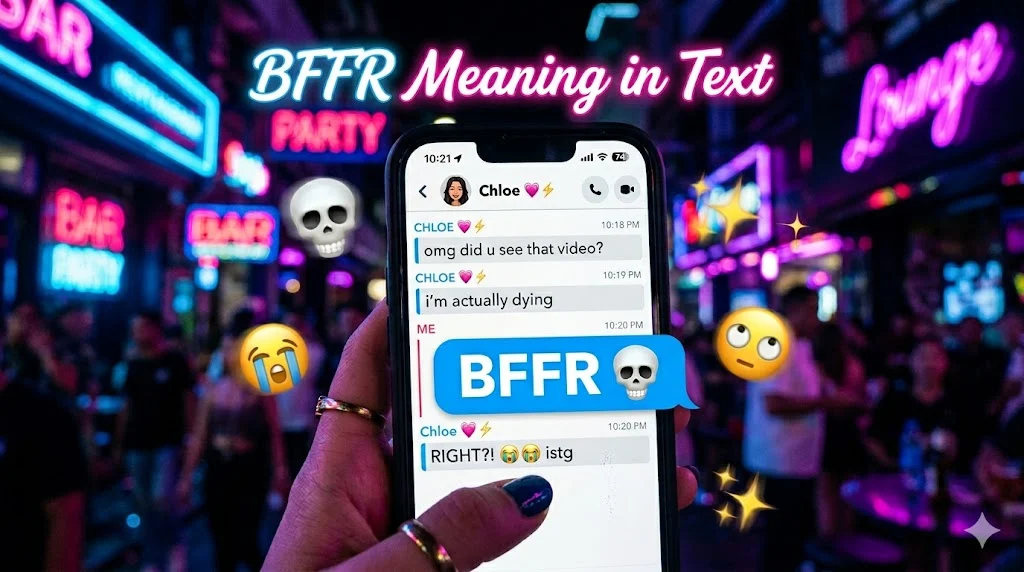
You’re scrolling through your messages and suddenly “bffr 💀.” Just that. No context. No explanation. Your friend sent it and you’re sitting there wondering if you’re being called out, roasted, or if they’re just dramatically reacting to something you said.
Don’t worry. You’re not alone. BFFR is one of those slang terms that hits differently depending on how it’s used and misreading the tone can make an already awkward conversation go sideways fast. This guide breaks down everything: what bffr means in text, where it came from, how tone shifts its entire meaning, and exactly when you should and shouldn’t drop it in a conversation.
Let’s get into it.
What Does BFFR Mean in Text?
BFFR stands for “Be F***ing For Real.”
That’s the full form. No hidden meaning. No alternate interpretation floating around on some obscure corner of the internet. It’s a raw, emphatic way of expressing disbelief, frustration, or calling someone out for saying something ridiculous.
Think of it like the digital version of looking someone dead in the eyes and saying, “Are you actually serious right now?”
| Term | Full Form | Type | Primary Tone |
|---|---|---|---|
| BFFR | Be F***ing For Real | Internet slang / acronym | Disbelief, sarcasm, callout |
It’s direct. It’s punchy. And when someone sends it to you, you immediately know the vibe even if you didn’t know what the letters meant five minutes ago.
BFFR Full Form Explained: Every Word Matters
Let’s slow down and look at each word because the phrasing isn’t accidental.
“Be” It’s a command. Not a question. BFFR isn’t asking if you’re serious. It’s demanding you get serious.
“F***ing” The intensifier. This is what separates BFFR from just “BFR” (be for real), which exists but lands much softer. The expletive adds urgency and emotional charge.
“For Real” The demand for authenticity. Stop the nonsense. Be honest. Acknowledge reality.
Together, those three components create something that’s simultaneously a callout, a reaction, and sometimes depending on context a term of endearment between close friends.
Where Did BFFR Come From? The Real Origin Story
Here’s what most articles skip and it matters.
BFFR has its roots in African American Vernacular English (AAVE). The phrase “be for real” and its more emphatic cousin “be f***ing for real” have existed in Black American speech long before the internet ever got hold of it. AAVE has consistently been one of the most influential sources of modern internet slang from “no cap” to “periodt” to “slay” and BFFR follows that same well-worn path.
The term started gaining serious online traction around 2021 on TikTok, where short-form video culture creates the perfect incubator for expressive language. A creator would react to something outrageous, say “BFFR” in the caption or comment, and suddenly thousands of people were using it in their own content.
By 2022, it had fully crossed over into mainstream Gen Z texting vocabulary. Twitter (now X) picked it up next, followed by Instagram comments, Snapchat streaks, and eventually your group chat.
This trajectory AAVE → TikTok → Twitter → iMessage is basically the standard route for modern slang in the 2020s. Understanding that origin isn’t just interesting context. It’s important for using the term respectfully.
A quick note on cultural context: When you use slang that comes from AAVE, you’re borrowing from a rich linguistic tradition. Use it authentically and appreciate where it comes from don’t flatten it into just a funny internet thing.
What BFFR Really Means: Tone Is Everything
This is the section most guides completely miss. Knowing the definition is just the starting point. BFFR means completely different things depending on how it’s deployed.
Disbelief and Genuine Shock
This is the most common use. Someone says something utterly wild and you respond with BFFR.
“She said she’s never eaten a grilled cheese sandwich in her life.” “BFFR right now 💀”
The tone here is pure astonishment. You’re not angry you just cannot wrap your head around what you just heard.
Calling Someone Out (Confrontational Use)
When the vibe shifts from playful to serious, BFFR becomes a direct challenge. Someone’s being dishonest, making excuses, or avoiding accountability and you’re done letting it slide.
“I didn’t have time to do my share of the work.” “You had two full weeks. BFFR.”
Notice that one no emoji, no softening. That’s intentional. More on why capitalization and punctuation change everything in a later section.
Playful Teasing Between Friends
Among close friends, BFFR gets tossed around constantly as a jokey reaction. Nothing’s serious. Nobody’s actually mad. It’s just the modern version of “oh come on.”
“I’m terrified of butterflies.” “BFFR 😭 they literally can’t hurt you”
The 😭 emoji does a lot of heavy lifting there. It signals the whole thing is affectionate, not aggressive.
Self-Directed Humor
One of the most relatable uses turning BFFR on yourself when you catch yourself doing something ridiculous.
“Me genuinely thinking I’d wake up at 5am to work out. BFFR.”
This version connects with the self-aware humor that runs through Gen Z communication. It’s honest. It’s a little self-deprecating. And it’s deeply, universally recognizable.
Sarcastic Commentary
Pair BFFR with sarcasm and you get something even sharper a layered reaction to something that’s either obvious or absurd.
“The company just announced free snacks and no raises. BFFR.”
The Emoji Code: How Emoji Pairings Change the Entire Meaning
You can’t talk about BFFR without talking about emoji. In digital communication, emoji function like vocal tone they tell you whether someone’s laughing, furious, or somewhere in between.
| Emoji Combo | What It Signals |
|---|---|
| BFFR 💀 | Maximum disbelief, comedic effect “I’m dying” |
| BFFR 😭 | Intense, playful, lovingly exasperated |
| BFFR 🙄 | Fed up, mild irritation, done with it |
| BFFR ‼️ | Dead serious, no jokes, confrontational |
| BFFR 😐 | Blank stare energy low-key the most threatening |
| BFFR 💅 | Sassy, unbothered, serving attitude |
Master this table and you’ll almost never misread a BFFR text again.
Capitalization and Punctuation: The Hidden Signals
This is a subtle but genuinely important distinction that native users pick up on intuitively.
BFFR (all caps, no punctuation) High energy. Reactive. Probably followed by an emoji. Surprise or playful disbelief.
bffr (all lowercase) Deadpan. Flat. This is the calm-before-the-storm version. It reads as more serious precisely because the energy is dialed down.
Bffr. (capitalized first letter, period at end) Finality. The conversation may be winding down. This person has made their point and they’re done making it.
bffr. (all lowercase with period) The most serious deployment. It’s quiet in the way that signals genuine frustration rather than performance. Treat this one carefully.
A single text that just says “bffr.” with that lowercase and that period? That hits different than “BFFR 😭”. Context still matters but the formatting alone tells a story.
BFFR Meaning Across Different Platforms
The same acronym lands differently depending on where you encounter it. Here’s what you actually need to know.
BFFR Meaning on TikTok
TikTok is where BFFR was essentially born at least in its mainstream internet form. On TikTok, you’ll find it:
- In video captions reacting to something outrageous (“POV: your boss schedules a meeting that could’ve been an email. BFFR.”)
- In comments under videos that show wild content or hot takes
- As on-screen text overlays during reaction videos
- In duet and stitch content where creators respond to other videos with “BFFR though??”
TikTok’s short-form, reaction-based culture makes BFFR a perfect fit. It’s punchy, immediate, and it captures exactly the kind of disbelief you feel when you’ve just watched a 15-second clip of someone doing something baffling.
BFFR Meaning on Snapchat
On Snapchat, BFFR tends to live in DMs and streaks the more intimate, casual end of digital communication. Because Snapchat conversations are typically between people who actually know each other, the playful and teasing versions of BFFR show up most often here.
You’ll get a snap of someone’s terrible food choice and just reply: “bffr 😭” and that’s the whole conversation. Efficient. Effective. On-brand for Snapchat’s low-effort, high-reaction communication style.
BFFR Meaning on Instagram
Instagram BFFR lives primarily in two places: comment sections and DMs.
In comments, it’s reactive someone posts a meme, a price tag, a headline and the top comment is just “BFFR 💀”. In DMs, especially group chats, it functions the same way it does in regular texting. It’s the reaction you send when your friend screenshots something unhinged and drops it in the group.
BFFR on Twitter / X
Twitter/X gives BFFR a sharper edge. The platform’s culture skews more toward public callouts, hot takes, and discourse so BFFR appears most often in:
- Quote tweets responding to bad takes (“They said what? BFFR.”)
- Replies to viral posts that defy logic
- Standalone tweets venting about situations where someone absolutely needs to be for real
The confrontational register is more dominant on X than on other platforms. Keep that in mind.
BFFR in iMessage and WhatsApp
In your actual text messages, BFFR behaves like regular conversational language between people who already share a shorthand. It’s the casual version quick, reactive, and completely natural in flow.
One important signal to know: a standalone “bffr.” sent as its own message in iMessage, with no emoji and no follow-up, usually means something genuinely frustrated you. In a group chat it’s slightly softer in a one-on-one, it can land heavy.
Real Conversation Examples: BFFR in Action
Seeing BFFR defined is one thing. Watching it work in actual conversations is another. Here are real-world scenarios showing every major variation.
Example 1 Pure Disbelief
Maya: “I think hot dogs are technically a sandwich.” Jordan: “BFFR right now 💀”
Register: Playful, energetic, no real conflict.
Example 2 The Callout
Chris: “I forgot to mention I can’t make your birthday dinner.” Sam: “You’ve known about it for three weeks. BFFR.”
Register: Direct, slightly cold, zero emoji = communicates genuine disappointment.
Example 3 Friendly Roast
Alex: “I’ve been trying to wake up early for a month and I keep failing.” Priya: “You set alarms for 5am and then snooze until 9. BFFR with yourself 😭”
Register: Teasing, warm, the laughing-crying emoji keeps it light.
Example 4 Self-Directed
“Me thinking $14 latte was a reasonable purchase. BFFR.”
Register: Self-aware, relatable, self-deprecating humor classic social media caption.
Example 5 The Serious One
“You told me you were home. I saw your car somewhere else. bffr.”
Register: All lowercase, no emoji, short. The most intense use of BFFR. No jokes here.
Example 6 Reacting to News / Content
“A gym just announced they’re charging extra for water. BFFR 🙄”
Register: Sarcastic, mildly outraged, relatable social commentary.
BFFR vs. Similar Slang: What’s the Difference?
BFFR fills a specific emotional slot. Here’s how it stacks up against similar terms you’ve probably seen.
| Slang Term | Full Form | Primary Use | Key Difference from BFFR |
|---|---|---|---|
| FR | For Real | Agreement or emphasis | Affirming something not calling it out |
| FR FR | For Real For Real | Extra emphasis | Doubles down on agreement, no challenge |
| NGL | Not Gonna Lie | Honest admission | Softer, confession-style not confrontational |
| ISTG | I Swear To God | Emotional intensity | Frustration or sincerity, less disbelief |
| IYKYK | If You Know You Know | Exclusivity signal | Different context entirely |
| No Cap | No lie / Seriously | Truth-telling | Affirms honesty rather than demanding it |
| IRL | In Real Life | Context marker | Completely different meaning and use case |
| SMH | Shaking My Head | Disappointment | Passive disappointment vs. BFFR’s active challenge |
The clearest contrast is FR vs. BFFR. “FR” agrees. “BFFR” challenges. They share the same base phrase but point in completely opposite directions emotionally.
How to Use BFFR Correctly: And When to Skip It
Knowing what something means is half the battle. Using it well is the other half.
Use BFFR when:
- Someone says something so outrageous you literally can’t let it pass
- You’re playfully teasing a close friend who knows your communication style
- You’re calling out something absurd in a lighthearted way
- You’re reacting to content online a caption, comment, or post
- You’re being self-deprecating about your own choices
Don’t use BFFR when:
- You’re texting someone significantly older who won’t recognize modern slang you’ll either confuse them or come across as rude without meaning to
- The conversation is genuinely serious grief, mental health, a major conflict BFFR will land as dismissive
- You’re in any professional context work Slack, email threads, messaging a client or colleague
- You’re not sure of the relationship dynamic BFFR between close friends reads as playful; between near-strangers it can read as aggressive
- You haven’t read the tone of the conversation if things are already tense, BFFR escalates
A Simple Decision Framework
Before you send it, ask yourself two questions:
- Would this person laugh or feel attacked?
- Is there an emoji softening this, or is it landing bare?
If you can’t answer both confidently, either add an emoji or rephrase entirely.
The Capitalization-Punctuation Cheat Sheet
Since this comes up constantly, here’s a consolidated reference:
| Variation | Energy Level | Likely Meaning |
|---|---|---|
| BFFR 💀 | High, comedic | Playful disbelief |
| BFFR!! | High, reactive | Shock or teasing |
| BFFR | Medium, reactive | Standard reaction |
| Bffr | Medium-low | Slightly more measured |
| bffr 😭 | Low energy, warm | Friendly exasperation |
| bffr | Low, flat | Getting serious |
| bffr. | Very low, final | Genuinely done |
Print this out. Laminate it if you have to.
BFFR in Pop Culture and Viral Moments
BFFR didn’t just stay in DMs. It leaked into broader culture in some notable ways.
TikTok audio clips built around BFFR reactions became their own format creators would react to absolutely unhinged situations with a flat, deadpan “bffr” and the format took off because of how relatable the energy was.
Twitter/X viral threads frequently use BFFR as a one-line response to news stories or quotes that defy belief. A leaked memo, a controversial price, a tone-deaf statement the comment section fills up with “BFFR 💀” within minutes.
Meme formats have emerged around the phrase too images of people with a skeptical or incredulous expression captioned with “the way I said bffr out loud reading this” became a recognizable template across platforms.
Influencers and content creators across niches beauty, gaming, finance, fitness adopted it because it crosses demographics while still feeling native to Gen Z speech. When a personal finance creator posts “They’re charging $8 for a parking app subscription. BFFR.” their entire audience gets it instantly.
Is BFFR Still Relevant in 2026?
Fair question. Slang has a shelf life. “Fleek” had a moment and then disappeared. “On fleek” is now a relic. So where does BFFR sit in 2026?
Still very much in active use. Here’s why it has staying power compared to a lot of internet slang:
- It fills a specific emotional niche no other acronym covers cleanly. There’s no real competitor for “emphatic disbelief + challenge to get real” that’s as punchy and flexible.
- It works across multiple registers playful, serious, sarcastic, self-directed. Most slang collapses into one tone. BFFR bends.
- Its AAVE roots give it linguistic depth that surface-level internet coinages lack.
- It translates naturally to speech people actually say “bffr” out loud now, not just in text. That crossover from written to spoken is a strong signal of longevity.
Google Trends data for BFFR shows consistent search volume through 2025 and into 2026 not the explosive spike-and-crash pattern that characterizes trend slang, but a steady plateau indicating it’s embedded in everyday use.
Emerging companion phrases you’ll see alongside BFFR in 2026:
- “bffr with yourself” the self-directed version that’s become its own sub-phrase
- “make it make sense” often follows or pairs with BFFR for a one-two punch
- “this is ridiculous behavior” parallel energy, different phrasing
- “I’m actually you right now” agreement that something is genuinely unbelievable
BFFR for Non-Native English Speakers
If English isn’t your first language, internet slang is a whole separate layer of the language to learn and BFFR is a good example of why.
Direct translation doesn’t capture the tone. If you translate “be f***ing for real” word-for-word into another language, you lose the idiomatic force. The phrase isn’t just its literal meaning it’s the exasperation, the disbelief, the demand for authenticity all compressed into four letters.
A few practical notes:
- The expletive in BFFR makes it informal and inappropriate in formal settings this isn’t subtle, it’s explicit
- Because it comes from AAVE, some of its cultural resonance won’t translate directly even to fluent non-native English speakers
- In many cultural contexts, this type of direct callout in text would read as aggressive in American Gen Z communication, it’s often just normal
- When in doubt, skip it. “Are you serious?” or “I can’t believe that” communicates the same idea without the risk of misreading
Quick-Reference Summary
Need the short version? Here it is.
- What it means: Be F***ing For Real
- Used for: Disbelief, calling out, teasing, self-aware humor
- Origin: AAVE → TikTok → mainstream internet (2021–2022)
- Who uses it: Primarily Gen Z, widely adopted by Millennials in digital spaces
- Where you’ll see it: TikTok, Snapchat, Instagram, iMessage, WhatsApp, Twitter/X
- Tone signals: All caps = energy; lowercase = serious; emoji = softens it; period = finalizes it
- When to avoid it: Professional contexts, unfamiliar relationships, genuinely serious situations
FAQs
What does BFFR mean in a text message?
BFFR stands for “Be F***ing For Real.” It’s used to express disbelief, call someone out, or react to something absurd. The tone ranges from playful to seriously confrontational depending on capitalization, punctuation, and emoji.
Is BFFR rude or offensive?
It can be, depending on context. Among close friends, it’s usually playful. In a one-on-one text with no emoji and lowercase letters, it signals genuine frustration. In professional or unfamiliar settings, it reads as rude. The context determines the register.
Where did BFFR come from?
BFFR has roots in AAVE (African American Vernacular English) and became mainstream through TikTok around 2021–2022. From there it spread to Twitter/X, Instagram, and everyday texting.
What’s the difference between BFFR and FR?
FR means “for real” and is used to agree with or emphasize something. BFFR means “be for real” and challenges or calls something out. They’re near-opposites in emotional direction despite sharing the same base phrase.
Can I use BFFR with someone I don’t know well?
Probably not. BFFR between strangers can come across as aggressive or unnecessarily confrontational. Reserve it for people who know your communication style and will read the tone correctly.
What does bffr mean on TikTok specifically?
On TikTok, BFFR appears in captions, comments, and on-screen text as a reaction to outrageous, absurd, or unbelievable content. It’s essentially the platform’s shorthand for “I cannot believe what I just watched.”
Conclusion
Here’s the thing about BFFR it’s not just four letters. It’s a whole mood compressed into an acronym. Depending on how it lands, it can mean “you’re hilarious and I love you” or “I’m genuinely done with this conversation.” That range is exactly what makes it such a durable piece of internet slang.
Now that you know what bffr means in text, where it came from, and crucially how to read the tone it’s carrying, you’re equipped to both understand it and use it correctly. Pay attention to the capitalization. Check for emoji. Read the energy of the conversation before you fire it off.
And next time someone texts you just “bffr.” you’ll know exactly what they mean.
Read More Related Articles:
- Don Mean in Spanish Culture: History, Respect and Usage In 2026
- “Esta” Mean in Spanish: The Small Word Learners Always Notice In 2026
- “Ir” Meaning in Spanish: Usage and Real-Life Examples In 2026

Neon Samuel is a digital content creator at TextSprout.com, dedicated to decoding modern words, slang, and expressions. His writing helps readers quickly grasp meanings and understand how terms are used in real conversations across text and social platforms.