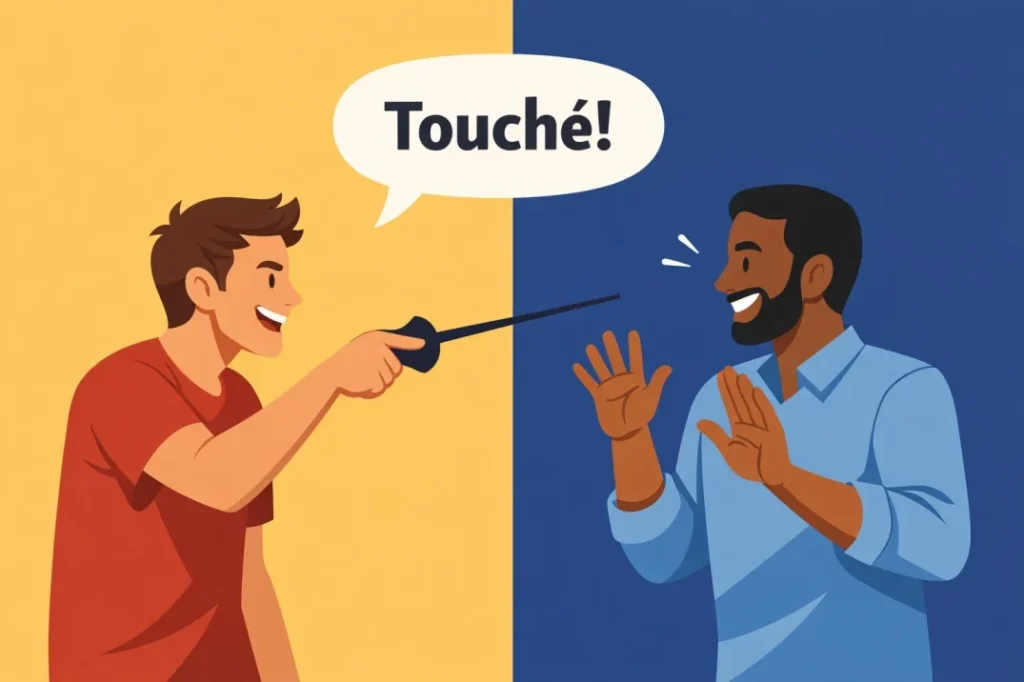
You’re in the middle of a heated but friendly argument. Your friend says something so sharp and so right that you have no comeback. So you smirk, nod, and say one word: “Touché Meaning”
Feels good, right?
But here’s the catch. A lot of people throw this word around without fully understanding its touché meaning. They think it just means “you got me.” That’s partially true. But you’re missing the richer, more respectful layer underneath.
In this guide, you’ll learn the real meaning of touché. You’ll see where it came from, how to use it in slang, and when to keep your mouth shut. No fluff. Just clear examples, hard facts, and practical tips.
Let’s settle this once and for all.
What Is the Simple Definition of Touché?
Let’s start with the basics.
Touché (pronounced too-SHAY) is an interjection. You use it to acknowledge that someone has made a clever or effective point against you in an argument or discussion.
Here’s a quick reference table:
| Term | Part of Speech | Simple Definition |
|---|---|---|
| Touché | Interjection (also noun informally) | “You made a good point. I admit it.” |
That’s the core meaning of touché. But the word carries more weight than a simple “fair enough.”
The Fencing Origin: Where “Touché” Really Comes From
You can’t fully understand the touche definition without a quick trip to 19th-century France.
The word touché is the past participle of the French verb toucher, which means “to touch.” In fencing, a judge yells “Touché!” when a fencer’s blade makes legal contact with their opponent. It’s a scored hit. Game continues. No hard feelings.
That’s the literal origin of the word touché.
Now think about how that translates to conversation. When you say “touché” after someone’s comeback, you’re basically saying: “You landed a hit. I felt it. And I respect the skill behind it.”
That’s huge. You’re not just admitting defeat. You’re complimenting your opponent’s wit.
Touché Meaning in Conversation
So what does touché mean when two people are just talking?
In everyday English, touché functions as a discourse marker. That’s a fancy NLP term for a word that organizes conversation. But here’s the plain truth: you say touché when someone out-argues you in a single sentence.
When to Say Touché (With Real Examples)
You don’t say touché after every minor point. Save it for moments where the other person turns your own logic against you or reveals a blind spot.
- Example 1 – Flipping your logic
You: “You never clean the kitchen.”
Your roommate: “I cleaned it Tuesday while you watched TV for three hours.”
You: “…Touché.”
- Example 2 – Calling out a contradiction
You: “I’m extremely organized.”
Your friend: “Your desk has three coffee cups from last week.”
You: “Touché.”
- Example 3 – Acknowledging a clever comeback in a debate
You: “Taxes should be lower across the board.”
Them: “So you support cutting school funding for rural areas?”
You: “Touché. That’s a real blind spot in my argument.”
Notice something? In each case, you don’t get angry. You don’t deflect. You just nod and say the word.
That’s the correct usage of touché in English.
When NOT to Say Touché
Knowing the meaning of touché also means knowing its limits.
| Situation | Why You Should Avoid Touché |
|---|---|
| Someone shares sad news | It’s a debate word, not an empathy word. |
| Formal business report | Too slangy. Use “valid point” instead. |
| You’re genuinely furious | Touché requires respect. Anger kills it. |
| After every single sentence | You’ll sound like a broken record. |
Also avoid touché when you actually lost the argument badly. If someone completely demolishes your position with facts and you mumble “touché,” it can sound sarcastic or bitter.
Touché Slang Meaning vs. Literal Meaning
Here’s a table that breaks down the two layers of this word.
| Aspect | Slang / Conversational Meaning | Literal Fencing Meaning |
|---|---|---|
| Core idea | “Good point. I concede that one.” | “You touched me (with your blade).” |
| Tone | Respectful, witty, sometimes sarcastic | Neutral, official referee call |
| Context | Arguments, banter, debates | Fencing matches |
| Body language | Smirk, nod, raised eyebrows | Referee hand signal |
Most people only know the slang meaning of touché. That’s fine. That’s how language evolves. But knowing the fencing origin makes you appreciate the word more. You realize you’re playing a verbal game, not a war.
How Does Touché Compare to Other Comeback Phrases?
You have options. Why choose “touché” over “fair point” or “you got me”?
Here’s a comparison table.
| Phrase | Vibe | Best Used When |
|---|---|---|
| Touché | Respectful + clever | You admire their counterpoint |
| Fair point | Neutral, warm | No competitive edge needed |
| You got me | Humble, simple | You’re clearly wrong |
| Well played | Slightly formal | Strategy or game context |
| Good one | Casual, generic | Light banter |
| I stand corrected | Polite, self-aware | You want to sound educated |
The unique touché slang meaning includes the idea of a hit. That’s what sets it apart. You’re not just agreeing. You’re acknowledging a strike against your position.
Touché Meaning in Text and Online Messaging
Digital communication changes everything. So what does touché mean in a text?
In texts and DMs, people often write it lowercase and drop the accent: “touche.”
That doesn’t change the meaning. But the tone shifts slightly. A texted “touche” usually signals:
- You’re not angry.
- You recognize they made a good point.
- You want to keep the conversation light.
Example text exchange:
A: “You said you’d quit caffeine. I just saw you buy a cold brew.”
B: “touche 😂”
The laughing emoji matters. Without it, “touche” alone in text can feel dry or passive-aggressive.
Sarcastic touché meaning in memes:
Sometimes people type “touché” after an overly obvious point. Example: Someone says “Water is wet.” You reply “touché.” That’s sarcasm. You’re mocking the lack of cleverness. Use that sparingly. It can annoy people fast.
Touché in Debates: A Strategic Tool
Debaters love this word. Why? Because it shows confidence.
When you say “touché” in a debate, you signal three things:
- You heard their point.
- You respect its validity.
- You’re not threatened by being wrong on a sub-point.
That’s powerful. Weak debaters never admit when someone lands a hit. Strong debaters say “touché” and move on. They don’t lose ground. They gain respect.
Touché meaning in debate context is therefore different from casual use. In a debate, it’s a tactical acknowledgment. You’re saying: “That was good. But I’m still winning the larger argument.”
That nuance matters.
Common Mistakes People Make With Touché
Even native English speakers mess this up. Don’t be one of them.
Mistake 1: Using touché when you’re angry
Wrong tone ruins the word. If you hiss “touché” through clenched teeth, it’s not an acknowledgment. It’s an insult.
Mistake 2: Overusing it
Say “touché” five times in one conversation and you become a meme. Save it for truly clever hits.
Mistake 3: Mispronouncing it
It’s too-SHAY. Not “toosh” (that’s a different word meaning sentimental nonsense). Not “TOO-shay” with flat American stress.
Mistake 4: Using it on yourself
You cannot say “touché” to yourself. That’s like giving yourself a high-five. Don’t.
Mistake 5: Using it in serious emotional conversations
If your partner says “You hurt my feelings when you forgot our anniversary,” do NOT say “touché.” That’s toxic behavior.
Touché Pronunciation and Usage Guide
Let’s lock this in.
Pronunciation:
/ tuːˈʃeɪ /
Rhymes with “fiancé” but without the first syllable.
Audio tip: Say “too” then “SHAY.” The second syllable gets the emphasis. Your voice should rise slightly on “SHAY.”
Usage formula:
Someone makes a counterpoint > You pause > You smile or nod > You say “Touché.”
That’s it. No extra words needed. The silence before the word makes it land harder.
Touché vs. Other French Loanwords in English
English borrows a lot from French. Touché sits in a family of fancy-sounding acknowledgment words.
| French Loanword | English Meaning | Vibe |
|---|---|---|
| Touché | Good point, you hit me | Clever, respectful |
| Cliché | Overused phrase | Critical |
| Fiancé | Engaged person | Romantic |
| RSVP | Please reply | Formal, polite |
| Déjà vu | Already seen | Dreamy, mysterious |
Touché stands out because it’s an action word in conversation. You don’t just observe with touché. And you respond. You engage.
Why Touché Works as a Discourse Marker
From a linguistic standpoint, touché is a fascinating little word.
Here are the NLP key terms that describe how touché functions:
| NLP Term | What It Means for Touché |
|---|---|
| Semantic meaning | The literal idea of “touching” or “hitting” |
| Lexical meaning | Dictionary definition: acknowledgment of a point |
| Slang interpretation | Witty, informal, friendly |
| Discourse marker | A word that organizes turn-taking in conversation |
| Conversational pragmatics | What you imply by using it (respect, cleverness) |
| Interjection | A standalone emotional word |
| Sentiment acknowledgment | You validate the other person’s statement |
| Rhetorical response | You concede without losing face |
When you say “touché,” you perform all these functions at once. That’s why one small word carries so much weight.
The Psychology Behind Saying Touché
Why does “touché” feel good to hear?
Because it contains a hidden compliment. When someone says “touché” to you, they’re not just admitting you’re right. They’re saying you’re quick. You’re sharp. You landed a verbal hit cleanly.
That’s why the touché response in arguments can actually lower tension. You turn a potential fight into a game of wits.
Psychologists call this “frame control.” You reframe an argument as mutual play instead of combat. Touché is a magic word for that.
FAQs
1. Is touché rude?
No. Not when you say it sincerely. Sarcasm or an angry tone makes it rude. Said with a nod and a small smile, it’s actually polite.
2. Can you say touché in a professional email?
Almost never. It’s too informal. Use “That’s a fair point” or “I take your point” instead.
3. What’s a good reply when someone says touché to you?
Try “Thanks” or “Just calling it like I see it.” You can also smile and say “Next round’s yours” to keep the banter going.
4. Do French people actually say touché in conversation?
Rarely. In modern France, they’d say “Bien joué” (well played) or “C’est vrai” (that’s true). Touché in French mostly stays in fencing clubs.
5. What does touché mean in a text without an emoji?
It can feel dry or even slightly annoyed. Add an emoji like 😅 or 😂 to keep it friendly.
6. Is touché only for arguments?
Mostly, yes. You can also use it playfully in games or sports. Example: You miss a shot and your friend scores. “Touché.”
7. What’s the difference between touché and touche (no accent)?
The accent matters in French but not in casual English writing. Many people drop it online. Both mean the same thing now.
8. Can touché be used sarcastically?
Yes. If someone states the obvious and you say “touché,” that’s sarcasm. Use it carefully. It can shut down conversation.
A Quick Reference Card
Use this as your cheat sheet.
| You want to… | Say this | Avoid this |
|---|---|---|
| Acknowledge a clever point | “Touché.” | “Whatever.” |
| Stay humble in a debate | “Touché, that’s fair.” | “I guess you’re right.” (sounds weak) |
| Keep banter playful | “Touché 😄” | No emoji in text (risks dry tone) |
| Respect someone’s wit | Smile + “Touché.” | Staring silently |
| Recover after being wrong | “Touché. Anyway…” | Making excuses |
Conclusion:
The meaning of touché is simple: “You made a great point, and I respect the hit.”
But the power of touché comes from how you use it. Say it with genuine respect. Save it for genuinely clever moments. And never use it to mask anger or sarcasm unless you intend to burn a bridge.
Next time you’re in a debate, a group chat, or even a playful argument with a friend, try a real, sincere “touché.” Watch how the mood changes. You don’t lose face. You gain trust.
And that’s the real win.
Read More Related Articles:
- POG Mean in Gaming: From Epic Wins to Gaming Chat Reactions (2026)
- Someone Texted You “TS”? Here’s What It Means and How to Respond (2026)
- “Eres” Meaning in Spanish: More Than Just “You Are” In 2026

Luna Hartley is a content creator at TextSprout.com, where she specializes in explaining word meanings, modern phrases, and everyday language used in texts and online conversations. Her writing focuses on clarity and context, helping readers understand how words are actually used in real communication.