
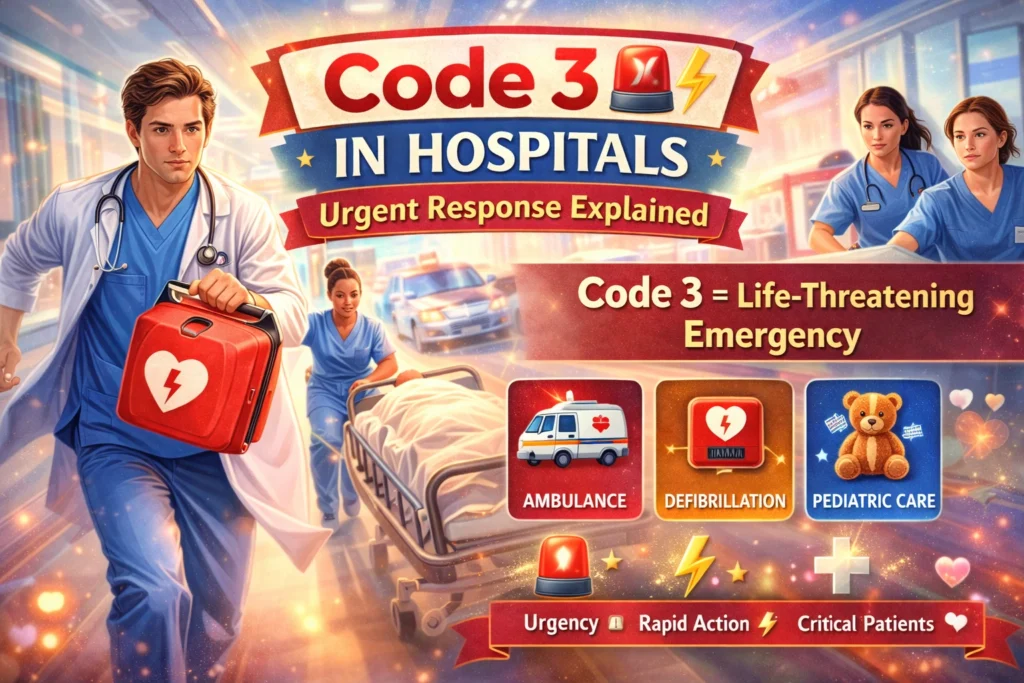
Code 3 in a hospital signals a life-threatening situation that requires immediate medical attention.
It alerts medical staff to act fast, mobilize resources, and sometimes involves urgent patient transport. Its exact meaning can vary by hospital, but it always represents high urgency.
Hospitals operate in fast paced environments where clear and immediate communication can save lives. To manage emergencies efficiently, medical facilities often use coded alerts that notify staff about urgent situations without alarming patients or visitors. One such alert you may hear is Code 3, a term commonly associated with rapid emergency response in hospitals and emergency services.
In healthcare settings, Code 3 typically signals that medical staff must respond immediately to a critical situation. It may involve rushing a patient for urgent treatment, activating emergency teams, or transporting someone quickly with life saving equipment. While the exact meaning can vary slightly between hospitals, Code 3 generally indicates a high priority medical response that requires speed, coordination, and immediate attention from trained professionals.
Hospitals operate on tight schedules where seconds can save lives. Using emergency codes like Code 3 helps staff communicate quickly, ensure patient safety, and reduce confusion during crises. Understanding this code can make you more informed if you ever visit or work in a hospital.
The Origin of Code 3
The use of hospital emergency codes dates back to the 1950s and 1960s when hospitals began expanding rapidly. As facilities grew larger, simple shouting or alarms became insufficient. Staff needed a system to alert the right people quickly without frightening patients or visitors.
- Numbered vs. Color Codes:
- Many hospitals use numbers (Code 1, 2, 3) to denote emergencies.
- Others use colors (Code Red for fire, Code Blue for cardiac arrest).
- Why Code 3?:
- Code 3 became popular because it signals immediate, urgent action, often without needing a public explanation.
- In EMS, Code 3 also became synonymous with lights-and-sirens transport.
Different hospitals might assign slightly different meanings to Code 3. For example:
| Hospital Type | Code 3 Meaning | Additional Notes |
|---|---|---|
| General Hospital | Life-threatening emergency inside hospital | Rapid response team dispatched |
| Trauma Center | Incoming critical trauma patient | EMS coordinates with ER |
| Pediatric Hospital | Severe infant/child emergency | May overlap with Code Pink protocols |
| Rural Clinic | Critical patient transport needed | Limited resources, Code 3 may involve multiple staff |
Real-World Usage of Code 3
Code 3 is a fast-acting alert used in multiple contexts:
- Internal Hospital Emergencies: A patient suddenly collapses, needs resuscitation, or is in respiratory distress.
- Ambulance / EMS Transport: When an ambulance needs priority passage, Code 3 instructs the driver to use lights and sirens.
- Equipment or Environmental Alerts: Some hospitals use Code 3 to indicate critical equipment failure or urgent system issues.
Example Situations
| Scenario | Description | Action Required | Tone |
|---|---|---|---|
| Cardiac Arrest | Patient collapses in ER | Rapid Response Team, CPR, defibrillator | Urgent 🚨 |
| Trauma Patient Arrival | Car accident victim with severe injuries | Prepare ER, surgical team | Neutral/Professional |
| Critical Equipment Failure | Ventilator or oxygen supply fails | Technical team + backup equipment | Neutral/Informative |
| Pediatric Emergency | Infant in severe distress | Pediatric rapid response | Urgent & Specialized |
Code 3 vs Other Hospital Codes
It helps to understand how Code 3 fits among other common codes in hospitals:
| Hospital Code | Meaning | Typical Action | Urgency Level |
|---|---|---|---|
| Code Red | Fire or smoke | Evacuate or alert fire team | High |
| Code Blue | Cardiac or respiratory arrest | CPR & resuscitation | High |
| Code Pink | Infant/Child abduction | Security alert, lock down | Very High |
| Code Black | Bomb threat | Security & evacuation | Very High |
| Code 3 | Life-threatening emergency or urgent transport | Rapid response or EMS coordination | High |
| Code White | Violent patient or intruder | Security & safety measures | Medium |
Observation: Code 3 often overlaps with Code Blue in medical emergencies but is more flexible for rapid transport and urgent interventions.
Examples of Code 3 in Context
Friendly Context:
- Nurse: “Room 210 is going Code 3. Let’s get the rapid response team here fast!”
- Staff remain calm but act immediately. 🚑
Neutral / Professional Context:
- EMS Dispatcher: “Ambulance 5 responding Code 3 to Main Street accident.”
- Lights-and-sirens transport, no panic.
Potential Confusion / Negative Context:
- Visitor: “Why is everyone running around saying Code 3?”
- Misunderstanding can cause stress, highlighting the need for visitor education.
Data on Hospital Emergency Responses
According to recent hospital studies:
| Type of Emergency | Frequency per 1000 Patients | Average Response Time | Staff Involved |
|---|---|---|---|
| Cardiac Arrest | 3 | < 3 minutes | 5-8 staff |
| Trauma / Severe Injury | 1.5 | < 5 minutes | 6-10 staff |
| Pediatric Emergency | 0.5 | < 4 minutes | 4-7 staff |
| Equipment Critical Failure | 0.2 | < 10 minutes | 2-5 staff |
These stats show that rapid response and proper code communication can save lives, especially when every second counts.
Alternate Meanings of Code 3
Outside the hospital, Code 3 can appear in:
- EMS / Fire Departments: Urgent lights-and-sirens response.
- Security / Institutions: Critical alerts for immediate attention.
- Medical Transport Services: Rapid patient transport protocol.
Professional alternatives within hospitals include phrases like:
- “Immediate intervention required”
- “Rapid response alert”
- “Life-threatening emergency”
These alternatives can reduce confusion among visitors and non-medical staff.
Quick Reference Table: Hospital Emergency Codes
| Code | Meaning | Action | Example |
|---|---|---|---|
| Code Red | Fire / smoke | Evacuate | Smoke in ICU |
| Code Blue | Cardiac arrest | CPR & defibrillation | Patient collapse |
| Code Pink | Infant abduction | Security lockdown | Missing newborn |
| Code Black | Bomb threat | Security & evacuation | Suspicious package |
| Code 3 | Life-threatening / urgent transport | Rapid response team | Trauma arrival, cardiac emergency |
| Code White | Violent patient | Security team | Aggressive visitor |
Example Table: Hospital Scenarios & Responses
| Scenario | Code | Response Team | Time Target | Notes |
|---|---|---|---|---|
| Cardiac Arrest | Code Blue / Code 3 | Rapid Response | <3 minutes | CPR + Defibrillator |
| Trauma Arrival | Code 3 | ER & Surgery Team | <5 minutes | Prepare OR if needed |
| Pediatric Emergency | Code 3 | Pediatric RRT | <4 minutes | Specialized care |
| Ventilator Failure | Code 3 | Technical + ICU Staff | <10 minutes | Backup equipment |
| Abduction Threat | Code Pink | Security | Immediate | Lockdown |
Practical Tips for Understanding Code 3
- Stay Calm: Only staff need to act. Visitors should observe safety protocols.
- Ask Questions Later: Families can ask for information after the emergency resolves.
- Follow Protocol: Staff should adhere to hospital rapid response protocols.
- Educate Yourself: Visitor guides often explain common hospital codes to reduce confusion.
FAQs
1. What does Code 3 mean in a hospital?
It signals an urgent medical situation requiring immediate staff response and sometimes emergency transport.
2. How is Code 3 different from Code Blue?
Code Blue is specific to cardiac or respiratory arrest. Code 3 can include any urgent life-threatening situation.
3. Do all hospitals use Code 3 the same way?
No. Each hospital defines codes based on its policies and resources.
4. Can visitors know when a Code 3 happens?
Hospitals usually keep Code 3 internal to prevent panic. Families may be informed after stabilization.
5. Who responds to a Code 3?
Rapid response teams, doctors, nurses, and sometimes EMS if transport is required.
6. Can Code 3 refer to equipment failure?
Yes, some hospitals use Code 3 for critical equipment malfunction affecting patient safety.
7. Are visual alerts used for Code 3?
Yes, hospitals may use digital notifications, colored lights, and overhead paging.
8. Is Code 3 used outside hospitals?
Yes, in EMS, fire, police, and some security settings for urgent response situations.
Conclusion
Code 3 in hospitals is a critical, high-urgency alert for life-threatening emergencies or rapid patient transport. Knowing what it means helps staff act fast, and families understand the context. It’s a vital tool for patient safety, rapid coordination, and operational efficiency.
Hospitals design these codes to save lives while keeping communication clear and discreet. Understanding them reduces confusion, promotes calm, and ensures a better response during emergencies.
Read More Related Aricles:
- What Does IKTR Mean in Text? Here’s What It Really Means (2026)
- What Does SLA Mean in Business: From Definition to Implementation In 2026
- What Does Senpai Mean in Japanese: Anime & Cultural Meaning In 2026

Ivy Madison is a content creator at TextSprout.com, specializing in word definitions, internet slang, acronyms, and text abbreviations. She delivers clear and engaging explanations, helping readers quickly understand modern digital language and trending terms.