
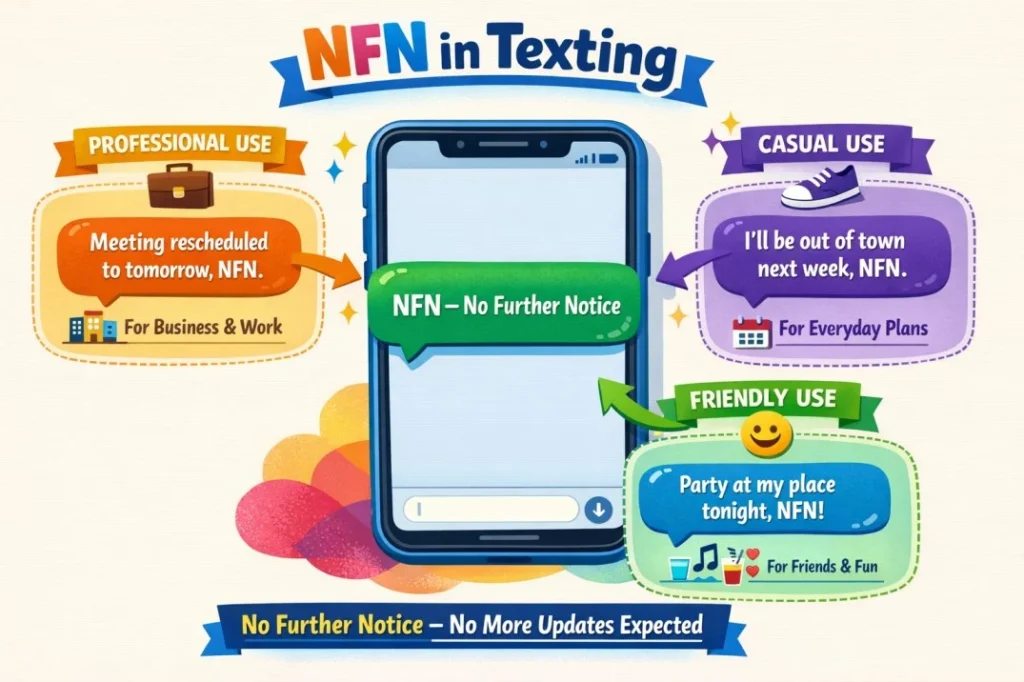
In texting, NFN stands for “No Further Notice.”
It is commonly used to indicate that no additional updates, explanations, or notifications will be provided regarding a topic, plan, or event. Essentially, it signals the end of a conversation thread or the finality of a message.
NFN can appear in texts, emails, chats, or social media messages where the sender wants to communicate closure or indicate that the information provided is all there is to know. While it is not as widely used as acronyms like LOL or BRB, it has a clear purpose in certain texting and professional contexts.
Acronyms and abbreviations have become a major part of modern communication, especially in texting and online messaging. With people typing quickly on phones, shorthand has evolved to convey meaning efficiently. One such acronym that may confuse some is NFN.
Texting is filled with creative ways to shorten messages. From LOL meaning laugh out loud to BRB meaning be right back, NFN fits into this ecosystem but with a more formal and purposeful tone. Unlike playful acronyms, NFN often carries a neutral or slightly authoritative tone, depending on the context.
Understanding what NFN means in texting is useful not only for casual conversations but also in work-related messages, group chats, and situations where clarity and closure are needed. In this article, we will explore the meaning, origin, usage, examples, comparisons with related terms, and provide tips for proper use.
Literal Meaning of NFN
NFN literally stands for No Further Notice. Breaking it down:
- No – indicating absence or negation
- Further – meaning additional or more
- Notice – referring to updates, messages, or communication
Put together, it communicates that the sender will not provide additional information beyond what has already been shared. It is concise and communicates finality without requiring extra words.
For example, if someone sends a text about a meeting schedule and ends with NFN, it implies that the schedule is final and no changes will be communicated afterward.
Origins and Popularity of NFN
Unlike casual texting acronyms like LOL or OMG, NFN has a slightly more formal origin. It is often used in contexts where instructions, updates, or notifications are involved.
NFN became popular in:
- Professional communication – workplaces, emails, or team chats to indicate no more updates will follow.
- Organizational or event notifications – to close a communication thread or confirm finality.
- Texting among friends or social media groups – occasionally, to signal the end of a discussion or decision.
Its usage is less common than entertainment-based acronyms but remains effective in contexts where clarity and closure are important.
Usage of NFN in Texting
NFN can be used in a variety of texting scenarios. Its tone and meaning can slightly vary depending on context.
1. Professional or Neutral Contexts
In professional settings, NFN communicates finality without confrontation. For example:
- “The project deadline is June 10th. NFN.”
- “All team members must submit reports by Friday. NFN.”
Here, NFN signals that the information is official and will not change, saving the sender from explaining further.
2. Casual or Friendly Contexts
Among friends or casual texting, NFN can indicate that a topic is closed or no further discussion is needed.
- “I already booked the movie tickets for Saturday. NFN.”
- “We are going to the beach tomorrow morning. NFN, see you there.”
In these examples, NFN is used to prevent confusion and establish a clear plan without additional back-and-forth messages.
3. Negative or Dismissive Tone
In some situations, NFN can also carry a slightly dismissive tone. It may signal that the sender does not want to continue the conversation:
- “Your excuses are not acceptable. NFN.”
- “The decision is final. NFN.”
While this tone is context-dependent, it shows that NFN can communicate both neutrality and firmness.
Examples of NFN in Real Conversations
| Scenario | Example Text | Meaning |
|---|---|---|
| Professional meeting | “Please submit your reports by 5 PM. NFN.” | No more updates will be given about deadlines. |
| Event planning | “Party starts at 7 PM sharp. NFN.” | The time is final and not flexible. |
| Casual chat | “We are meeting at the café at 4. NFN.” | Confirms meeting time, no further discussion needed. |
| Firm statement | “This offer is valid until Friday only. NFN.” | The sender does not plan to provide more information. |
Variations and Related Acronyms
While NFN specifically means No Further Notice, it can sometimes be confused with similar abbreviations:
- FYI – For Your Information, shares information without implying closure.
- TBA – To Be Announced, indicates that updates will follow later.
- ETA – Estimated Time of Arrival, gives information about timing rather than finality.
NFN is distinct because it explicitly communicates finality, whereas acronyms like TBA or ETA leave room for updates.
Tone and Context Matters
NFN is flexible in tone but understanding context is crucial:
- Friendly tone: NFN can be light, signaling that plans are set and no more details are needed.
- Professional tone: NFN communicates finality clearly, avoiding misinterpretation.
- Dismissive tone: NFN can come across as curt if used in heated discussions.
For example, in a workplace chat, ending a message with NFN is seen as efficient and clear, but using it in a disagreement with friends could be interpreted as blunt or unfriendly.
When to Use NFN in Texting
NFN is best used in situations where:
- You want to confirm a decision or plan is final.
- Additional updates or notifications are unnecessary.
- You want to prevent confusion or extra questions.
- You need to close a discussion clearly and efficiently.
It is less suitable for casual chat where playful or expressive acronyms are preferred, such as LOL or BRB. NFN works best when clarity and closure are required.
Examples in Different Contexts
Workplace
- “The office will be closed on Friday for maintenance. NFN.”
- “Please send your monthly reports by Tuesday. NFN.”
Social Media
- “Tickets sold out in two hours. NFN, try next time.”
- “The livestream starts at 6 PM. NFN, no changes.”
Personal Texting
- “Dinner at my place at 7 PM. NFN, don’t be late.”
- “We are leaving for the trip at 8 AM. NFN, see you then.”
These examples show the versatility of NFN in signaling that no further explanation or change is coming.
Polite Alternatives to NFN
While NFN is clear and concise, sometimes a softer or more polite phrasing may be better, especially in professional or sensitive situations.
- “No further updates will be provided.”
- “This concludes the information.”
- “All details are final.”
- “No additional notice is necessary.”
These alternatives convey the same meaning as NFN but in a way that may feel less abrupt.
NFN in Email Communication
NFN is also used in emails, especially in work contexts where brevity is appreciated. For example:
- “The project timeline is finalized. NFN.”
- “The guidelines above are complete. NFN.”
It is particularly useful when sending official updates, instructions, or notifications where the recipient does not need to expect further messages.
Misconceptions About NFN
Some people may confuse NFN with other acronyms or interpret it incorrectly:
- Thinking NFN means something casual or playful. It is more formal and purposeful.
- Believing NFN allows for further discussion. In fact, it signals closure.
- Assuming NFN is widely recognized. While understood in professional contexts, casual users may not know it.
FAQs
What does NFN mean in texting?
It means No Further Notice, signaling that no additional updates or messages will be provided.
Is NFN used only professionally?
No. While common in professional contexts, it can be used in casual texting to indicate closure.
Can NFN sound rude?
Yes, depending on context. In casual or heated conversations, NFN can seem blunt or dismissive.
Are there alternatives to NFN?
Yes, phrases like “No additional notice will be given” or “All details are final” are more polite.
Is NFN the same as FYI?
No. FYI shares information without implying finality, while NFN communicates closure.
Can NFN be used in group chats?
Yes. It is useful for confirming plans or instructions to all members clearly.
Is NFN commonly recognized by teenagers?
Not as much as LOL, BRB, or TTYL. NFN is more formal and less common in casual teen texting.
Does NFN indicate a deadline?
Not always. It indicates finality in information, which may include deadlines but does not specifically communicate timing.
Conclusion
NFN in texting stands for No Further Notice, and it is a concise way to communicate closure, finality, and certainty. Whether used in professional emails, casual messages, or group chats, it signals that no additional updates or messages will follow.
While NFN may appear formal, it is versatile and can be adapted to friendly, neutral, or firm contexts depending on tone and intent. Understanding NFN helps people communicate more clearly, avoid confusion, and convey decisions or updates effectively.
As texting and online communication continue to evolve, acronyms like NFN will remain valuable for efficient and clear messaging, especially when clarity and closure are needed.
Read More Related Articles:
- Tesoro Mean in English: A Word of Love and Affection In 2026
- FGA Mean in Basketball: Stat Every Fan Should Understand In 2026
- Bonnie Mean in Scottish: Definition and Explanation

Neon Samuel is a digital content creator at TextSprout.com, dedicated to decoding modern words, slang, and expressions. His writing helps readers quickly grasp meanings and understand how terms are used in real conversations across text and social platforms.