
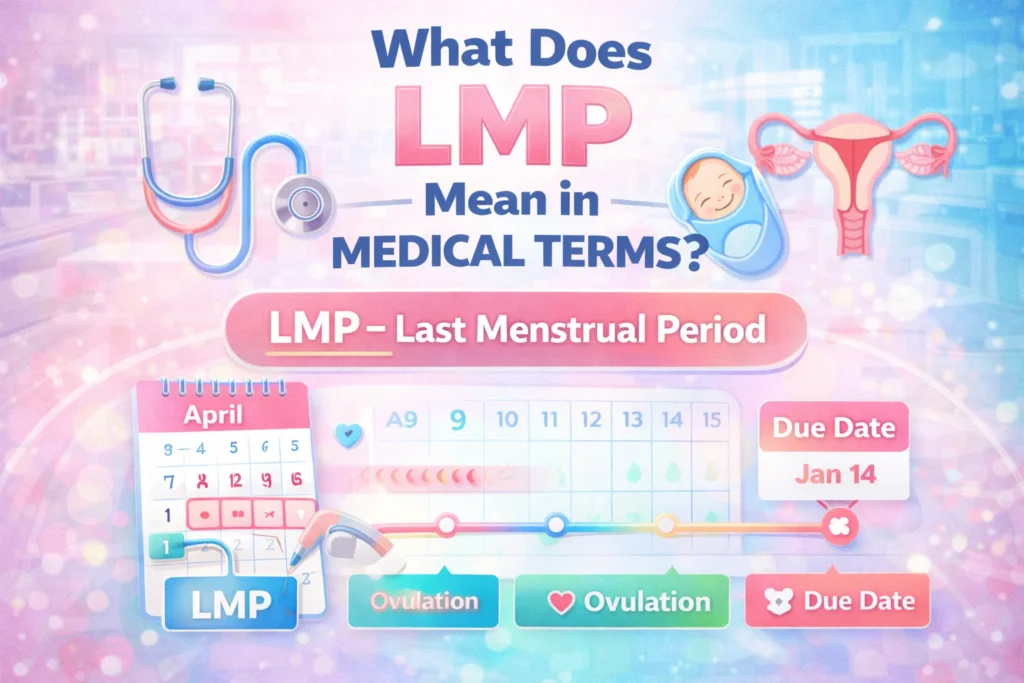
In medical terms, LMP stands for “Last Menstrual Period”, which refers to the first day of a person’s most recent menstrual cycle.
It is a critical date used by healthcare providers to calculate pregnancy timelines, estimate due dates, and assess reproductive health.
The term LMP meaning has been a cornerstone in gynecology and obstetrics for decades. It is derived from basic reproductive health tracking, helping clinicians and patients understand cycles and predict outcomes.
Why it matters:
- Helps calculate gestational age in pregnancy
- Provides context for fertility assessments
- Guides medical screenings and appointments
The use of LMP became widely standardized in the 20th century when modern obstetrics emphasized accurate pregnancy dating. Its simplicity, just marking the first day of the last period made it a universal reference point.
LMP date means the first day of your Last Menstrual Period, which is the start of your most recent menstrual cycle. It is an important reference point used by healthcare providers to track menstrual health and estimate pregnancy timelines.
How LMP is Used in Medical Practice
Healthcare providers rely on LMP for multiple purposes:
| Purpose | How LMP is Applied | Example |
|---|---|---|
| Estimating Due Date | Doctors calculate due date by adding 280 days (40 weeks) to the LMP | If LMP was Jan 1, expected delivery is Oct 8 |
| Tracking Menstrual Cycles | Helps monitor cycle length and detect irregularities | A 28-day cycle starting Feb 5 implies next period on Mar 5 |
| Assessing Fertility | Fertility specialists track ovulation timing relative to LMP | Ovulation typically occurs ~14 days after LMP |
Gestational Age vs. Fetal Age
It’s important to note the distinction:
- Gestational Age: Measured from LMP
- Fetal Age: Measured from conception (usually ~2 weeks after LMP)
This slight difference is crucial when interpreting ultrasound results or planning prenatal care.
What Does LMP Medical Abbreviation Mean?
Understanding lmp medical abbreviation is important in healthcare, especially in fields like gynecology and obstetrics. LMP stands for Last Menstrual Period, which refers to the first day of a woman’s most recent menstrual cycle. This information is commonly used by doctors to estimate pregnancy timelines, calculate due dates, and assess reproductive health.
For example, in pregnancy care, the LMP helps determine gestational age and guides important medical decisions throughout each trimester. It is also useful in diagnosing hormonal imbalances, irregular cycles, or other health conditions. Patients are often asked about their LMP during routine checkups because it provides valuable insight into overall reproductive function.
Knowing the lmp medical abbreviation can help patients better understand their medical records and communicate more clearly with healthcare providers.
Examples of LMP in Real Contexts
Understanding how LMP is used in everyday situations can make the term much easier to recognize and apply. Here are extended, real-life style examples across different tones and settings.
Friendly Context
A patient asks, “Doctor, my LMP was March 10. When am I due?”
The doctor smiles and replies, “Based on your LMP, your estimated due date is December 15. We will monitor your progress and confirm it with ultrasound as well.”
In another casual clinic interaction, a patient might say, “I think my LMP was sometime in early April.” The doctor may respond, “That’s helpful. We will use that as a starting point and refine your dates with further tests.”
Neutral or Professional Context
In medical records, LMP is documented clearly and concisely to support diagnosis and treatment decisions. For example:
- LMP: 05/02/2026
- Estimated delivery date: 12/12/2026
- Gestational age: 8 weeks
In a consultation note, a doctor might write:
“Patient reports regular cycles. LMP recorded as 10/03/2026. No complications noted at this stage.”
Healthcare providers rely on this information to track pregnancy development and ensure accurate care planning.
Dismissive or Negative Context
Sometimes confusion around LMP can lead to misunderstandings. For instance, a patient might say, “My baby was conceived on a certain date, so that must be my due date.”
A doctor may clarify, “We actually calculate due dates based on your LMP, not the exact conception date, because ovulation timing can vary.”
In another situation, a patient may not remember their LMP accurately, which can make early pregnancy dating less precise. This is why doctors often confirm with ultrasounds.
Emoji or Casual Communication Context
In informal conversations, especially in chats with friends or family, LMP may come up in a lighter tone:
“Hey! 😊 My LMP was Jan 5, so baby is coming around Oct 🎉”
Or
“Just checked my calendar 📅 My LMP was Feb 12… looks like I’m about 6 weeks now 😍”
These examples show how LMP can be used outside clinical settings while still carrying important meaning.
Calculating Pregnancy Using LMP
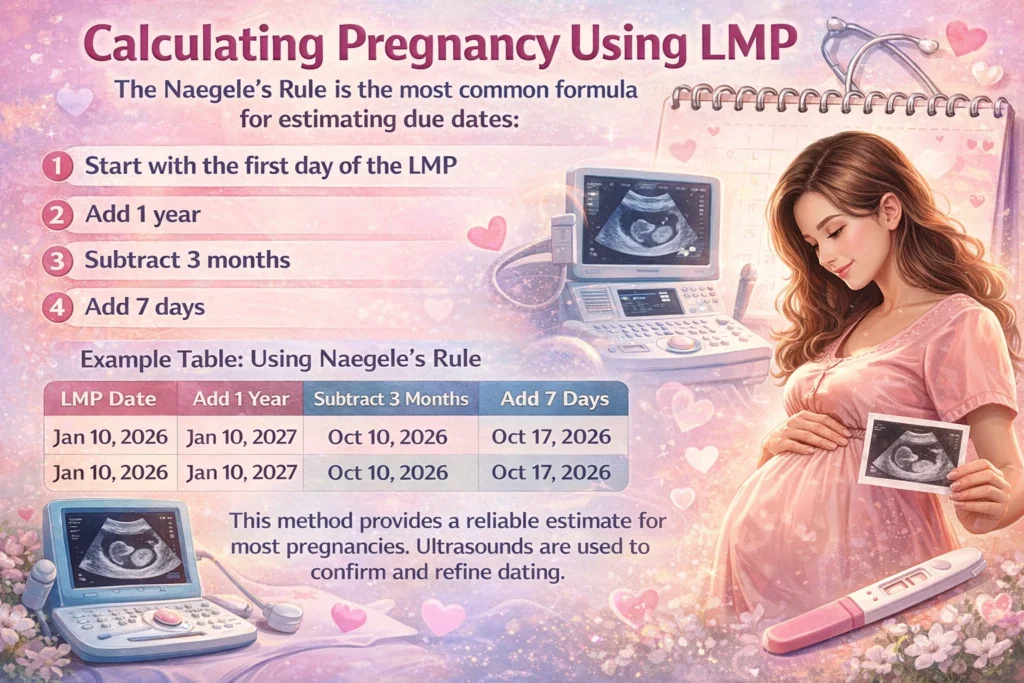
The Naegele’s Rule is the most common formula for estimating due dates:
- Start with the first day of the LMP
- Add 1 year
- Subtract 3 months
- Add 7 days
Example Table: Using Naegele’s Rule
| LMP Date | Add 1 Year | Subtract 3 Months | Add 7 Days | Estimated Due Date |
|---|---|---|---|---|
| Jan 10, 2026 | Jan 10, 2027 | Oct 10, 2026 | Oct 17, 2026 | Oct 17, 2026 |
This method provides a reliable estimate for most pregnancies. Ultrasounds are used to confirm and refine dating.
Comparison with Related Terms
| Term | Definition | Difference from LMP |
|---|---|---|
| EDD (Estimated Due Date) | Predicted date of delivery | Calculated based on LMP or ultrasound |
| Ovulation Date | Day when an egg is released | Occurs ~14 days after LMP in a standard cycle |
| Conception Date | Day when fertilization occurs | Usually 2 weeks after LMP; less commonly used in charts |
| Menstrual Cycle Start | First day of bleeding | This is exactly the LMP |
Understanding these differences avoids confusion when reading medical charts or discussing reproductive health.
Alternate Meanings of LMP
While Last Menstrual Period is the most common, LMP can occasionally stand for other medical or professional terms:
- Local Medical Practitioner – used in some healthcare communications
- Lymphocyte Maturation Pathway – found in immunology research
- Linear Measurement Point – in clinical imaging
In most patient care contexts, LMP almost always refers to the last menstrual period.
Professional and Polite Alternatives
For sensitive patient conversations, doctors sometimes replace “LMP” with:
- Date of last period
- Most recent menstrual cycle start
- Cycle start date
These alternatives make discussions clearer for patients unfamiliar with medical abbreviations.
LMP Example Scenarios
Table: LMP and Pregnancy Timeline Examples
| LMP Date | Estimated Ovulation | Estimated Conception | Estimated Due Date | Notes |
|---|---|---|---|---|
| Feb 1, 2026 | Feb 15, 2026 | Feb 15–16, 2026 | Nov 8, 2026 | Regular 28-day cycle |
| Mar 10, 2026 | Mar 24, 2026 | Mar 24–25, 2026 | Dec 17, 2026 | Short 26-day cycle |
| Apr 5, 2026 | Apr 19, 2026 | Apr 19–20, 2026 | Jan 12, 2027 | Irregular cycle noted |
These examples help visualize how LMP guides pregnancy tracking.
FAQs:
1. What is LMP in pregnancy?
LMP refers to the first day of your last menstrual period, used to calculate gestational age and due date.
2. How is LMP different from conception date?
Conception usually occurs about two weeks after LMP. LMP is easier to track, which is why doctors use it.
3. Can LMP be inaccurate?
Yes. Irregular cycles or memory errors can affect LMP accuracy, which is why ultrasound dating is often recommended.
4. How do I calculate my due date from LMP?
Use Naegele’s Rule: add 1 year, subtract 3 months, add 7 days to the LMP date.
5. Why do doctors ask about my LMP?
It helps with pregnancy dating, fertility assessments, and planning prenatal care.
6. Can LMP change over time?
The LMP itself doesn’t change, but estimations of ovulation and due date may be adjusted based on tests and ultrasounds.
7. Are there non-pregnancy uses for LMP?
Yes. LMP can track menstrual irregularities, hormonal cycles, or fertility planning.
8. Is LMP always accurate for due dates?
It gives a strong estimate, but ultrasound measurements provide more precision, especially if cycles are irregular.
Conclusion:
- LMP = Last Menstrual Period, the starting point for pregnancy calculations.
- It is a simple, standardized, and widely used medical abbreviation.
- Gestational age is calculated from LMP, while fetal age is from conception.
- Alternate terms like “date of last period” improve patient communication.
- Accuracy may vary; combine LMP with ultrasound for best results.
- Tracking LMP helps with fertility, pregnancy planning, and cycle monitoring.
Pro tip: Always note your LMP in a calendar or app—it saves time and ensures accurate healthcare tracking.
Read More Related Articles:
- “Más” Means in Spanish: Why This One Word Changes Everything In 2026
- PF Meaning in Basketball: More Than Just a Position In 2026
- What Does XX Mean in Text? Unlock the Secret Meaning (2026)

Neon Samuel is a digital content creator at TextSprout.com, dedicated to decoding modern words, slang, and expressions. His writing helps readers quickly grasp meanings and understand how terms are used in real conversations across text and social platforms.