
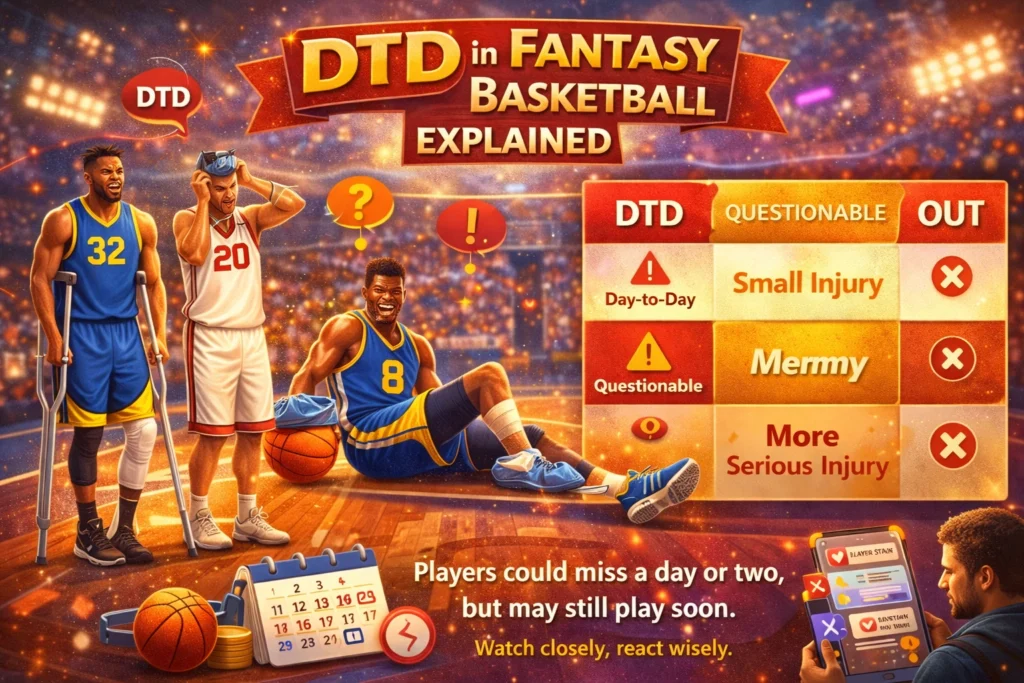
DTD in fantasy basketball stands for “Day-To-Day.” It is used to indicate that a player is questionable to play due to minor injuries or health concerns, and their availability can change on a daily basis. Knowing which players are DTD is essential for managing your fantasy lineup effectively and avoiding unexpected point losses.
If you’ve ever scrolled through your fantasy basketball app and seen a player labeled as DTD, you probably paused and wondered whether to start them or find a replacement. Managing DTD players can be tricky because their availability often shifts at the last minute. But with the right strategy, DTD players don’t have to be a headache—they can actually present opportunities if you monitor them carefully.
Fantasy basketball is all about maximizing points, and understanding DTD is a key part of that. In this guide, we’ll break down what DTD really means, how it affects your roster, practical strategies to manage these players, and provide real-world examples to make it easy to implement.
Origin of DTD in Basketball
The term DTD (Day-To-Day) comes from real-world NBA injury reports, where players’ injuries are categorized based on expected recovery time. Teams and sports journalists use these labels to communicate a player’s likelihood of playing in the next game.
- Day-to-Day (DTD): Minor injury, player may or may not play.
- Questionable (Q): Could play, but less certainty than DTD.
- Out (O): Will not play upcoming game(s).
- Injured Reserve (IR): Out for an extended period.
Fantasy basketball platforms adopted these terms to help managers track player status quickly. Over time, DTD became especially important as apps like ESPN, Yahoo, and Sleeper provide real-time alerts, allowing fantasy players to make last-minute lineup adjustments.
Why DTD Matters in Fantasy Basketball
DTD players can make or break your fantasy week. Since their availability is uncertain, knowing which players are DTD allows you to:
- Plan Your Lineup Smartly: You can decide whether to bench them, start them, or find a replacement.
- Manage Risk: Avoid wasting points on a player who might not play.
- Trade Strategically: Players who frequently appear as DTD may have lower trade value.
- React Quickly in Daily Fantasy Sports: DTD alerts help you swap players right up to game time.
A practical tip: don’t panic every time a player is DTD. Some players frequently show as DTD but rarely miss games. The key is to monitor their practice participation and track patterns over the week.
How to Handle DTD Players in Your Lineup
Here’s a practical approach to DTD players:
| Situation | Player Status | Recommended Action |
|---|---|---|
| Single DTD player | Minor injury | Monitor updates, have a backup ready but consider starting if you trust the player |
| Multiple DTD players | High uncertainty | Use bench options or waiver wire pickups |
| Late-breaking DTD | Right before game | Swap last-minute DFS or daily fantasy starters |
| Frequent DTD players | History of minor injuries | Evaluate for trade or adjust long-term strategy |
💡 Human suggestion: Keep a “DTD watchlist” on your phone or app. It helps you stay ahead and avoid last-minute stress.
Example: Weekly DTD Player Tracker
Tracking DTD players throughout the week gives you a better picture of their reliability:
| Player | Team | Monday | Tuesday | Wednesday | Thursday | Friday | Saturday | Sunday | Notes |
|---|---|---|---|---|---|---|---|---|---|
| LeBron James | Los Angeles Lakers | DTD | DTD | Active | Active | DTD | DTD | Active | Minor ankle soreness |
| Kevin Durant | Brooklyn Nets | Active | DTD | DTD | Active | Active | DTD | Active | Managed rest days |
| Joel Embiid | Philadelphia 76ers | Out | DTD | Active | Active | DTD | Active | Active | Wrist injury improving |
| Stephen Curry | Golden State Warriors | DTD | DTD | DTD | Active | Active | Active | Active | Knee tweak |
| Jayson Tatum | Boston Celtics | Active | Active | DTD | DTD | DTD | Active | Active | Wrist soreness affecting practice |
✅ Suggestion: If multiple starters are DTD, consider picking up flexible bench players like versatile forwards or guards who can fill in any spot.
DTD vs Related Terms
Understanding the difference between similar injury abbreviations prevents lineup mistakes:
| Abbreviation | Meaning | Difference from DTD |
|---|---|---|
| DTD | Day-To-Day | Minor injury, may or may not play |
| Q | Questionable | Less specific, could play or sit |
| OUT | Out | Will not play next game(s) |
| IR | Injured Reserve | Sidelined for an extended period |
💡 Tip: When a player is DTD but practices fully, they’re more likely to play. Questionable players require extra caution.
DTD and Player Performance
Do DTD players perform worse? Here’s a comparison based on average fantasy points (hypothetical data):
| Status | Avg Fantasy Points/Game | Notes |
|---|---|---|
| DTD | 32.1 | Slightly lower than fully healthy due to limited minutes |
| Questionable | 30.5 | Performance unpredictable |
| Active | 35.0 | Full performance expected |
Practical advice: Start DTD players only if you’re confident in their likelihood to play. Otherwise, use the safest options from your bench.
Real-Life Examples in Context
- Friendly: “KD is DTD tonight. Might be fine, but I’ll grab a backup just in case 😉.”
- Neutral: “Player X is DTD. Monitor status before finalizing your lineup.”
- Dismissive: “Another DTD? Ugh, fantasy basketball is stressful 😩.”
💡 Suggestion: Use emoji or short notes in your personal fantasy tracker to indicate risk level for each DTD player.
Managing Multiple DTD Players
When multiple DTD players appear in your lineup:
| Scenario | Recommended Action | Example |
|---|---|---|
| Single DTD | Monitor status | LeBron James DTD vs SF backup |
| Multiple DTD | Start safe alternatives | Curry & Durant DTD, use Lillard & Booker |
| Last-minute DTD alerts | Swap DFS starters | Quick adjustments before tip-off |
| Trading DTD | Consider injury history | Avoid trading Tatum if frequently DTD |
💡 Human tip: Sometimes it’s better to accept minor risk with DTD starters than to overreact and bench them unnecessarily.
Top 10 DTD NBA Players & Weekly Fantasy Impact
| Player | Team | Injury | DTD Days (This Week) | Probability to Play | Avg Fantasy Points/Game | Suggested Fantasy Action | Notes |
|---|---|---|---|---|---|---|---|
| LeBron James | Los Angeles Lakers | Ankle | 3 | 80% | 34 | Monitor practice, start if confirmed | Minor soreness, usually plays |
| Kevin Durant | Brooklyn Nets | Hamstring | 2 | 70% | 32 | Have backup ready, start if active | Rest managed by team |
| Stephen Curry | Golden State Warriors | Knee | 2 | 75% | 35 | Risk-reward start, monitor alerts | Usually high scoring if plays |
| Joel Embiid | Philadelphia 76ers | Wrist | 1 | 90% | 38 | Safe to start, check warmups | Key player for points |
| Jayson Tatum | Boston Celtics | Wrist | 3 | 65% | 31 | Start only if confirmed | Uncertain, moderate risk |
| Damian Lillard | Portland Trail Blazers | Calf | 2 | 80% | 33 | Start if active | Limited minutes possible |
| Anthony Davis | Los Angeles Lakers | Back | 1 | 85% | 29 | Monitor alerts, usually safe | Minor discomfort, plays most games |
| Trae Young | Atlanta Hawks | Finger | 2 | 75% | 30 | Start with caution | Slight chance of limited minutes |
| Kawhi Leonard | Los Angeles Clippers | Knee | 3 | 60% | 28 | Only start if confirmed | High-risk, check last-minute reports |
| Jimmy Butler | Miami Heat | Ankle | 1 | 90% | 32 | Safe start | Minimal risk, often plays full games |
FAQs
What does DTD mean in fantasy basketball?
DTD stands for Day-To-Day. It indicates that a player may or may not play due to minor injuries.
How do I manage a DTD player in my lineup?
Monitor practice reports, set alerts for last-minute updates, and have bench options ready.
Is DTD worse than Questionable?
Not necessarily. DTD is more specific and often indicates minor injuries; Questionable is broader.
Can DTD players still perform well?
Yes. Many DTD players still play full games and score normal points.
How often do DTD statuses change?
They can change multiple times before the game, depending on recovery and team decisions.
Should I trade a DTD player?
It depends on the frequency of DTD appearances and your roster needs.
What are polite alternatives to saying DTD?
“Day-to-day due to a minor injury” or “availability uncertain” are professional alternatives.
Are DTD players safe for daily fantasy?
It’s a risk-reward decision. If confirmed to play, they can provide great points, but monitor updates closely.
Conclusion
DTD, or Day-To-Day, is a crucial concept for fantasy basketball managers. It directly affects lineups, trades, and point potential. By tracking DTD players, monitoring updates, and having flexible bench options, you can turn injury uncertainty into a strategic advantage.
Key takeaways:
- DTD = Minor injury, uncertain availability.
- Track DTD trends over the week for better prediction.
- Keep backup players ready for last-minute swaps.
- Understand related terms like Questionable, Out, and IR.
Read More Related Articles:
- Snake Mean in Dreams: Spiritual and Psychological Meaning In 2026
- Hermosa Mean in English: Beautiful Spanish Word Explained In 2026
- “MK” Mean in Texting: Understanding the Tone Behind It In 2026

Luna Hartley is a content creator at TextSprout.com, where she specializes in explaining word meanings, modern phrases, and everyday language used in texts and online conversations. Her writing focuses on clarity and context, helping readers understand how words are actually used in real communication.