In mathematics, to decompose means to break a number, function, or expression into smaller, simpler parts to make it easier to analyze, solve, or understand. Decomposition is a key strategy in arithmetic, algebra, and higher-level math to simplify complex problems.
If you have ever looked at a big, intimidating math problem and thought there must be an easier way, you are absolutely right. One of the smartest strategies mathematicians use is decomposition. It sounds technical, but the idea is surprisingly simple. Break a complex number, expression, or shape into smaller, manageable parts, then solve step by step.
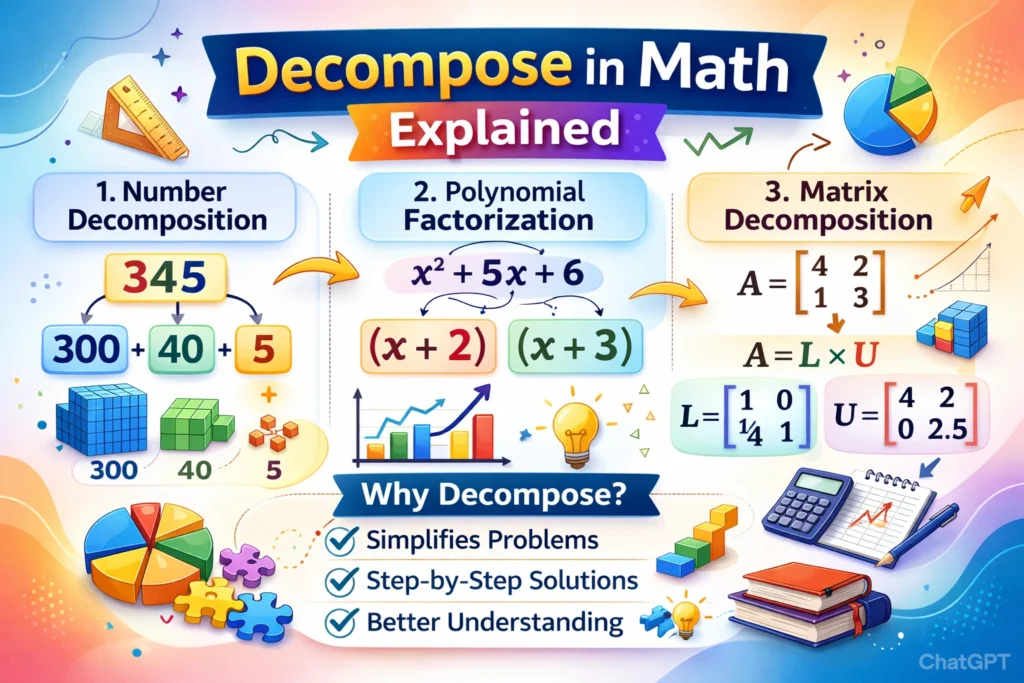
So what does decompose mean in math? It means to separate a number, shape, polynomial, or expression into parts that are easier to understand or calculate. Instead of tackling 345 all at once, you might decompose it into 300 + 40 + 5. Instead of multiplying 18 × 7 directly, you might break 18 into 10 + 8 and calculate in pieces. Suddenly the problem feels lighter and more logical.
In 2026, decomposition is more than just a classroom strategy. It is a core technique in modern math education, mental math training, coding logic, and even financial analysis. Teachers emphasize it because it builds number sense. Programmers use similar thinking to break large problems into smaller algorithms. Analysts apply decomposition to study data trends piece by piece.
Decomposition transforms confusion into clarity. It reduces mental overload and encourages strategic thinking instead of memorization. Whether you are working with place value, fractions, algebraic expressions, or geometry, understanding how to decompose makes problem solving faster and smarter.
Mathematics might sometimes feel like a labyrinth of symbols, equations, and numbers. The concept of decomposition is one of the most practical tools in this maze. It allows us to take a complicated problem and break it into manageable pieces, making problem-solving more intuitive and efficient. Whether you are calculating large numbers, factoring expressions, or analyzing matrices, decomposition is everywhere. Let’s explore this concept deeply and in a friendly, approachable way.
Origin and Popularity of the Term “Decompose” in Math
The term decompose originates from the Latin word decomponere, which means “to separate” or “to put apart.” While it has a natural and chemical meaning in biology and chemistry—like when organic material breaks down—in mathematics, it metaphorically captures the same idea: breaking something complex into parts.
Over time, decomposition has become a fundamental concept in educational curricula, programming, and applied mathematics. Teachers often introduce it as a strategy for simplifying problems, while in advanced mathematics, it forms the basis of matrix decomposition, prime factorization, and function analysis. Its popularity persists because it bridges abstract math with practical problem-solving.
Usage of Decompose in Math
Decomposition is used in multiple branches of mathematics. Here’s a breakdown of the most common applications:
1. Arithmetic Decomposition
Breaking numbers into smaller components to make calculations easier.
Example:
- 345 can be decomposed as 300 + 40 + 5
- 72 can be decomposed into 8 × 9
This helps in mental math and understanding the structure of numbers.
2. Algebraic Decomposition
Breaking algebraic expressions or equations into simpler terms.
Example:
- x2+5x+6 can be decomposed into (x+2)(x+3)
- Polynomial division often involves decomposition to simplify expressions.
3. Function Decomposition
Splitting complex functions into compositions of simpler functions.
Example:
- f(x)=2x+3 can be decomposed into g(x)=2x+3 and h(x)=x
- This helps in calculus and computer programming where nested functions are common.
4. Matrix Decomposition
Used in linear algebra to simplify matrix calculations.
Example:
- LU decomposition splits a matrix into a lower and an upper triangular matrix for easier solving of equations.
- Eigenvalue decomposition breaks a matrix into eigenvectors and eigenvalues for advanced data analysis.
Examples of Decompose in Math
Here’s a table with friendly examples to illustrate different contexts:
| Type of Decomposition | Example | Explanation |
|---|---|---|
| Arithmetic | 246 = 200 + 40 + 6 | Breaks a number into hundreds, tens, and units |
| Prime Factorization | 60 = 2 × 2 × 3 × 5 | Breaks a number into its prime components |
| Algebra | x2+7x+12=(x+3)(x+4) | Factorizes a quadratic equation into linear factors |
| Function | f(x)=ln(3x+1) → g(x)=3x+1,h(x)=ln(x) | Separates a function into simpler compositions |
| Matrix | A=LU decomposition | Simplifies matrix operations for solving linear equations |
💡 Tip: Decomposition often reveals hidden patterns in numbers or expressions, making problem-solving smoother and faster.
Friendly, Neutral, and Negative Tone Examples
- Friendly: “Let’s decompose 123 into 100 + 20 + 3—it’s like opening a math puzzle one piece at a time!” 🎉
- Neutral: “We can decompose the polynomial x2+5x+6 into (x+2)(x+3) to simplify solving.”
- Negative/Dismissive: “You can decompose it, but honestly, that seems overcomplicated for such a small number.”
Tone matters when explaining decomposition, especially in teaching or tutoring contexts. A friendly tone encourages learning, while a neutral tone keeps it professional.
Comparison With Related Terms
Decompose is often confused with similar terms. Let’s clarify:
| Term | Meaning | Comparison with Decompose |
|---|---|---|
| Factor | Breaking a number or expression into factors | Factorization is a type of decomposition |
| Expand | Rewriting an expression into a longer form | Opposite of decomposition; expands rather than simplifies |
| Simplify | Making an expression easier to work with | Decomposition is often a step in simplification |
| Break down | General term for separation | Decompose is a formal mathematical version |
Alternate Meanings and Professional Alternatives
Outside mathematics, decompose can mean:
- Breaking down organic matter (science/biology)
- Decay or rot
In professional math contexts, alternatives could be:
- Break down
- Factorize
- Separate into components
These alternatives are polite, professional, and sometimes clearer for students or beginners.
Usage Tips and Best Practices
- Start small: Begin decomposition with simple numbers or expressions.
- Check your work: After decomposing, try recombining to ensure accuracy.
- Use visuals: Tables or diagrams often make decomposition easier to understand.
- Practice repeatedly: From arithmetic to algebra to matrices, practice helps solidify understanding.
- Connect to real-world problems: Think of decomposition like breaking a task into smaller steps—it works in math and life!
Examples Table of Different Decomposition Methods
| Method | Example | Step-by-Step Breakdown |
|---|---|---|
| Arithmetic | 534 | 500 + 30 + 4 |
| Prime Factorization | 84 | 2 × 2 × 3 × 7 |
| Polynomial | x2+6x+8 | (x+2)(x+4) |
| Function | sin(3x) | g(x)=3x,h(x)=sin(x), then f(x)=h(g(x)) |
| Matrix | A=[2534] | LU decomposition → L = lower, U = upper triangular matrices |
FAQs
1. What does it mean to decompose a number?
Decomposing a number means breaking it into smaller parts, like hundreds, tens, and units, to simplify calculations.
2. How is decomposition used in algebra?
It helps break complex expressions, like polynomials, into simpler factors for easier solving.
3. Can functions be decomposed?
Yes, functions can be expressed as compositions of simpler functions for easier evaluation or analysis.
4. Is decomposition the same as factorization?
Factorization is a type of decomposition, but decomposition is a broader concept.
5. What is matrix decomposition?
It involves splitting a matrix into simpler matrices (like LU or eigenvalue decomposition) to solve equations more efficiently.
6. Why is decomposition important in math?
It makes complex problems manageable, reveals patterns, and improves problem-solving skills.
7. Can decomposition help in mental math?
Absolutely! Breaking numbers into parts makes addition, subtraction, and multiplication much faster.
8. Is decomposition only used in mathematics?
No, it’s used in science, engineering, and computer programming, but in math, it specifically means breaking numbers, expressions, or matrices into parts.
Conclusion:
Decomposition in mathematics is a powerful, versatile tool. By breaking down numbers, functions, expressions, or matrices into simpler components:
- Problem-solving becomes faster
- Patterns become clearer
- Learning and teaching math becomes more approachable
💡 Practical tip: Always look for opportunities to decompose problems—it’s not just a math trick, but a life strategy!
Read More Related Articles:
- PF Meaning in Basketball: More Than Just a Position In 2026
- What Does XX Mean in Text? Unlock the Secret Meaning (2026)
- “Ir” Meaning in Spanish: Usage and Real-Life Examples In 2026

Luna Hartley is a content creator at TextSprout.com, where she specializes in explaining word meanings, modern phrases, and everyday language used in texts and online conversations. Her writing focuses on clarity and context, helping readers understand how words are actually used in real communication.