
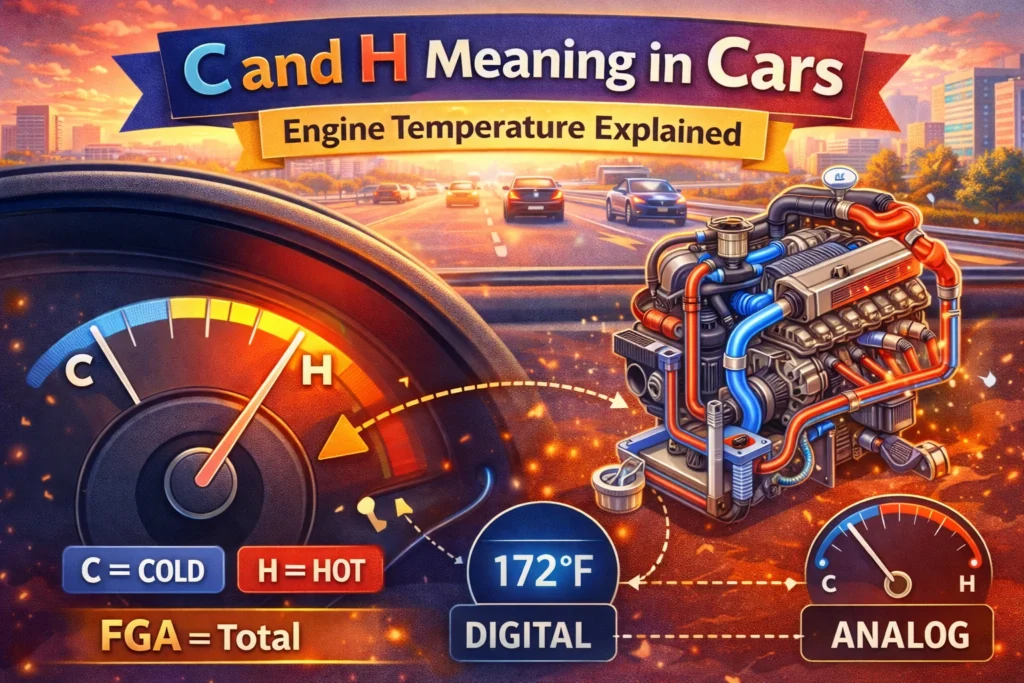
In a car, the letters C and H on the dashboard typically refer to Coolant (C) and Hot (H). They indicate the engine’s temperature range, with C representing a cold engine and H representing overheating. Monitoring this gauge is crucial for engine performance, fuel efficiency, and long-term vehicle reliability.
Did you know that engine overheating accounts for over 25% of roadside breakdowns annually worldwide? Modern vehicles are designed with sophisticated cooling systems, yet many drivers neglect one of the simplest indicators: the C/H temperature gauge.
When you glance at your dashboard, the C and H letters may seem trivial. But they tell a story about your engine’s health:
- C (Cold): Indicates the engine hasn’t reached optimal operating temperature. Driving aggressively while the engine is cold increases fuel consumption by up to 30%.
- H (Hot): Warns that the engine is overheating, which can cause warped cylinders, gasket failures, or complete engine seizures. Repairing an overheated engine can cost $1,000–$5,000, depending on the damage.
The gauge is a simple yet effective diagnostic tool that can save you money and keep your car performing efficiently. 🚗
Modern dashboards may combine analog gauges with digital readouts, but the concept remains universal. Ignoring this information can compromise your car’s longevity, safety, and fuel efficiency.
Interestingly, a study by AAA found that nearly 40% of drivers don’t know the meaning of the C and H symbols on their dashboard. That’s almost half of all drivers at risk of overheating their engine simply because they didn’t understand a few letters.
This guide will take a deep dive into what C and H mean in a car, how they work, and how to use them effectively to protect your vehicle.
Understanding the C and H in Cars
The temperature gauge is an essential part of the dashboard. It provides real-time information about your engine’s operating temperature, which affects both performance and longevity.
- C (Cold): Signals that the engine is below its optimal temperature.
- H (Hot): Indicates potential overheating and requires immediate action.
Most engines operate best in a temperature range of 195°F to 220°F (90°C to 105°C). The C/H gauge simplifies this by using letters instead of exact numbers, making it easier for drivers to interpret at a glance.
Ignoring the C/H gauge can result in:
- Reduced engine efficiency
- Increased wear and tear
- Higher emissions
- Potential engine failure
Origin of C and H on Car Dashboards
The C and H symbols have been used for decades. Early vehicles lacked sophisticated sensors, but engineers needed a simple, intuitive way to indicate engine temperature.
- C (Cold): Alerts drivers not to stress the engine immediately after starting.
- H (Hot): Warns drivers that the engine is overheating.
This system became standard because it’s easy to understand and visually clear. Even drivers with minimal technical knowledge can quickly grasp it.
Interestingly, the first temperature gauges appeared in the 1920s, and early cars used a color-coded system: blue for cold, red for hot. Letters were added later to improve clarity.
How the C and H Gauge Works
Modern cars use either analog or digital gauges. These rely on sensors in the cooling system to detect temperature changes.
| Indicator | Meaning | Action Required | Possible Causes of Abnormal Reading |
|---|---|---|---|
| C | Engine is cold | Warm up engine | Cold start, low coolant sensor voltage |
| Middle | Normal operating temperature | Drive normally | Normal engine operation |
| H | Engine is overheating | Stop immediately | Low coolant, blocked radiator, failing thermostat |
The gauge is a quick diagnostic tool. It reacts to engine heat caused by combustion, friction, and environmental conditions.
Real-World Usage Examples
Friendly Example
On a winter morning, the needle sits at C. You wait 2–3 minutes for the engine to warm up, allowing oil to circulate efficiently. This prevents wear and improves fuel efficiency. ☕🚗
Neutral Example
During a regular commute, the needle remains near the middle. The engine is in its optimal temperature range, and no action is needed.
Negative/Dismissive Example
Ignoring the gauge while driving in heavy traffic can cause the needle to hit H, leading to overheating, warped cylinders, or blown head gaskets. 💸
Brand-Specific Dashboard Examples
Different car brands use slightly varied dashboard designs. Despite these differences, the C and H meaning remains consistent.
| Car Brand | Gauge Style | C/H Representation | Notes |
|---|---|---|---|
| Toyota | Analog dial | C on left, H on right | Needle moves smoothly; hybrids may show digital readouts |
| Honda | Analog + Digital | C on left, H on right; warning light for overheating | Newer models may use red warning lights instead of just H |
| Ford | Modern digital | C/H represented numerically | Digital displays provide exact °C or °F readings |
| BMW | Analog with blue/red | Blue = C, Red = H | Aesthetic difference; function remains the same |
| Tesla | Fully digital | No letters; color-coded bar | Green = normal, yellow/red = overheating |
Key Takeaway: No matter the dashboard style, the principle remains—avoid the red zone.
Comparison With Related Terms
| Term | Meaning | Difference from C/H |
|---|---|---|
| O/D | Overdrive | Controls gear ratio, not engine temperature |
| RPM | Revolutions per Minute | Shows engine speed; unrelated to temperature |
| Temp | Engine temperature (numeric/digital) | Digital version of C/H gauge |
| ECU | Engine Control Unit | Monitors engine systems; may trigger warning lights if overheating occurs |
While other gauges track performance, the C/H gauge is safety-focused.
Alternate Meanings of C and H
Although C/H almost always refers to engine temperature:
- C: Could indicate Charging in older electrical systems.
- H: May denote High Temperature Limit in race or heavy-duty vehicles.
For everyday driving, the standard Cold/Hot interpretation is sufficient.
Polite and Professional Alternatives
For formal contexts:
- Engine temperature gauge instead of C/H
- Cold-to-hot temperature range for clarity
- Operating temperature indicator in manuals or training materials
Example Table: Temperature Gauge Behavior
| Driving Scenario | Needle Position | Expected Action | Real-Life Tip |
|---|---|---|---|
| Cold morning start | C | Warm up engine | Avoid high revs until middle |
| Normal city commute | Middle | Drive normally | Optimal fuel efficiency |
| Long highway drive | Slightly above middle | Monitor fluctuations | Safe for extended trips |
| Engine overheating | H | Stop immediately | Turn off AC and check coolant |
| Idling in traffic | Slightly above middle | Monitor | Keep an eye for spikes |
| Uphill climb | Middle to high | Monitor closely | Use lower gears to reduce strain |
Tips for Monitoring Your C and H Gauge
- Let your car warm up in cold weather.
- Avoid aggressive driving when the needle is near C.
- Watch for sudden spikes toward H.
- Check coolant levels regularly.
- Maintain radiator, thermostat, hoses, and belts.
- Address warning lights immediately.
- Consider periodic professional inspections for older cars.
FAQs
What does C mean on a car dashboard?
C stands for Cold, indicating the engine hasn’t reached optimal operating temperature.
What does H mean on a car dashboard?
H stands for Hot, warning that the engine is overheating.
Is it normal for the needle to stay at C for a long time?
Yes, especially in very cold weather or during short trips. Let the engine warm up.
Can I drive when the needle is near H?
No, it can cause serious engine damage. Stop, inspect coolant and radiator.
Why does the temperature gauge fluctuate?
Temperature changes during acceleration, idle, or climbing hills are normal. Large swings indicate a potential problem.
Are digital temperature displays more accurate than C/H gauges?
Yes, digital sensors provide exact temperatures. Analog gauges are sufficient for quick monitoring.
Can a faulty thermostat affect the C/H reading?
Yes, a stuck thermostat can cause the gauge to stay near C or quickly jump to H.
Do all cars have C and H on the dashboard?
Most do, though newer models may use digital readouts or warning lights instead of letters.
What should I do if the needle reaches H repeatedly?
Check coolant levels, inspect radiator and hoses, and consult a mechanic.
Can driving habits affect C/H gauge readings?
Yes, aggressive driving, heavy loads, or towing can raise the needle toward H more quickly.
Is it safe to ignore C/H warnings on electric or hybrid cars?
Even electric and hybrid vehicles have thermal management systems. Ignoring warnings can affect battery or engine performance.
Conclusion
The C and H gauge is simple, but its significance cannot be overstated. It helps you maintain engine health, prevent overheating, and improve fuel efficiency.
Practical Tips:
- Monitor the gauge consistently while driving.
- Perform regular maintenance on coolant, radiator, thermostat, hoses, and belts.
- Respond to warnings promptly.
- Understand brand-specific variations but know the underlying principle is universal.
With this knowledge, you can drive confidently, protect your engine, and save money on costly repairs. 🚗💡
Read More Related Articles:
- MRN Mean in Medical Terms: Medical Record Number Explained In 2026
- ADL Means in Medical Terms: Assessment & Clinical Use In 2026
- HMB Meaning in Text Messages: What It Stands For, When to Use It &Better Alternatives (2026)

Neon Samuel is a digital content creator at TextSprout.com, dedicated to decoding modern words, slang, and expressions. His writing helps readers quickly grasp meanings and understand how terms are used in real conversations across text and social platforms.