
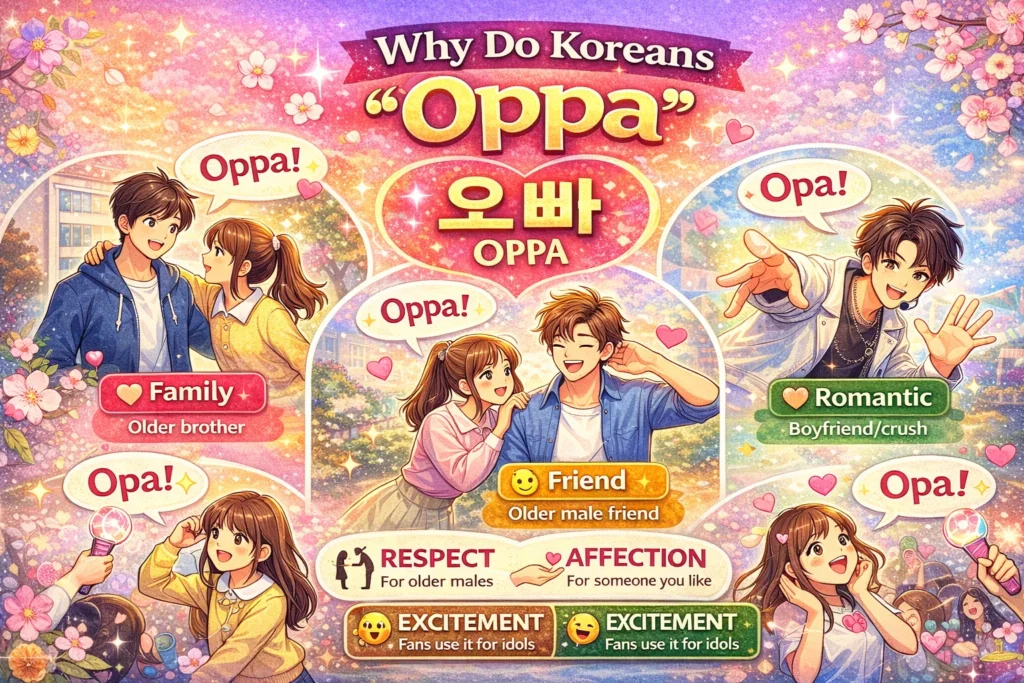
In Korean, “Opa” (오빠) is a term used by females to address an older male, typically an older brother, a close older male friend, or a boyfriend. It conveys respect, affection, and familiarity, depending on the relationship.
While it literally means “older brother,” it has broadened in modern Korean culture to include romantic and social contexts.
If you’ve watched Korean dramas, listened to K-pop, or spent time exploring Korean culture online, you’ve probably heard the word “oppa.” It pops up in emotional scenes, playful conversations, and even in song lyrics. To many international fans, the word may simply sound like a cute nickname. In reality, however, oppa carries a much deeper meaning rooted in Korean language and social culture.
In Korean, “oppa” is a term used by a woman to address or refer to an older brother or an older male she feels close to. The word reflects the importance of age and relationships in Korean society, where language changes depending on who you’re speaking to. Because of this cultural structure, simple words like oppa can reveal a lot about respect, familiarity, and emotional connection.
Over time, the meaning of oppa has expanded beyond family relationships. In everyday life, women may use it for close male friends, boyfriends, or even admired figures slightly older than them. In K-dramas and pop culture, the term often carries a warm or affectionate tone, which is why it has become widely recognized around the world.
Understanding why Koreans say “oppa” is not just about learning a vocabulary word. It offers insight into how Korean culture values hierarchy, politeness, and relationships. Once you know the meaning behind it, you’ll start noticing how this single word can express everything from respect to affection in Korean conversations.
Origin and Popularity of “Opa”
The word “Opa” (오빠) comes from the Korean language, rooted in Confucian traditions, which emphasize respect for elders and hierarchy within families. In Korean culture, age and seniority influence speech patterns, social roles, and even daily interactions.
Originally, “Opa” was strictly used by younger females to refer to their biological older brothers. Over time, its usage expanded:
- In friendships: Young women use it for slightly older male friends.
- In romance: Female partners often use it for boyfriends or husbands.
- In pop culture: Fans use it for male idols or actors they admire.
Its popularity skyrocketed globally through K-dramas, K-pop, and Korean variety shows, where female characters or fans frequently call male stars “Opa.” For instance, fans of male K-pop idols like those in BTS or EXO often say “Opa!” to express excitement, affection, or admiration.
Usage of “Opa” in Korean Culture
Understanding how “Opa” is used requires context. The term conveys respect, intimacy, or even romantic affection depending on the situation.
1. Family Usage
- Literal meaning: Older brother
- Example: A younger sister might say: “Opa, can you help me with homework?”
- Tone: Respectful and loving
2. Friendships
- Extended usage: Older male friend
- Example: A female friend might say: “Opa, do you want to grab coffee?”
- Tone: Friendly and casual, still showing mild respect
3. Romantic Relationships
- Affectionate usage: Boyfriend, husband, or romantic partner
- Example: In a K-drama, a female character says: “Opa, I missed you”
- Tone: Loving, intimate, slightly flirtatious
4. Pop Culture
- Fans to idols: Often shouted at concerts or used online
- Example: “Opa! That song is amazing!”
- Tone: Playful, admiring, excited
Pronunciation and Writing
- Korean: 오빠
- Romanization: O-ppa (sometimes spelled “oppa”)
- Pronunciation tips:
- Stress the first syllable slightly: “OH-ppa”
- The double “p” indicates a slightly stronger plosive sound in Korean
- Hangeul breakdown:
- 오 (O) = “Oh”
- 빠 (ppa) = “ppa” (with strong emphasis)
Knowing how to pronounce “Opa” correctly is crucial because small changes in pronunciation can affect meaning in Korean.
Examples of “Opa” in Different Contexts
Friendly Example:
A girl asks her older brother for help:
- Question: “Opa, can you lend me your notes?”
- Interpretation: Polite request between siblings
Romantic Example:
A girl texts her boyfriend after a long day:
- Message: “Opa, I miss you 😘”
- Interpretation: Affectionate and intimate
Neutral Example in Social Context:
- Female friend talking to older male friend: “Opa, want to watch a movie tonight?”
- Interpretation: Casual, polite, friendly
Pop Culture Example:
- At a BTS concert: “Opa! Saranghae!” (Opa! I love you!)
- Interpretation: Playful admiration
Table: Usage Scenarios for “Opa”
| Context | Who Says It | Who Receives It | Tone | Example |
|---|---|---|---|---|
| Family | Younger sister | Older brother | Loving, respectful | “Opa, help me with homework.” |
| Friendship | Female friend | Older male friend | Friendly, casual | “Opa, let’s grab coffee.” |
| Romance | Girlfriend | Boyfriend | Affectionate, intimate | “Opa, I missed you today.” |
| Pop Culture | Fan | Male idol | Playful, excited | “Opa! That performance was amazing!” |
Comparison with Related Terms
Korean has many terms addressing older males or showing respect, and knowing them helps avoid confusion:
| Term | Meaning | Difference from Opa | Example |
|---|---|---|---|
| 형 (Hyung) | Used by males to address older males | Opa is used by females, Hyung by males | “Hyung, let’s play soccer.” |
| 오빠 (Opa) | Female to older male | Standard term for sister → brother / female → boyfriend | “Opa, can you help me?” |
| 삼촌 (Samchon) | Uncle | Opa is for close, younger-to-older relationships, not relatives outside family | “Samchon, nice to see you!” |
| 선배 (Sunbae) | Senior at work/school | More formal, not affectionate | “Sunbae, can you teach me?” |
| 형님 (Hyeong-nim) | Very respectful male older brother | More formal than Opa | “Hyeong-nim, please join us.” |
Key takeaway:
“Opa” conveys affection and familiarity, while terms like Sunbae or Hyeong-nim lean toward formal respect.
Alternate Meanings of “Opa”
Though primarily used to address an older male in Korean, “Opa” can have other connotations depending on context:
- Exclamation in Greek Culture:
- In Greek, “Opa!” is an expression of excitement, celebration, or encouragement, often heard during dances or festivals.
- Completely unrelated to Korean usage, but popular on social media, so context is important.
- Slang and Modern Usage:
- In Korean online communities, young women may use “Opa” jokingly for male celebrities even if not actually older.
- Professional Alternatives:
- In formal settings or workplace, using Sunbae (senior) instead of Opa is appropriate.
Tips for Using “Opa” Correctly
- Know the relationship: Only females use Opa toward older males. Using it incorrectly can sound awkward.
- Avoid with strangers: Calling someone “Opa” without a prior relationship may be inappropriate.
- Pronunciation matters: Slight mispronunciation can change the nuance or sound unnatural.
- Use in moderation in romance: Overusing it may feel exaggerated or childish.
- Learn related terms: Hyung, Sunbae, and Samchon provide alternatives for different situations.
Table: Dos and Don’ts of Using “Opa”
| Dos | Don’ts |
|---|---|
| Use with older male family members or close friends | Use with strangers or much older men you don’t know |
| Use affectionate tone with boyfriends | Use over-familiar tone in professional settings |
| Pronounce properly: OH-ppa | Mispronounce as O-pa or Op-a |
| Combine with polite endings for formality | Overuse in casual text in serious contexts |
| Learn complementary terms (Hyung, Sunbae) | Confuse Opa with male-to-male terms like Hyung |
Cultural Context and Popularity in Media
Korean media has popularized “Opa” globally, especially through:
- K-Dramas: Romantic scenes often feature female leads calling male leads “Opa.”
- K-Pop: Fans shout “Opa!” at concerts for their favorite male idols.
- Variety Shows: Hosts or participants use “Opa” in humorous or affectionate ways.
Example:
In the drama Descendants of the Sun, the female lead often calls the male lead “Opa,” blending respect, admiration, and subtle romance. This has made the word widely recognized among international fans.
Pop Culture Note:
“Opa” is often paired with “Saranghae” (I love you) in social media posts, creating phrases like:
- “Opa! Saranghae!”
- This conveys playful affection, similar to saying “Big brother, I love you” but in a cute, romanticized tone.
FAQs
1. What does Opa mean in Korean?
It is a term used by females to address older males, meaning older brother, boyfriend, or older male friend.
2. Who can say Opa?
Only females should use Opa toward older males. Males use “Hyung” for older males.
3. Can Opa be romantic?
Yes, in modern usage, girlfriends often call boyfriends Opa affectionately.
4. Is Opa formal or casual?
Opa is casual and familiar; it’s not suitable in professional or formal contexts.
5. Can foreigners use Opa?
Yes, if they understand the cultural nuances. Misuse may cause confusion or awkwardness.
6. How is Opa different from Hyung?
Opa is unisex, Hyung is male-to-male. Both mean older brother/friend depending on context.
7. Does Opa have other meanings?
In Greek culture, it’s an exclamation of excitement, completely unrelated to Korean.
8. How did K-pop popularize Opa?
Through fan interactions, concerts, and songs where fans address idols with “Opa,” often blending admiration and affection.
Conclusion
The Korean term “Opa” is more than just a word—it represents cultural values, emotional connections, and social hierarchy. From family to friendship to romance, Opa conveys respect, familiarity, and sometimes love.
Key Takeaways:
- Opa is used by females for older males, whether brothers, friends, or romantic partners.
- Context matters: family, friendship, romance, or pop culture usage all differ slightly in tone.
- Pronunciation, relationship, and setting are important to avoid awkwardness.
- Related terms like Hyung, Sunbae, and Samchon provide alternatives for male-to-male or formal situations.
- Global exposure through K-dramas, K-pop, and social media has made Opa widely recognized.
By understanding Opa, learners can navigate Korean conversations, media, and social interactions with confidence and cultural insight.
Read More Related Articles:
- What Does “Diff” Mean in Gaming: How Gamers Compare Skills in Chat In 2026
- What Does IHY Mean in Text: Joke, Flirt, or Genuine Anger In 2026
- Exclamation Point Mean in a Car: Don’t Ignore This Warning In 2026

Neon Samuel is a digital content creator at TextSprout.com, dedicated to decoding modern words, slang, and expressions. His writing helps readers quickly grasp meanings and understand how terms are used in real conversations across text and social platforms.