Inference in reading is the process of using clues from the text along with your own knowledge to understand what is not directly stated.
It is the “reading between the lines” skill that allows readers to grasp hidden meanings, make predictions, or understand characters’ feelings and intentions.
Have you ever read something and understood more than what was directly written on the page? That quiet mental leap you make is called inference. It is the skill of using clues, evidence, and prior knowledge to figure out information that is not stated explicitly.
Inference goes beyond simply reading words or hearing facts. It involves thinking critically and connecting ideas. If a story says the sky turned dark and people rushed indoors, you infer that a storm is coming. The text does not say it directly, but your brain fills in the missing pieces.
In 2026, inference is more important than ever. With information flowing constantly through digital platforms, social media, and news outlets, being able to read between the lines helps you analyze meaning, detect bias, and understand context. Whether in reading comprehension, research, or everyday conversations, it is the hidden skill that transforms surface level information into deeper understanding.
Understanding it is crucial for becoming an engaged and thoughtful reader. While we often focus on the words themselves, the true depth of reading comes from interpreting the subtle hints that authors leave behind. Let’s dive into what inference means in reading, why it matters, and how you can master it.
Origin and Popularity of the Term “Inference”
The word inference comes from the Latin root inferre, which means “to bring in” or “to deduce.” Historically, it has been a term used in logic, philosophy, and science to describe reasoning processes.
Over time, the concept of inference became central to reading comprehension. Educators emphasize it because understanding implied meaning is often more important than merely recognizing words. In the digital age, it has grown in popularity as critical thinking skills are increasingly valued in both academic and professional contexts.
- Historical roots: Latin inferre → “to deduce”
- Education: Emphasized in reading programs and comprehension tests
- Everyday relevance: Helps interpret news articles, social media, and personal communications
How Inference Works in Reading
It combines textual evidence with prior knowledge to uncover meaning. When reading, authors often leave gaps intentionally. Good readers infer to fill in these gaps.
Example Table: How Inference Works
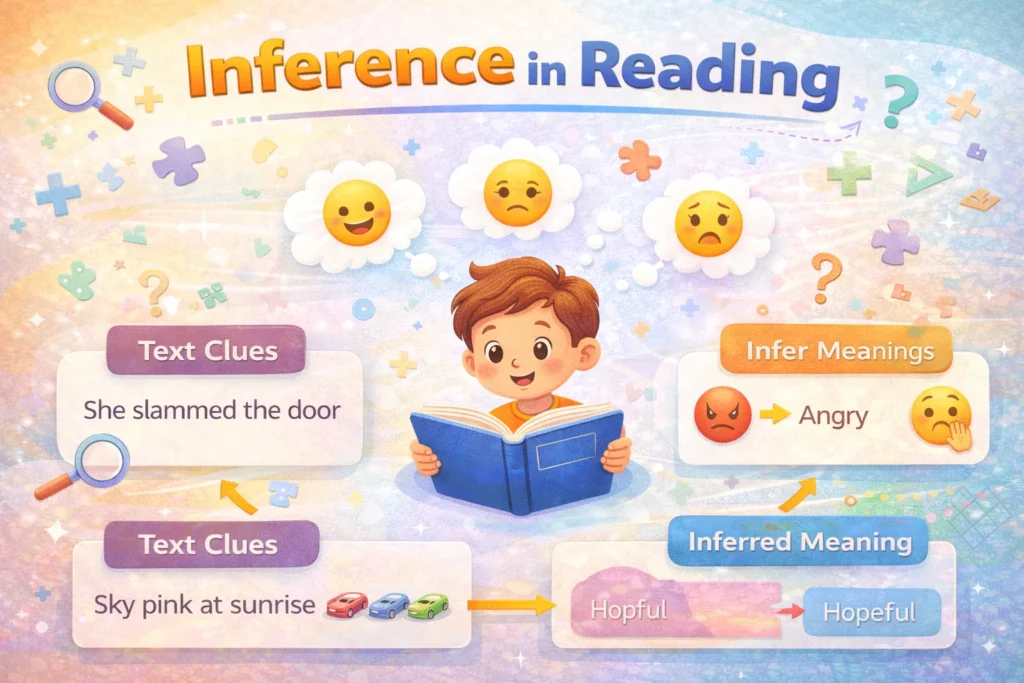
| Text Clue | Prior Knowledge | Inferred Meaning | Tone |
|---|---|---|---|
| “She slammed the door and didn’t answer his calls.” | Slamming doors often indicates anger | The character is upset or angry | Neutral/Negative |
| “The sky was streaked with pink and orange as the sun rose.” | Sunrise often signifies a new beginning | The story is setting a hopeful or fresh mood | Positive/Friendly |
| “He yawned repeatedly and checked his watch.” | Yawning and checking time often indicate boredom | The character is uninterested or tired | Neutral/Dismissive |
The key to inference is noticing small details, understanding context, and connecting them with what you already know.
Examples of Inference in Reading
Here are some everyday examples showing how inference works:
Friendly Tone Example:
“Maya handed him the umbrella with a smile even though it was raining cats and dogs.”
- Maya is considerate and caring.
Neutral Tone Example:
“The train arrived late again, and passengers were glancing at their watches.”
- People are impatient and likely frustrated, though nothing is explicitly stated.
Negative/Dismissive Tone Example:
“John muttered under his breath and rolled his eyes as Sarah explained the instructions.”
- John is annoyed or dismissive, even though he didn’t directly say it.
Using emojis can also be a playful way to convey inference in casual reading or messaging:
“Wow, another meeting 😒” → The person is bored or frustrated.
Comparison with Related Terms
It is helpful to understand how inference differs from similar concepts in reading and comprehension.
| Term | Definition | How It Differs from Inference |
|---|---|---|
| Prediction | Guessing what will happen next based on current clues | Prediction is future-oriented; inference explains what is implied or hidden now |
| Summary | Condensing the main ideas of a text | Summary focuses on explicit content; inference focuses on implicit meaning |
| Conclusion | Logical judgment drawn from evidence | Inference often leads to a conclusion but includes personal knowledge and interpretation |
| Context Clues | Words or phrases that hint at meanings | Context clues provide hints; inference requires connecting those hints to prior knowledge |
By understanding these distinctions, readers can approach texts with a more nuanced perspective.
Alternate Meanings of Inference
While inference is mostly used in reading, it can have other contexts:
- Logic and Science: Deduction from data or evidence. Example: Scientists inferred a connection between diet and heart health.
- Everyday conversation: Making assumptions based on behavior. Example: “I inferred from his silence that he disagreed.”
Polite or professional alternatives for “making an inference” include:
- Drawing a conclusion
- Deductive reasoning
- Analytical observation
Tips for Making Inferences While Reading
- Look for Clues: Pay attention to dialogue, actions, and descriptive details.
- Connect with Prior Knowledge: Relate the text to your own experiences or world knowledge.
- Consider Tone and Context: Is the author humorous, sarcastic, serious, or emotional?
- Ask Questions: Who, what, why, and how – these help uncover hidden meaning.
- Practice with Short Texts: Start with short stories, news articles, or even comics.
- Check Your Inferences: See if the text supports your interpretation.
Example Table of Inference Practice
| Sentence | Clues | Possible Inference |
|---|---|---|
| “After the exam, she threw her pencil on the desk and smiled.” | Smiling, throwing pencil | She is relieved or happy about finishing the exam |
| “He refused the dessert, saying he was full.” | Refusal, reason given | He genuinely may be full, or politely declining |
| “The streets were empty, and the wind howled through the alleys.” | Empty streets, howling wind | Setting is eerie, possibly indicating suspense or danger |
This table can serve as a template for students or readers practicing inference skills.
Real-World Usage
Inference is not just for novels or academic exercises. It is widely used in:
- Education: Standardized reading comprehension tests (SAT, ACT, IELTS) assess inference skills.
- Professional Settings: Understanding emails, reports, or indirect communication requires inference.
- Daily Life: Interpreting social cues, understanding intentions, and reading between the lines in conversations.
- Digital Media: Decoding sarcasm, humor, or subtext in social media posts.
The ability to infer enhances critical thinking, empathy, and communication skills.
FAQs
1. What is an inference in simple words?
Inference is understanding something that the text doesn’t say directly by using clues and your own knowledge.
2. How do you find inferences in a text?
Look for hints in the dialogue, actions, descriptions, or tone, and combine them with what you already know.
3. Is inference the same as predicting?
No. Prediction guesses what will happen next, while it explains meaning that is implied now.
4. Can inference be wrong?
Yes. An inference is a guess based on evidence, so it can be incorrect if the clues are misinterpreted.
5. Why is inference important in reading?
It helps readers understand deeper meanings, emotions, motives, and themes, improving comprehension.
6. Are there types of inference?
Yes. Common types include:
- Character (feelings, motives)
- Plot (what will happen next)
- Theme (underlying message)
7. Can inference be used in real life?
Absolutely. People infer in conversations, work communications, and social interactions daily.
8. How can I improve my inference skills?
Practice reading diverse texts, asking questions, and discussing interpretations with others to refine your reasoning.
Conclusion
It is a vital skill that turns passive reading into active understanding. By paying attention to clues, connecting them to prior knowledge, and considering tone, readers can uncover hidden meanings, anticipate outcomes, and empathize with characters.
- Inference = reading between the lines
- Combines textual clues with prior knowledge
- Applicable in academics, professional life, and daily interactions
- Practice enhances both comprehension and critical thinking
Practical Tips:
- Start small with short stories
- Use tables or notes to track clues and inferences
- Discuss interpretations with peers to see different perspectives
With practice, it can become second nature, enriching your reading experience and overall understanding of the world.
Read More Related Articles:
- What Does Vanilla Mean in Slang? Modern Slang Guide (2026)
- WYF Meaning in Texting and Slang: Full Guide with Examples and Tips (2026)
- What Does IKTR Mean in Text? Here’s What It Really Means (2026)

Luna Hartley is a content creator at TextSprout.com, where she specializes in explaining word meanings, modern phrases, and everyday language used in texts and online conversations. Her writing focuses on clarity and context, helping readers understand how words are actually used in real communication.