
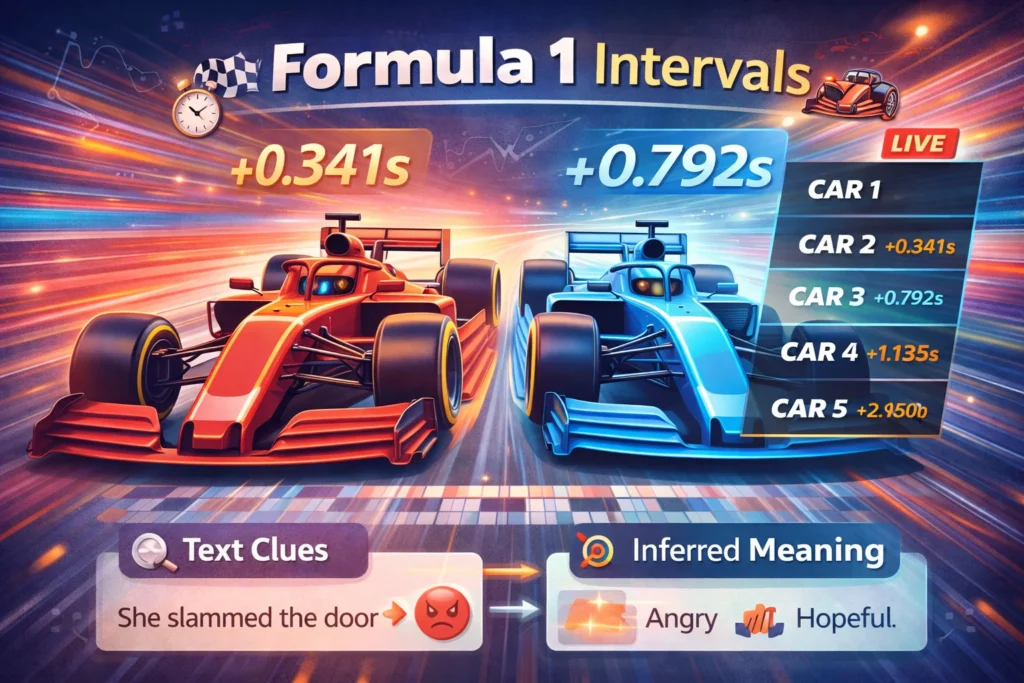
Interval in F1 refers to the time difference between two drivers on the track, usually expressed in seconds or fractions of a second.
It shows how far ahead or behind a driver is relative to another competitor, often used to track gaps, strategize pit stops, and analyze race performance.
In the thrilling world of Formula 1, where every millisecond counts, understanding the term “interval” is crucial for fans, commentators, and even aspiring drivers. Whether you’re watching the live race, checking the leaderboard, or analyzing lap times, the concept of interval pops up repeatedly. But what exactly does it mean in F1? Let’s dive deep into this essential racing term.
In Formula 1, every second counts, and understanding intervals is key to both racing and strategy. Simply put, an interval measures the time difference between two cars on the track. It might seem like just a number on a timing screen, but in F1, that fraction of a second can determine overtakes, pit stop timing, and even championship outcomes.
Intervals are not just about speed—they are about positioning, strategy, and momentum. A driver may be trailing by 1.2 seconds, but knowing the exact interval helps the team decide whether to push for an overtake, conserve tires, or plan a pit stop. It is a precise measurement that turns raw data into actionable decisions.
In 2026, as technology and analytics become more advanced, intervals continue to provide insights beyond the track. Teams analyze split times, sector intervals, and gaps over laps to optimize performance, plan strategies, and respond in real time. Understanding what interval really means in F1 gives fans and professionals alike a clearer picture of the subtle, high-stakes calculations that define racing excellence.
Origin of the Term “Interval” in F1
The word “interval” comes from Latin intervallum, meaning “space between.” In motorsports, it has been used since the early days of racing to indicate differences in timing between cars. With the advent of electronic timing systems in Formula 1 during the 1970s and 1980s, intervals became more precise, measured down to thousandths of a second.
Today, intervals are broadcasted live during races, appearing on timing screens, official leaderboards, and live TV graphics. They are an essential part of F1 commentary and strategy.
Usage of Interval in Formula 1
In Formula 1, intervals serve multiple purposes:
1. Race Position Awareness
Drivers and teams constantly monitor intervals to know their gap to the car ahead or behind. This information is crucial to decide whether to push harder or conserve tires and fuel.
2. Pit Stop Strategy
Intervals can dictate pit stop timing. For instance, if a trailing car is closing in rapidly, a team might bring in the leading car earlier to maintain the gap.
3. Safety and Racing Decisions
Knowing intervals helps avoid risky overtakes when the gap is too small or to capitalize on a mistake from the car ahead.
4. Television and Fan Engagement
Fans love tracking intervals to understand race dynamics, whether a driver is gaining, losing, or maintaining their position.
Examples of Interval in F1
Here are a few scenarios to make the concept crystal clear:
| Driver Ahead | Driver Behind | Interval | Context |
|---|---|---|---|
| Max Verstappen | Lewis Hamilton | 2.3 seconds | Neutral, showing gap in early laps |
| Charles Leclerc | Sergio Perez | 0.8 seconds | Friendly tone, indicates close racing |
| Lando Norris | Valtteri Bottas | 10 seconds | Negative/dismissive, showing significant lag |
Intervals are also dynamic. A 2-second gap early in the race could become 0.5 seconds after a few laps if the trailing driver is faster or after a pit stop.
How Intervals Are Measured
Intervals are measured using advanced timing systems installed at multiple points on the track. These include:
- Transponders on every car
- Trackside sensors to record lap times and sector splits
- Live telemetry sent to team strategists
Intervals can be overall race intervals or sector intervals, which show gaps in specific track sections. For example, a driver may be 0.3 seconds behind in sector 1 but 0.7 seconds ahead in sector 2.
Comparison with Related Terms
| Term | Meaning | Difference from Interval |
|---|---|---|
| Gap | Same as interval, often used interchangeably | Usually refers to larger differences, more informal |
| Delta | Change in lap time compared to reference | Focuses on improvement or loss, not relative position |
| Split | Time at a sector or checkpoint | More granular, used to analyze performance at track segments |
Understanding these terms can help fans interpret race broadcasts more accurately.
Alternate Meanings of Interval in Motorsports
While primarily a timing term in F1, “interval” can also mean:
- Break between sessions – For example, a 30-minute interval between practice sessions.
- Interval in audio/TV – Sometimes used by broadcasters to indicate commercial or technical breaks, but this is rare in F1.
Polite alternatives for “interval” include gap, time difference, or time split, which are often used in commentary for clarity.
Real-World Examples and Contextual Usage
Friendly Example
“Leclerc is closing the interval to Perez. Just 0.6 seconds now! This is going to be an exciting fight for P3.” 🏎️
Neutral Example
“Hamilton maintains an interval of 2.5 seconds over Verstappen after the second pit stop.”
Negative/Dismissive Example
“Norris has an interval of over 15 seconds to the leaders. Looks like recovery is impossible this lap.” 😬
These tones show how intervals add context and narrative to the race, making every second count for fans and teams.
Tips for Understanding Intervals During Live F1 Races
- Watch sector times – They help identify where a driver is gaining or losing time.
- Compare intervals over laps – A decreasing interval indicates a chasing driver is faster.
- Consider tire and fuel strategy – A gap can widen if one driver is on fresh tires or lighter fuel.
- Use team radio updates – Teams often mention intervals to manage the driver’s pace.
Example Table: Interval Dynamics Over Laps
| Lap | Driver Ahead | Driver Behind | Interval | Change from Previous Lap |
|---|---|---|---|---|
| 1 | Verstappen | Hamilton | 2.2 s | – |
| 2 | Verstappen | Hamilton | 2.0 s | -0.2 s |
| 3 | Verstappen | Hamilton | 1.7 s | -0.3 s |
| 4 | Verstappen | Hamilton | 1.5 s | -0.2 s |
This table shows how small changes each lap can indicate momentum shifts.
Related Terms and Key Notes
- Split time vs Interval: Split time measures sector performance; interval measures gap between drivers.
- Live timing boards: Intervals are displayed live for fans on apps, TV, and circuits.
- Impact on championship: Consistently closing intervals and overtaking can affect race points and standings.
FAQs
What does interval mean in F1 commentary?
It refers to the time gap between two drivers on track, showing who is ahead and by how much.
How is interval different from lap time?
Lap time measures a single lap duration; interval shows time difference between two drivers.
Why do intervals change during a race?
Because drivers’ speed varies due to tires, traffic, strategy, or pit stops.
Can interval be negative?
Yes, if the trailing driver overtakes, the previously leading driver’s interval effectively becomes negative for that pair.
Is interval the same as gap?
Mostly, yes. “Gap” is a more casual term, while interval is technical and precise.
Do F1 teams use intervals for strategy?
Absolutely. Teams monitor intervals to decide pit stops, tire choices, and when to push or conserve.
How are intervals measured accurately?
Using transponders on cars, trackside sensors, and live telemetry systems.
Can fans track intervals in real time?
Yes, through official F1 apps, TV graphics, and circuit leaderboards.
Conclusion
Understanding intervals in F1 provides deeper insights into the race’s drama, strategy, and excitement. By tracking intervals, fans can follow the nuances of overtaking battles, tire strategy, and driver performance. For teams, intervals are critical for tactical decisions, from pit stops to lap pacing.
Next time you watch a race, notice the intervals and see how they change lap by lap—it’s like watching a chess match at 200 mph!
- Intervals = time difference between drivers.
- Measured using advanced transponders and telemetry.
- Crucial for strategy, commentary, and fan understanding.
- Dynamic and can fluctuate every lap.
- Related terms include gap, delta, and split time.
Read More Related Articles:
- “Le” Means in Spanish: Why This Small Word Matters So Much In 2026
- OP Meaning in Gaming – The Term Every Gamer Uses (2026)
- What Does QHS Stand For? A Clear Medical Definition In 2026

Luna Hartley is a content creator at TextSprout.com, where she specializes in explaining word meanings, modern phrases, and everyday language used in texts and online conversations. Her writing focuses on clarity and context, helping readers understand how words are actually used in real communication.