
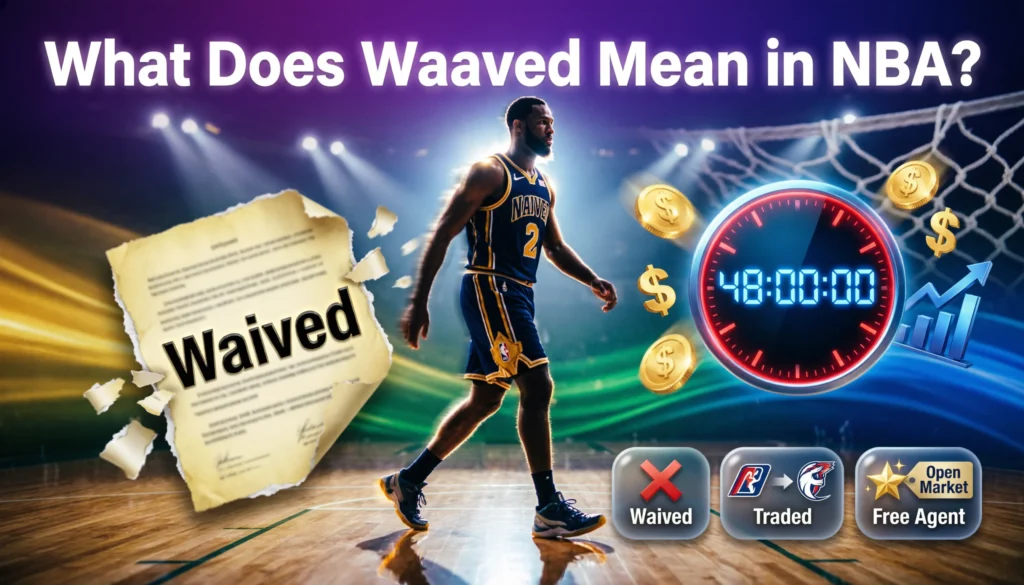
In the NBA, “waived” means a team has officially released a player from its roster before the contract ends.
The player is removed from the active lineup, and other NBA teams have 48 hours to claim the player’s contract.
If no team claims him, he becomes an unrestricted free agent and can sign with any team.
If you follow basketball news even casually, you have probably seen headlines like “Player X waived by Lakers” or “Veteran guard waived ahead of trade deadline.”
The word sounds simple.
Yet in the NBA, it carries specific rules, financial consequences, and strategic meaning.
Let’s break it down in plain English so you fully understand what waived means in the NBA, how it works, and why teams use it.
What Does Waived Mean in the NBA?
When an NBA team waives a player, it is formally terminating that player’s contract and removing him from the roster.
However, that does not mean the contract disappears.
Here is what actually happens:
- The team files paperwork with the league.
- The player enters the NBA waiver wire.
- Other teams have 48 hours to claim his contract.
- If no team claims him, he clears waivers.
- He becomes a free agent.
The process is regulated by the league office and applies to both guaranteed and non guaranteed contracts.
How the NBA Waiver Process Works
Understanding the waiver process helps you see why teams use this option strategically.
Step by Step Breakdown
| Step | What Happens | Why It Matters |
|---|---|---|
| 1 | Team waives the player | Removes him from roster |
| 2 | Player enters waiver wire | Other teams can claim him |
| 3 | 48 hour window | Claim priority based on record |
| 4 | Claimed or clears | Determines contract outcome |
| 5 | Free agency (if unclaimed) | Player negotiates new deal |
The waiver priority typically goes to teams with worse records first, similar to how certain league systems are structured during the season.
If a team claims the player, they take on his existing contract.
If no one claims him, he is free to sign anywhere.
Why Do NBA Teams Waive Players?
Waiving a player is not always negative.
Sometimes it is strategic.
Here are common reasons:
1. Roster Space
NBA teams can only carry 15 standard contracts during the regular season.
If they want to sign someone new, someone else might have to go.
2. Financial Strategy
Teams sometimes waive players to reduce future salary obligations.
3. Performance Issues
A player may not fit the system or may be underperforming.
4. Buyout Agreements
Veterans on non contending teams sometimes negotiate buyouts, then get waived so they can join contenders.
For example, teams like the Los Angeles Lakers and Golden State Warriors have historically signed veterans after they were waived mid season to strengthen playoff rotations.
Guaranteed vs Non Guaranteed Contracts
Not all waived players are treated the same financially.
Guaranteed Contracts
If a player has a fully guaranteed contract and is waived:
- He still gets paid.
- The salary often counts against the team’s salary cap.
- The team cannot simply erase the money.
Non Guaranteed Contracts
If the contract is not fully guaranteed:
- The team may owe only a portion.
- Sometimes they owe nothing if waived before a deadline.
Here is a simple comparison.
| Contract Type | Does Player Get Paid After Being Waived? | Cap Impact |
|---|---|---|
| Fully Guaranteed | Yes | Usually counts against cap |
| Partially Guaranteed | Depends on timing | Partial impact |
| Non Guaranteed | Often no | Minimal impact |
This financial distinction plays a big role in roster decisions, especially around contract guarantee deadlines in January.
What Does “Clearing Waivers” Mean?
When a player is waived and no team claims him within 48 hours, he clears waivers.
At that point:
- He becomes an unrestricted free agent.
- He can sign with any NBA team.
- He can sign overseas.
- He can negotiate a new deal at any salary allowed under cap rules.
Clearing waivers can actually benefit a player because he regains flexibility.
Waived vs Released vs Cut
Many fans use these words interchangeably.
Technically, waived is the formal NBA term.
Here is how they compare.
| Term | Meaning in NBA | Formal League Term? |
|---|---|---|
| Waived | Official contract termination | Yes |
| Released | Informal media term for waived | No |
| Cut | Often used during preseason | No |
During preseason, you may hear a player was “cut.”
In official league documents, he was waived.
Real World Usage Examples
The phrase “waived” can carry different tones depending on context.
Friendly or Neutral Tone
“The team waived the rookie to create roster flexibility.”
This suggests a business decision.
Slightly Negative Tone
“He was waived after struggling to find consistency.”
This implies performance issues.
Strategic Tone
“The veteran was waived following a buyout agreement to join a playoff contender.”
This often benefits both sides.
In reports involving teams like the Miami Heat or Boston Celtics, waived veterans sometimes reappear quickly on contenders.
Basketball is a business.
Waiving does not always reflect a player’s value.
What Is a Waiver Claim?
If a team claims a waived player:
- They assume his existing contract.
- They add him to their roster.
- They must have cap space or an exception.
Waiver claims are more common early in the season when teams experiment with roster depth.
Later in the season, buyouts and free agency are more common paths.
What Is a Buyout in the NBA?
A buyout is slightly different from a simple waiver.
In a buyout:
- The player and team agree to reduce the owed salary.
- The team waives the player.
- The player signs elsewhere.
Veteran players on rebuilding teams often pursue buyouts near the trade deadline.
It gives contenders experienced depth without major trade assets.
Salary Cap Impact of Waiving a Player
Waiving a player does not always remove salary cap charges.
Here is how it typically works:
| Scenario | Cap Hit Remains? | Explanation |
|---|---|---|
| Guaranteed contract | Yes | Full salary counts |
| Stretch provision used | Spread out | Salary spread over years |
| Non guaranteed contract | Possibly no | Depends on timing |
| Buyout | Partial | Reduced cap hit |
The stretch provision allows teams to spread remaining salary over multiple seasons.
This helps create short term flexibility but extends cap impact.
Teams like the Brooklyn Nets have used creative cap management strategies in recent years.
Is Being Waived a Bad Thing?
Not necessarily.
For young players, it can be a setback.
For veterans, it can be an opportunity.
Some players have revived careers after being waived.
Others use the G League or overseas leagues as stepping stones.
Context matters.
A rebuilding team might waive a veteran simply to give younger players minutes.
Origin of the Term “Waived”
The word waive comes from legal terminology.
It means to give up a claim or right.
In sports leagues, waiver systems were designed to:
- Maintain competitive balance
- Prevent talent hoarding
- Allow weaker teams first opportunity
The NBA adopted waiver procedures to regulate roster control and fairness.
The concept exists in other leagues too, including the NFL and MLB.
Alternate Meanings of Waived
Outside basketball, waived can mean:
- A fee was waived at a bank.
- A requirement was waived in school.
- A legal right was waived in court.
In each case, something is formally given up.
In the NBA, it specifically refers to contract termination.
Polite or Professional Alternatives
In media writing, alternatives to “waived” may include:
- Released from roster
- Contract terminated
- Removed from active roster
- Parted ways with
However, official NBA language always uses waived.
Example Scenario Table
Here is a realistic scenario to clarify things.
| Situation | What Happens | Outcome |
|---|---|---|
| Rookie waived before guarantee date | Minimal salary owed | Team saves cap space |
| Veteran bought out and waived | Partial salary paid | Player joins contender |
| Injured player waived with guarantee | Full salary paid | Team absorbs cap hit |
| End of bench player waived mid season | Enters waiver wire | May sign elsewhere |
This shows how varied outcomes can be.
Key Differences Between Waived, Traded, and Free Agency
| Term | Who Initiates | Contract Status | Player Choice |
|---|---|---|---|
| Waived | Team | Terminated | Limited during 48 hours |
| Traded | Team | Transferred | No veto in most cases |
| Free Agency | Contract ends | Expired | Full control |
Understanding these differences helps fans interpret NBA news more accurately.
Practical Tips for Understanding NBA News
When you see “waived” in headlines:
- Check if the contract was guaranteed.
- Look at timing relative to deadlines.
- See if a buyout was involved.
- Monitor which teams might claim him.
- Understand cap implications.
Basketball reporting often leaves out those financial layers.
FAQs
What happens when a player is waived in the NBA?
He is removed from the team roster and placed on waivers for 48 hours. Other teams can claim his contract. If unclaimed, he becomes a free agent.
Do waived NBA players still get paid?
If the contract is guaranteed, yes. If non guaranteed, it depends on the timing and terms.
How long is the NBA waiver period?
The waiver period lasts 48 hours.
Can a waived player return to the same team?
Yes, but usually only after clearing waivers and under certain cap rules.
What is the difference between waived and bought out?
A buyout is a mutual agreement to reduce salary before being waived. Waived alone is a unilateral team decision.
Does waiving a player free up salary cap space?
Not always. Guaranteed money usually remains on the books unless special provisions apply.
Can playoff teams sign waived players?
Yes, especially after buyouts, provided the player was waived before the postseason eligibility deadline.
Is being waived the same as being traded?
No. A trade transfers the contract to another team. Waiving ends the contract with the current team.
Conclusion
So what does waived mean in the NBA?
It means a team has officially ended a player’s contract and removed him from the roster, placing him on waivers for 48 hours before he potentially becomes a free agent.
The term sounds harsh.
In reality, it is a strategic roster management tool.
Some players lose opportunities.
Others gain new ones.
Understanding waiver rules helps you read NBA headlines with more insight and less confusion.
Next time you see a breaking news alert about a player being waived, you will know exactly what it means, how it works, and why it matters.
Read More Related Articles:
- HMB Meaning in Text Messages: What It Stands For, When to Use It &Better Alternatives (2026)
- Zeal Meaning in the Bible: Passion or Problem? (2026)
- Rebuke Mean in the Bible: Learn Its Meaning and Power (2026)

Ivy Madison is a content creator at TextSprout.com, specializing in word definitions, internet slang, acronyms, and text abbreviations. She delivers clear and engaging explanations, helping readers quickly understand modern digital language and trending terms.