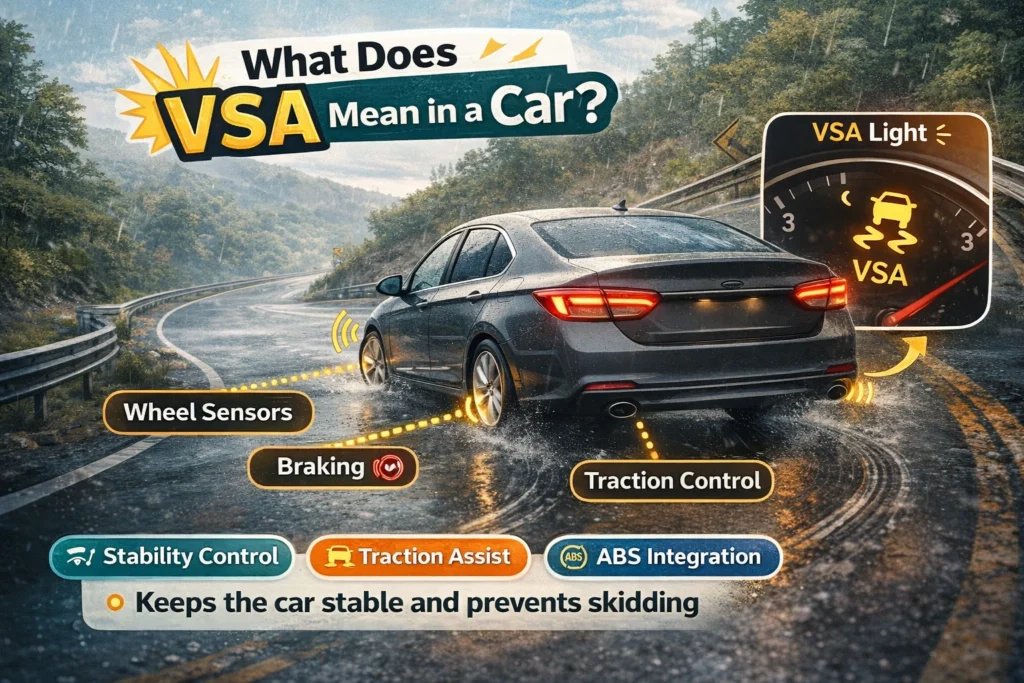
VSA stands for Vehicle Stability Assist, a safety system in cars that helps drivers maintain control during slippery or sharp-turn conditions by stabilizing the vehicle and preventing skidding or loss of traction.
Driving a car safely isn’t just about knowing how to steer or brake—it’s also about understanding the technology designed to keep you on the road. One such technology that many drivers encounter is VSA. If you’ve ever noticed a warning light on your dashboard with the letters VSA, you might have wondered what it really means.
Understanding VSA is essential not only for safety but also for knowing how your car responds in emergency situations. This article dives deep into VSA, its origin, functions, real-world examples, comparisons, and frequently asked questions so you can confidently interpret that dashboard light.
The Origin of VSA in Cars
Vehicle Stability Assist (VSA) was introduced by Honda in the late 1990s as an advanced safety system to complement anti-lock braking (ABS) and traction control systems (TCS).
- Why it was created: To reduce accidents caused by skidding, oversteering, or understeering.
- Evolution: Early stability systems were purely mechanical, but VSA combines sensors, electronic controls, and braking technology.
- Popularity: Today, VSA or similar systems (ESP, ESC) are standard in most modern vehicles worldwide.
The system is part of a broader trend in automotive safety toward active safety systems, which actively help prevent accidents rather than just protect passengers in a crash.
How VSA Works in Cars
VSA monitors several parameters to ensure your car stays under control:
- Wheel speed sensors – Detect differences in wheel rotation.
- Steering angle sensors – Track the direction you are turning.
- Yaw rate sensors – Measure vehicle rotation around its vertical axis.
- Brake and throttle control – Adjust braking and engine power automatically.
If the system detects a loss of traction—like on ice, rain, or gravel—VSA can apply brakes to individual wheels and reduce engine power to help the car follow your intended path.
Example Scenario:
- You’re taking a sharp turn in the rain.
- Your rear wheels start sliding slightly.
- VSA engages, applies braking to the slipping wheel, and helps you maintain control.
Table: Key VSA Functions
| Function | Description | Real-World Benefit |
|---|---|---|
| Brake control | Applies brakes to individual wheels | Reduces skidding in slippery conditions |
| Engine control | Adjusts throttle power | Prevents wheel spin and over-acceleration |
| Traction monitoring | Detects loss of grip | Helps maintain intended driving path |
| Stability monitoring | Monitors steering and yaw | Keeps vehicle aligned during sharp turns |
Signs Your VSA Is Working
- Dashboard warning light: A triangle with “VSA” inside may appear.
- Sensation in braking: You may feel slight brake pulses during traction loss.
- Reduced wheel spin: Even on slippery surfaces, the car feels more stable.
It’s important to note that VSA doesn’t make your car invincible—it only assists. Drivers must still adjust speed and maintain safe distances.
VSA vs Other Safety Systems
VSA is often compared with other similar systems. Understanding the differences can help:
| System | Abbreviation | Main Purpose | Difference from VSA |
|---|---|---|---|
| ABS | Anti-lock Braking System | Prevents wheel lockup during braking | ABS only prevents lockup; VSA adds stability control |
| TCS | Traction Control System | Reduces wheel spin during acceleration | TCS prevents wheel spin; VSA also manages yaw and steering |
| ESC | Electronic Stability Control | Keeps vehicle stable in extreme maneuvers | ESC is similar to VSA; VSA is Honda’s brand name |
Essentially, VSA is Honda’s version of ESC, combining traction and stability functions into one system.
Real-World Examples of VSA in Action
Friendly Scenario
You’re driving on a wet city street. Suddenly, the car starts to slide slightly in a turn. Thanks to VSA, brakes are applied to the slipping wheel, and the car steadies—no panic, smooth handling.
Neutral Scenario
Highway driving in light rain: You accelerate slightly faster than ideal, VSA engages momentarily to prevent wheel spin. You barely notice the intervention.
Slightly Humorous Scenario
Imagine trying to show off drifting skills in a Honda Civic. 😆 VSA will politely override your fun, keeping the car under control and your ego slightly bruised.
Common Causes for VSA Warning Light
Seeing the VSA light on your dashboard doesn’t always mean a major problem. Common causes include:
- Low tire pressure
- Worn-out tires
- Slippery road conditions triggering the system
- Malfunction in wheel speed or yaw sensors
Pro Tip: If the light stays on continuously, it’s best to have a professional inspect the system. Ignoring it can compromise vehicle stability.
How to Use VSA Safely
- Do not disable VSA unless instructed for specific conditions like deep snow or sand.
- Adjust driving in adverse conditions: Even with VSA, reduce speed on ice, rain, or gravel.
- Regular maintenance: Ensure tires, brakes, and sensors are in good condition.
- Learn the system: Understand what dashboard alerts mean and how the car behaves.
Alternatives and Related Terms
While VSA is Honda-specific, other manufacturers use different names:
- ESC (Electronic Stability Control) – General term used by many brands.
- DSC (Dynamic Stability Control) – BMW’s version.
- VDC (Vehicle Dynamic Control) – Nissan’s terminology.
Professional alternatives in writing or manuals:
- Instead of saying “VSA activated,” you could say “stability control system engaged.”
- In educational materials, explaining VSA as “a system that helps maintain vehicle stability” is often clearer.
FAQs
1. What does VSA mean on my car dashboard?
It stands for Vehicle Stability Assist, helping your car maintain traction and control during slippery or sudden maneuvers.
2. Is VSA the same as ABS?
No. ABS prevents wheel lockup while braking. VSA includes ABS functions but also manages steering, yaw, and traction.
3. Can I drive with VSA off?
Yes, but it’s not recommended in slippery conditions. Disabling it reduces safety.
4. Why is the VSA light blinking?
It usually indicates the system is actively working to stabilize your car.
5. Does VSA help in snow or ice?
Yes, it helps prevent wheel spin and skidding, but you still need winter tires and cautious driving.
6. Is VSA only in Honda cars?
VSA is Honda’s brand name, but similar systems exist in most modern cars under different names like ESC, DSC, or VDC.
7. What should I do if the VSA light stays on?
Check tire pressure, inspect brakes and sensors, and consult a certified mechanic.
8. How does VSA improve safety?
By assisting braking, reducing wheel spin, and stabilizing the vehicle, VSA lowers the risk of accidents due to skidding or loss of control.
Conclusion
VSA (Vehicle Stability Assist) is an essential safety feature in modern cars, especially for drivers navigating wet, icy, or uneven roads. It combines traction control, braking, and steering input to help prevent skidding and maintain vehicle control. While it cannot replace safe driving habits, it provides an extra layer of security, especially in unexpected conditions.
- VSA = Vehicle Stability Assist, Honda’s stability control system.
- Works alongside ABS and traction control.
- Activates automatically in slippery conditions or sharp maneuvers.
- Understanding the system and dashboard indicators ensures safer driving.
- Similar systems exist across brands under different names: ESC, DSC, VDC.
By understanding VSA, you can better interpret your car’s alerts, drive safely in adverse conditions, and maximize the safety features your car provides.
Read More Related Articles:
- PRN Means in Jobs: Flexible Work or Unpredictable Hours In 2026
- “How Much” Mean in Math: From Basic Counting to Word Problems In 2026
- Meaning of Fewer in Math: A Tiny Word With Big Importance In 2026

Ivy Madison is a content creator at TextSprout.com, specializing in word definitions, internet slang, acronyms, and text abbreviations. She delivers clear and engaging explanations, helping readers quickly understand modern digital language and trending terms.