
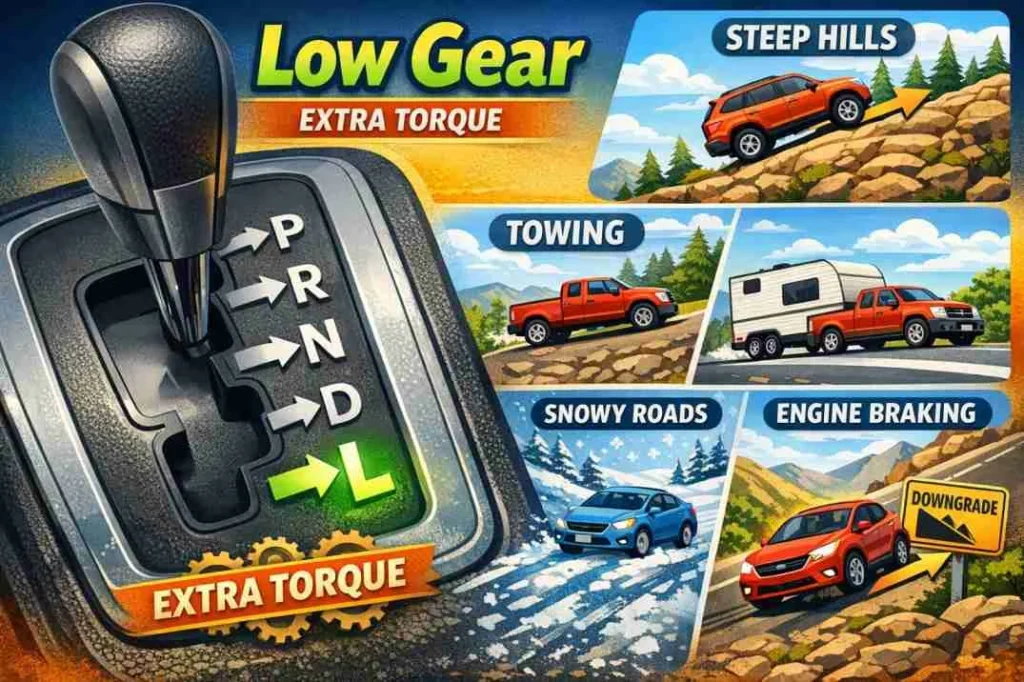
In a car, the L on the gear shift or dashboard typically stands for “Low Gear.”
Low gear is used when the driver needs extra torque for climbing hills, towing, or driving in slippery conditions. It keeps the engine running at higher RPMs while reducing the speed of the wheels, giving better control over the vehicle.
Understanding what the L means is essential for safe driving and optimal vehicle performance, whether you are new to driving, learning about automatic transmissions, or simply curious about car controls.
Every driver, whether experienced or new, notices letters on the gear shift of an automatic car. Most are familiar with P for Park, R for Reverse, N for Neutral, and D for Drive. But what about L?
The L can seem mysterious at first, yet it plays a critical role in vehicle control. Understanding its purpose ensures that drivers can handle steep hills, heavy loads, or challenging driving conditions safely.
By the end, you will have a clear understanding of L gear and feel confident about using it properly.
What Does L Mean in a Car?
The L on a car’s gear shift stands for Low Gear. It is part of the automatic transmission system and allows the vehicle to operate at lower speeds with higher engine power.
In low gear, the car’s engine runs at higher revolutions per minute (RPM) while the transmission reduces wheel speed. This gives the car:
- More torque: Helps the car climb steep inclines or carry heavy loads.
- Better control: Reduces the risk of skidding when driving downhill or on slippery roads.
- Engine braking: Helps slow the car without overusing the brakes.
Unlike Drive (D), which allows the car to shift through all gears automatically, L keeps the car in one or two low gears, making it ideal for specific driving situations.
How L Differs From Other Gears
Understanding how L compares to other gears helps drivers know when to use it. Here’s a simple comparison:
| Gear | Meaning | When to Use | Engine Behavior |
|---|---|---|---|
| P | Park | When the car is stationary | Locks the transmission |
| R | Reverse | Moving backward | Engages reverse gear |
| N | Neutral | Car rolls freely | Disengages engine from wheels |
| D | Drive | Normal driving | Automatically shifts through gears |
| L | Low | Steep hills, towing, slippery roads | Keeps engine in low gear for torque and control |
As the table shows, L is different from Drive because it prevents the transmission from shifting to higher gears. This gives the driver more power and control, especially in situations where D would allow the car to shift automatically, potentially causing loss of traction or speed control.
When to Use L Gear
There are several scenarios where low gear is particularly useful:
1. Driving Uphill
When climbing steep hills, low gear prevents the engine from struggling. The car can maintain speed without overworking the engine, providing steady acceleration.
2. Driving Downhill
When descending steep slopes, low gear provides engine braking, which reduces wear on the brakes and prevents overheating. It helps the driver control the vehicle without riding the brakes constantly.
3. Towing or Hauling Heavy Loads
Low gear helps generate extra torque, making it easier to pull trailers, boats, or other heavy loads. Using L gear ensures that the engine produces enough power while the wheels move at a safe speed.
4. Driving on Slippery Roads
On snow, ice, or mud, low gear allows for better traction and prevents the wheels from spinning too quickly. It keeps the car moving safely and reduces the chances of skidding.
Example Scenarios
Here are some real-life examples of using L gear:
Example 1: Climbing a Mountain Road
A driver approaches a steep incline. Shifting to L ensures the car climbs smoothly without straining the engine. The speed remains moderate while torque increases.
Example 2: Descending a Hill Safely
Driving downhill on a long slope, the driver shifts to L. The car slows naturally due to engine braking, reducing the need to press the brakes continuously.
Example 3: Towing a Trailer
When towing a trailer uphill, using L gear keeps the car from downshifting repeatedly, ensuring the engine delivers enough power to pull the load steadily.
Example 4: Snowy Conditions
On a snowy road, L gear helps maintain traction and prevents the car from sliding, allowing the driver to maintain control at low speeds.
Common Misconceptions About L Gear
Many drivers misunderstand the purpose of L gear. Some common misconceptions include:
- Misconception 1: L means the car will go faster
In reality, L keeps the car in a low gear, which reduces speed but increases torque. It is not designed for speed but for control and power. - Misconception 2: L is only for manual cars
L gear is specifically for automatic transmissions, although manual cars have similar low gear options. - Misconception 3: L should be used all the time
Using L in normal driving conditions is unnecessary and can reduce fuel efficiency. It is intended for specific situations like hills, towing, or slippery roads. - Misconception 4: L replaces brakes when stopping
While L helps with engine braking, it does not replace brakes. The driver still needs to brake when approaching obstacles or stopping.
L Gear and Automatic vs Manual Transmissions
In automatic cars, L is part of the gear shift as a special low gear option. Manual cars have a different system where drivers can select lower gears manually using the clutch and gear stick.
The principle is similar: keeping the engine in a lower gear increases torque and control, especially on inclines or declines. Automatic cars simply make it easier to switch into low gear without manually operating a clutch.
Benefits of Using L Gear
Using L gear appropriately has several benefits:
- Enhanced Control – Helps maintain speed and prevents wheel spin.
- Safer Descents – Engine braking reduces reliance on brakes.
- Better Performance Under Load – Improves towing and climbing ability.
- Reduced Engine Strain – Keeps the engine running at optimal RPM for power.
- Improved Traction – On slippery surfaces, low gear keeps wheels moving steadily.
Tips for Using L Gear
- Use L for short distances and specific conditions, not for everyday driving.
- Combine L with careful braking and attention to road conditions.
- Avoid excessive speed in low gear to prevent engine strain.
- Remember that L is ideal for engine braking, not for stopping completely.
- Check your car’s owner manual for manufacturer recommendations, as some vehicles have different L gear capabilities.
Examples of Sentences Using L in Cars
| Sentence | Context |
|---|---|
| Shift to L when climbing a steep hill | Driving advice |
| Use L gear for engine braking on long descents | Safety guidance |
| The truck performed better towing the trailer in L | Towing example |
| Low gear helps maintain traction on icy roads | Winter driving advice |
| Avoid using L gear on flat roads for fuel efficiency | General driving tip |
FAQs
What does L mean in a car?
It stands for Low Gear, which keeps the car in lower gears for more power and control.
When should I use L in my car?
Use it for climbing hills, descending steep roads, towing heavy loads, or driving on slippery surfaces.
Can I use L gear for normal driving?
No, using L for everyday driving can reduce fuel efficiency and increase engine wear.
Does L replace brakes?
No, L assists with engine braking but does not replace your car’s brakes.
Is L the same as first gear in a manual car?
It is similar in principle, keeping the car in a low gear for torque and control.
Will L damage my car?
Using L incorrectly or for extended periods on flat roads can increase engine strain, but proper use is safe.
Do all automatic cars have L gear?
Most do, but the labeling may vary, sometimes shown as 1 or 2 for first and second low gears.
Does L improve safety?
Yes, it provides better control in hills, towing, and slippery conditions, enhancing driving safety.
Conclusion
The L on a car gear shift stands for Low Gear, a feature that enhances driving control, engine performance, and safety in specific conditions. From climbing steep hills to descending slopes and towing heavy loads, L gear is a useful tool that every driver should understand.
Knowing when and how to use L gear can improve driving confidence, reduce brake wear, and help maintain traction in challenging conditions. While it is not necessary for everyday driving on flat roads, it becomes invaluable in mountainous regions, snowy roads, or when towing.
Understanding L gear is part of understanding your vehicle, ensuring both safety and performance on the road. Proper knowledge allows drivers to take full advantage of their car’s transmission features, making every journey smoother, safer, and more controlled.
Read More Related Articles:
- DTD Mean in Fantasy Basketball: Impact and Strategy Tips In 2026
- What Does Texture Mean in Music: Guide for Music Lovers In 2026
- C and H Mean in a Car: And What It Means for Your Engine In 2026

Neon Samuel is a digital content creator at TextSprout.com, dedicated to decoding modern words, slang, and expressions. His writing helps readers quickly grasp meanings and understand how terms are used in real conversations across text and social platforms.