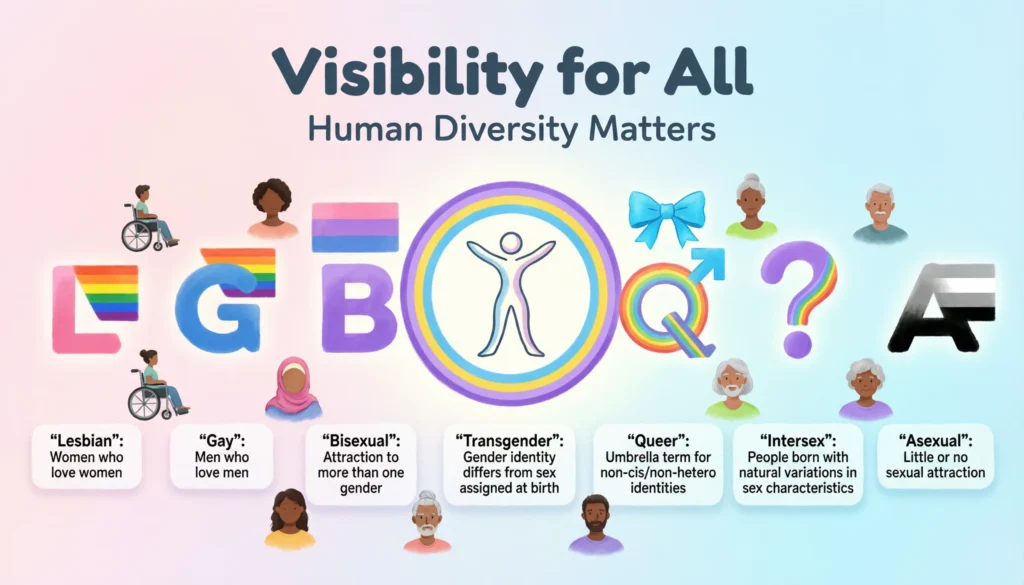
The “I” in LGBTQIA stands for Intersex.
Intersex refers to people who are born with biological characteristics such as chromosomes, hormones, or reproductive anatomy that do not fit typical definitions of male or female. Being intersex is about natural variation in human biology and is not the same as a person’s gender identity or sexual orientation.
In simple terms, intersex individuals may have physical traits that are a mix of traditional male and female characteristics, and their inclusion in LGBTQIA recognizes their place in the broader queer community.
The acronym LGBTQIA has become increasingly common in discussions about sexuality, gender identity, and human rights. You might know the first few letters—L for lesbian, G for gay, B for bisexual, T for transgender, and Q for queer or questioning—but what about the “I” and “A”?
Many people are curious about the “I” in LGBTQIA, as it is less visible in mainstream discussions. Understanding what intersex means, how it differs from gender identity, and why it is included in LGBTQIA is crucial for fostering awareness, inclusivity, and respect.
Intersex individuals face unique challenges, including medical interventions, social stigma, and misrepresentation. Yet their voices are increasingly recognized within the LGBTQIA community, highlighting the diversity of human experiences beyond traditional male and female classifications.
What Does the “I” Stand For?
In LGBTQIA, the “I” represents Intersex.
Intersex is a term that encompasses a wide range of natural biological variations. These variations may involve:
- Chromosomes: People may have combinations other than XX (female) or XY (male), such as XXY or X0.
- Hormonal differences: Levels of sex hormones might differ from what is typically expected for male or female bodies.
- Reproductive or genital anatomy: This can include ambiguous genitalia, internal reproductive organs not matching outward appearance, or other variations.
It is important to note that intersex is about biology, not a person’s sexual orientation or gender identity. An intersex person may identify as male, female, non-binary, or any other gender.
Brief History of Intersex Awareness
Intersex awareness has grown significantly over the past few decades:
- Ancient references: Historical texts in many cultures mentioned people with ambiguous sexual characteristics. However, they were often misunderstood or stigmatized.
- 20th century medicalization: Many intersex individuals underwent surgeries in infancy to “normalize” their bodies. These procedures were often non-consensual and led to lifelong consequences.
- Advocacy and human rights movement: From the late 20th century onwards, intersex activists began advocating for bodily autonomy, informed consent, and legal recognition.
Today, including the “I” in LGBTQIA ensures that intersex people are visible and acknowledged as part of the community, even though their experiences differ from sexual orientation or gender identity.
Intersex vs. Gender Identity
It is common to confuse intersex with transgender or non-binary identities, but they are distinct:
| Term | Meaning | Relation to “I” in LGBTQIA |
|---|---|---|
| Intersex | Biological variation in sex characteristics | The “I” |
| Transgender | Gender identity differs from assigned sex at birth | The “T” |
| Non-binary | Gender outside the male-female binary | Part of broader LGBTQIA recognition |
Key takeaway: Intersex refers to physical traits, while transgender or non-binary identities refer to gender identity. An intersex person may or may not be transgender or non-binary.
Real-Life Examples of Intersex Individuals
- Caster Semenya – South African Olympic athlete known for her exceptional running ability. She was subjected to scrutiny over her naturally high testosterone levels, illustrating social and legal challenges faced by intersex people.
- Hanne Gaby Odiele – Belgian model who publicly shared her experience as an intersex person, advocating for bodily autonomy and human rights.
- Pidgeon Pagonis – American activist working on intersex human rights and raising awareness about non-consensual surgeries.
These examples show that intersex people exist across all walks of life and have contributed to sports, fashion, advocacy, and culture.
Challenges Faced by Intersex Individuals
Despite growing awareness, intersex people continue to face challenges:
- Medical interventions: Surgeries to “normalize” genitalia often occur without informed consent.
- Social stigma: Many intersex people are subject to bullying, secrecy, or marginalization.
- Legal recognition: Birth certificates and legal documents often require binary male/female classifications.
- Limited awareness: Lack of public knowledge can lead to misconceptions and discrimination.
Recognizing the “I” in LGBTQIA is a step toward addressing these challenges.
Why Intersex Is Part of LGBTQIA
The LGBTQIA acronym is about inclusivity of all sexual orientations, gender identities, and bodily variations. Including intersex individuals highlights:
- Visibility for biological diversity
- Advocacy for human rights
- Awareness of medical ethics and bodily autonomy
- Solidarity with broader queer communities
By being part of LGBTQIA, intersex people are acknowledged as an integral part of the spectrum of human diversity.
Differences Between Intersex, Transgender, and Queer
To better understand the term, here’s a comparison:
| Term | Focus | Example |
|---|---|---|
| Intersex | Biological sex traits | Chromosomes, hormones, reproductive organs |
| Transgender | Gender identity | A person assigned male at birth identifies as female |
| Queer | Sexual orientation or gender identity outside heteronormative norms | Non-binary, gay, pansexual |
While these terms overlap in activism and social recognition, each addresses a different aspect of identity or biology.
How Society Can Support Intersex People
- Respect bodily autonomy: Avoid unnecessary surgeries on infants without consent.
- Use inclusive language: Ask for pronouns and respect intersex identities.
- Educate communities: Include intersex topics in school and health education.
- Advocate for legal recognition: Allow non-binary or intersex options on documents.
- Support organizations: Groups like Intersex Human Rights Australia or InterACT work to protect intersex rights.
Common Misconceptions About Intersex
- Misconception 1: Intersex people are always transgender.
Fact: Intersex is about biology, not gender identity. - Misconception 2: Intersex is extremely rare.
Fact: Estimates suggest 1 in 1,500 to 1 in 2,000 births involve noticeable intersex traits, but broader variations are more common. - Misconception 3: Intersex individuals require surgery.
Fact: Many intersex people live healthy lives without medical interventions. - Misconception 4: Intersex is a sexual orientation.
Fact: Intersex refers to biology, not who someone is attracted to.
Example Table: Intersex Variations
| Type | Description | Notes |
|---|---|---|
| Chromosomal | Variations like XXY, X0, or mosaic patterns | Affect genetics, may influence hormone levels |
| Hormonal | Differences in estrogen/testosterone balance | May impact secondary sexual characteristics |
| Anatomical | Genital or internal reproductive organ variations | Can be visible at birth or during puberty |
| Combined | Individuals may have multiple intersex traits | Requires careful medical and social support |
Tone and Context in LGBTQIA Discussions
When discussing intersex, tone is important:
- Professional/educational: “Intersex individuals have unique medical and social considerations.”
- Friendly/supportive: “Including the ‘I’ in LGBTQIA helps everyone feel seen.”
- Activist tone: “Intersex rights are human rights—no one should face non-consensual surgery.”
The emphasis should always be respect, accuracy, and inclusivity.
Alternate Meanings of “I” in Other Contexts
While the “I” in LGBTQIA stands for intersex, it can occasionally represent:
- Inclusive – highlighting general inclusivity of marginalized identities.
- Identity – emphasizing personal self-identification.
However, in standard usage, intersex remains the primary meaning.
FAQs
What does the “I” mean in LGBTQIA?
It stands for Intersex, describing individuals with biological sex characteristics that don’t fit typical male or female classifications.
Is being intersex the same as being transgender?
No. Intersex refers to biological traits, while transgender refers to gender identity.
Are intersex people rare?
Visible intersex traits are estimated at about 1 in 1,500–2,000 births, but broader variations are more common.
Do all intersex individuals undergo surgery?
No. Some may receive medical interventions, but many live healthy lives without them.
Can intersex people identify with any gender?
Yes. Intersex individuals may identify as male, female, non-binary, or any other gender.
Why is intersex included in LGBTQIA?
To promote visibility, awareness, and human rights for people with diverse biological traits.
Is intersex a sexual orientation?
No. Intersex is about biological sex characteristics, not sexual attraction.
How can I support intersex people?
Use inclusive language, respect bodily autonomy, educate yourself, and support intersex advocacy organizations.
Conclusion
The “I” in LGBTQIA represents intersex, a vital part of human diversity. Recognizing intersex individuals in the LGBTQIA community is more than symbolic—it is a step toward visibility, inclusion, and human rights.
Intersex people face unique challenges, from medical interventions to social stigma, but advocacy, awareness, and education are making progress. By learning what intersex means, respecting intersex experiences, and supporting inclusive policies, we create a society where all bodies and identities are valued.
Understanding the full LGBTQIA acronym, including the “I,” helps foster a culture of respect, inclusivity, and empathy for everyone, regardless of their biology, gender, or sexual orientation.
Read More Related Articles:
- True Meaning of “Quiero” in Spanish and How It’s Used In 2026
- “Of” Mean When Someone Texts It: Detailed Explanation in 2026
- Low MCHC Mean: Understanding Your Blood Test Results In 2026

Ivy Madison is a content creator at TextSprout.com, specializing in word definitions, internet slang, acronyms, and text abbreviations. She delivers clear and engaging explanations, helping readers quickly understand modern digital language and trending terms.