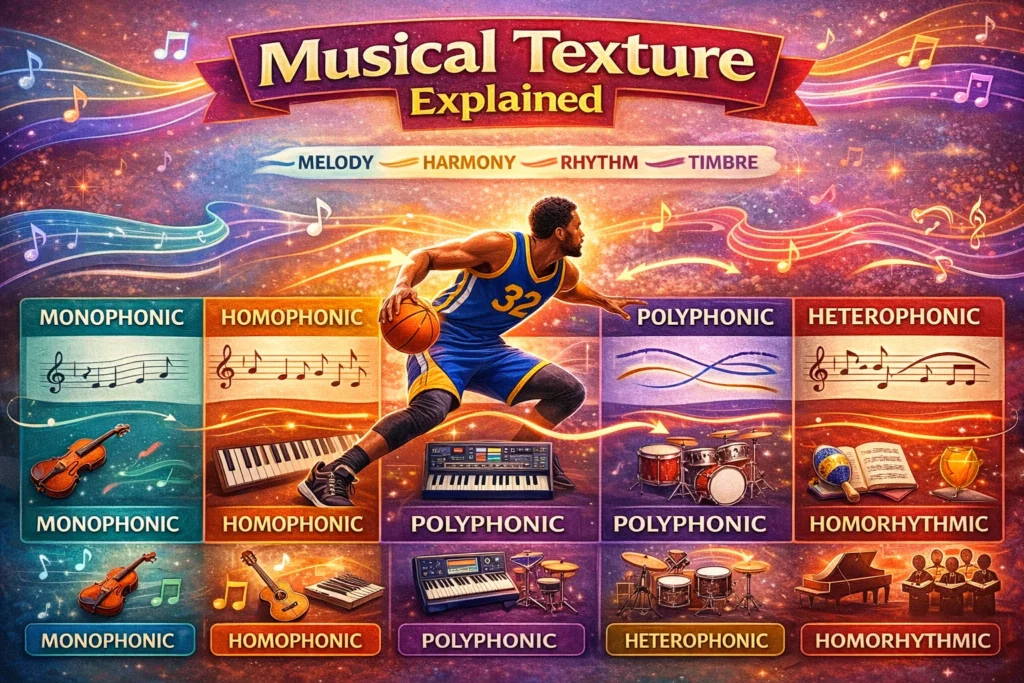
In music, texture refers to the way multiple musical elements such as melody, harmony, rhythm, and timbre interact in a composition. It describes how thick or thin the music feels, whether it is simple and transparent or rich and complex. Texture shapes the overall character and emotional impact of a piece, guiding how listeners experience sound.
Music is much more than just notes on a page or beats in a rhythm. The way these elements are layered and interact, what we call texture, can completely change the way a song feels. For example, imagine a solo violin performing a soft melody compared to a full orchestra playing the same tune. The melody itself is the same, but the listener experiences it differently because of the texture. 🎻🎺
Why Texture Matters
Texture influences the emotion and mood of music. Thick textures often feel dramatic, lush, or intense while thin textures feel light, clear, and intimate. Understanding texture also helps musicians maintain clarity and focus by emphasizing the main melody or important harmonic lines.
Texture plays a major role in identifying genre and style. Pop music often features a clear vocal melody over instrumental accompaniment. Classical compositions frequently embrace polyphonic textures where multiple melodies intertwine. Folk music may use heterophony, which is subtle variations of the same melody played simultaneously.
Composers and arrangers use texture intentionally to create contrast, suspense, or emphasis within a piece. In everyday listening, texture affects the experience even if the audience is not aware of it. In jazz, multiple instruments might improvise together, forming a complex polyphonic texture. Film scores often manipulate texture to guide the emotional response of viewers.
Texture also interacts with other musical elements such as harmony, rhythm, timbre, and dynamics, creating a multidimensional listening experience. By understanding musical texture, listeners can notice subtle details such as the layering of a cello beneath a flute or the rhythmic interplay between drums and piano. This transforms music from a simple sequence of notes into a rich and immersive experience.
Origin of the Term “Texture” in Music
The term texture comes from the Latin textura, meaning “woven fabric.” Just like threads interlace to form cloth, musical lines are interwoven to create a unified sound.
Historical Evolution:
- Medieval & Renaissance (500–1600):
Early music focused on monophony, a single melody without accompaniment, or simple polyphony, where multiple melodic lines were combined. - Baroque Era (1600–1750):
Composers like Bach and Vivaldi expanded polyphonic textures using counterpoint and complex layering. - Classical Era (1750–1820):
Homophonic texture became dominant: a clear melody supported by chords, emphasizing clarity and balance. - Romantic & Modern (1820–Present):
Music embraced dense, expressive textures, including orchestral layering, electronic effects, and multi-layered pop productions.
Usage of Texture in Music
Texture is a practical tool for analyzing, composing, and performing music. It informs:
- How performers emphasize the main melody
- How arrangers balance instruments in orchestras or bands
- How composers evoke mood, tension, or intimacy
Real-World Examples:
- Solo guitar or piano: thin texture → clear, intimate sound
- Orchestra tutti: thick texture → rich, immersive sound
- Electronic music layers: texture is often manipulated digitally for depth and space
Types of Musical Texture
Musical texture can be categorized into several types, each creating a distinct auditory experience.
| Texture Type | Description | Example | Typical Genres |
|---|---|---|---|
| Monophonic | Single melodic line, no harmony or accompaniment | Gregorian chant | Classical, Folk |
| Homophonic | Melody with supporting chords or accompaniment | Adele – Hello | Pop, Classical |
| Polyphonic | Two or more independent melodies played simultaneously | Bach – Fugue in C Major | Classical, Jazz |
| Heterophonic | Simultaneous variations of the same melody | Traditional Irish tunes | Folk, World Music |
| Homorhythmic | All parts move together rhythmically | Chorales, Hymns | Classical, Gospel |
Additional Notes:
- A piece may combine textures (polyphonic sections followed by homophonic choruses).
- Texture contributes to the song’s mood, tension, and clarity.
Advanced Examples of Musical Texture
Here are examples across different contexts and genres:
| Context | Texture Type | Explanation | Example |
|---|---|---|---|
| Friendly/Light | Monophonic | Simple, clear melody; easy to follow | Ukulele strumming with vocal line |
| Neutral | Homophonic | Melody dominates, supported by harmony | Classical piano sonatas |
| Complex | Polyphonic | Multiple independent lines create intricate layering | Bach fugues, Jazz improvisation |
| Cultural/Folk | Heterophonic | Multiple performers play variations of the same tune | Middle Eastern ensemble music |
| Dramatic/Intense | Thick Polyphony | Dense textures create tension and emotion | Film scores by Hans Zimmer |
Comparison With Related Musical Terms
It’s crucial to understand texture in relation to other musical elements:
| Term | Definition | Relation to Texture | Example |
|---|---|---|---|
| Timbre | Tone color of an instrument or voice | Texture describes layering; timbre describes color of each layer | Violin vs. flute sound |
| Harmony | Chord progression supporting a melody | Homophonic texture uses harmony; texture is overall structure | C major chord progression supporting melody |
| Rhythm | Timing and beat patterns | Texture includes how rhythms of different voices interact | Polyrhythms in African drumming |
| Dynamics | Loudness or softness | Texture can be thick or thin regardless of volume | Forte orchestra vs. piano solo |
Expanded Practical Examples Table
| Genre | Typical Texture | Detailed Explanation | Example |
|---|---|---|---|
| Classical | Polyphonic | Interweaving multiple melodies to create depth | Bach – Art of Fugue |
| Pop | Homophonic | Vocal melody highlighted, instruments provide harmonic support | Taylor Swift – Love Story |
| Jazz | Polyphonic & Improvisation | Independent lines with improvisation layered over rhythm section | Miles Davis – So What |
| Folk | Monophonic / Heterophonic | Single melody or variations played simultaneously | Traditional Irish reels |
| Film Score | Variable | Uses thin textures for suspense, thick for climactic moments | Inception by Hans Zimmer |
| Electronic | Layered | Multiple synth and vocal tracks combined digitally | Ignorant Punk – Get Lucky |
Alternate Meanings of Texture
Outside music, texture can refer to:
- Physical surfaces: Rough or smooth fabric, food texture
- Visual texture: Patterns and brush strokes in art
- Metaphorical use: “Textured writing” or “textured personality”
In professional settings, clarify musical texture to avoid confusion.
Polite and Professional Alternatives
When discussing texture in a classroom or professional context, consider using:
- Musical layering – Focus on how multiple voices or instruments interact
- Textural density – Describes thickness or richness
- Voicing – Arrangement of melodic and harmonic lines
- Instrumentation – Refers to choice of instruments creating texture
These terms make your analysis precise and constructive.
In-Depth Texture Examples Across Genres
| Genre | Texture Examples | Notable Features | Listening Tip |
|---|---|---|---|
| Classical | Beethoven’s Symphony No. 5 | Thick orchestral texture; dynamic layering | Focus on how strings and winds interact |
| Pop | Billie Eilish – Bad Guy | Sparse verses, denser chorus texture | Listen to how bass and vocals create contrast |
| Jazz | Duke Ellington – Take the A Train | Polyphonic improvisation | Notice independent melody lines in instruments |
| Folk | Appalachian ballads | Heterophonic with slight variations | Observe differences between instruments |
| Film Score | John Williams – Star Wars | Varying textures for tension and excitement | Listen to solo instrument vs full orchestra sections |
How to Analyze Texture in a Song
- Identify the melody: Who is carrying it?
- Observe harmony: Are there chords or supporting lines?
- Count layers: How many instruments or voices are interacting?
- Note rhythmic interactions: Are parts moving together or independently?
- Assess density: Is the texture thin (transparent) or thick (dense)?
FAQs
What is texture in music?
Texture describes how multiple musical elements interact in a composition, shaping how thick or thin the music feels.
How many types of musical textures exist?
Common types are monophonic, homophonic, polyphonic, heterophonic, and homorhythmic. Some compositions combine multiple types.
Why is texture important in music?
Texture affects clarity, mood, emphasis, and emotional impact. It helps listeners understand the piece’s structure.
Can a song have more than one texture?
Yes, songs often shift textures within sections for contrast and emotional effect.
Is texture the same as harmony?
No. Harmony refers to chords, while texture describes how all musical lines interact overall.
How do I identify texture in a song?
Listen for the number of voices, how they interact, and whether the sound feels thin or dense.
Does texture affect mood in music?
Absolutely. Dense textures feel rich or dramatic, while thin textures feel light and intimate.
Are there texture examples in pop music?
Yes, pop typically uses homophonic textures, with a clear vocal melody supported by instruments.
Conclusion
Musical texture is a cornerstone of music theory, helping us understand how compositions are built and why they affect listeners emotionally. Recognizing texture:
- Enhances listening and appreciation
- Improves performance and arrangement
- Clarifies compositional structure
Tips for practical use:
- Listen actively to identify layers
- Compare textures across genres
- Notice how texture changes affect mood and clarity
By mastering musical texture, you gain a deeper understanding of both simple and complex musical works. 🎵
Read More Related Articles:
- ACV Mean in Insurance: What It Means for Your Insurance Claim In 2026
- Yielding Mean in Driving: What Drivers Need to Know In 2026
- “Allora” Mean in Italian: Translation and Everyday Use In 2026

Ivy Madison is a content creator at TextSprout.com, specializing in word definitions, internet slang, acronyms, and text abbreviations. She delivers clear and engaging explanations, helping readers quickly understand modern digital language and trending terms.