
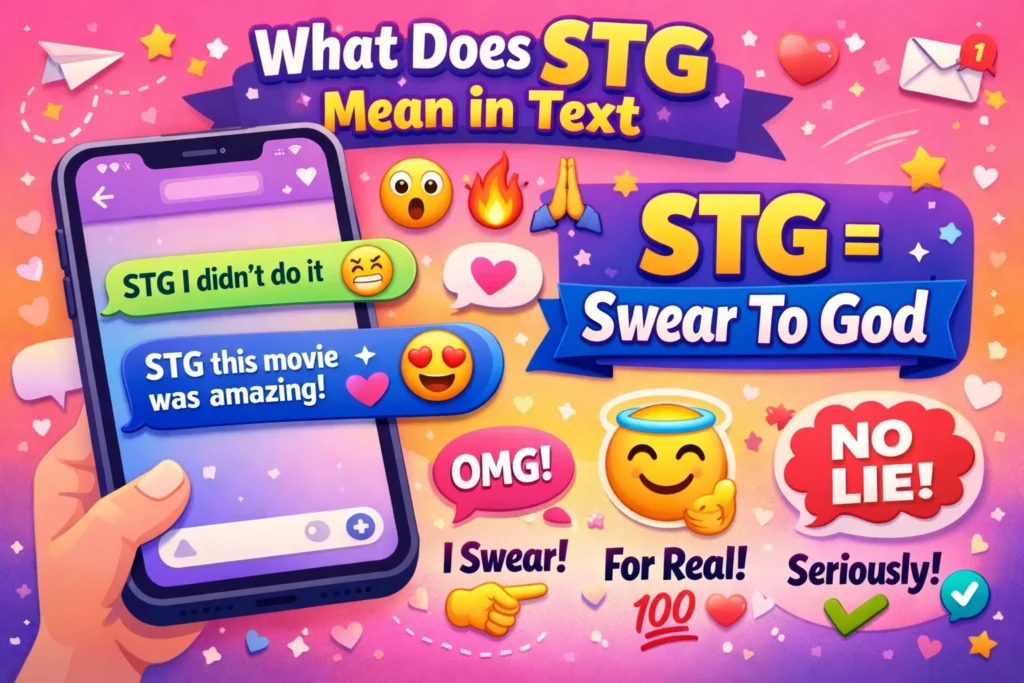
STG in texting means “Swear To God.” It is an abbreviation used to emphasize that someone is being honest, serious, or completely sincere about what they are saying.
For example,
A person might text, “STG I did not touch your phone.” In this case, STG signals that the sender wants the receiver to trust their words. It adds a sense of urgency, honesty, or emotional intensity to the statement.
Texting has changed the way people communicate. Conversations that once relied on full sentences now often include abbreviations, acronyms, and shorthand. This shift has made chatting faster and sometimes more expressive, but it can also create confusion. One abbreviation you may have come across is STG. If you have ever seen a text like “STG I didn’t do it” or “STG I am not kidding,” you might have wondered what it means, why people use it, and when it is appropriate.
Understanding texting slang is more than just decoding letters. It is also about understanding tone, context, and the subtle ways people convey emotion in written words. Knowing what STG means can help you better interpret conversations online, respond appropriately, and even use it yourself without misunderstandings.
What STG Means in Texting
In digital communication, STG is shorthand for a phrase that many people say in everyday life: “Swear to God.” People use it when they want to convince someone that they are telling the truth or expressing something seriously. It is common in casual texting, social media posts, direct messages, and online gaming chats.
Using STG in a message tells the recipient that the speaker is serious. It can indicate strong feelings, frustration, excitement, or humor, depending on the context. While the letters themselves are simple, the emotions behind them can vary widely.
For instance, a teenager might text “STG I am going to pass this exam” to show confidence and determination, while a friend might say “STG this homework is impossible” to express frustration. In both cases, STG emphasizes sincerity or intensity.
The Origin and Popularity of STG
The phrase “swear to God” has existed in spoken English for centuries. Historically, it was used in personal promises or to assert truthfulness in conversation. Saying it aloud added weight to one’s words and was a way of assuring honesty.
The abbreviation STG began appearing in text messaging and internet culture in the early 2000s. As people started texting more, especially on cell phones with small keyboards, abbreviations became popular for saving time and typing effort. STG was a natural shorthand for a commonly used phrase, and it quickly spread among teenagers, young adults, and online communities.
Social media platforms like Instagram, Snapchat, and TikTok helped increase its popularity. People often use STG in posts, comments, and captions to quickly convey strong emotions or emphasize honesty. Today, it is considered mainstream among younger generations, though adults may also use it in casual conversations.
How STG Is Used in Conversations
STG can convey different emotions depending on context. It can show sincerity, frustration, excitement, exaggeration, or humor. Reading the tone of the message is key to understanding how STG is being used.
Some common situations include:
- Expressing honesty: “STG I did not eat your snack”
- Showing seriousness: “I am quitting this game STG”
- Expressing frustration: “STG this app keeps crashing”
- Making a promise: “STG I will call you later”
- Adding dramatic effect: “STG I am done with this show”
The way STG is written, along with the surrounding words and emojis, helps readers interpret the intended emotion.
Examples of STG in Text Messages
Let’s look at examples in different tones to understand how STG is used in real life.
Friendly tone
“STG that concert was amazing! You have to come next time.”
Here, STG emphasizes excitement and enthusiasm.
Neutral tone
“STG I already sent the email earlier today.”
This usage signals honesty and confirms a fact.
Frustrated tone
“STG if the internet stops again I am going to lose it.”
The sender expresses annoyance or frustration using STG.
Playful tone
“STG if you beat my score again I am uninstalling this game.”
This is a joking exaggeration where STG adds a dramatic, playful effect.
Emotional tone
“STG I cannot believe she said that.”
In this case, STG adds emotional weight to the message.
These examples show how versatile STG can be, depending on context and tone.
STG Compared With Similar Text Slang
STG is not the only abbreviation used to indicate honesty or seriousness in texting. Understanding similar terms can help you follow digital conversations more easily.
| Slang Term | Meaning | Example Usage |
|---|---|---|
| STG | Swear To God | STG I did not touch it |
| ISTG | I Swear To God | ISTG this is the last time I tell you |
| FR | For Real | That was scary FR |
| ONG | On God | ONG I am telling the truth |
| TBH | To Be Honest | TBH I did not enjoy the movie |
STG and ISTG are particularly strong forms of emphasis, while FR and TBH are more casual ways of highlighting honesty. ONG is also used to convey sincerity, often with an added sense of seriousness.
Tone and Emotional Meaning of STG
Although the letters STG always stand for “Swear To God,” the emotion behind them can vary widely.
| Tone | Message Example | Meaning |
|---|---|---|
| Serious | STG I did not take your charger | Honest statement |
| Excited | STG that roller coaster was out of control | Expressing enthusiasm |
| Annoyed | STG this app is glitching again | Showing frustration |
| Dramatic | STG I cannot handle this drama | Exaggerated expression |
Understanding tone requires reading the context, punctuation, and any emojis used. For instance, “STG 😤 I am so done” conveys frustration more strongly than a plain “STG I am done.”
Polite and Professional Alternatives
While STG works well in casual texting, it is often inappropriate in professional settings or formal communication. Religious references and informal phrasing can be seen as unprofessional. In these contexts, consider using alternative ways to express sincerity.
| Informal Phrase | Professional Alternative |
|---|---|
| STG I did not do it | I assure you that I did not do it |
| STG this is correct | I confirm that this is correct |
| STG I will finish it | I promise I will complete it |
| STG that is true | I can guarantee that is accurate |
These alternatives are clear, polite, and suitable for workplace emails, official messages, or academic communication.
Alternate Meanings of STG
While “Swear To God” is by far the most common meaning in texting, STG can have other definitions in different contexts.
| Meaning | Context |
|---|---|
| Sterling | British currency abbreviation |
| Street | Used in addresses |
| Set Top Game | Rare abbreviation in gaming |
Despite these alternative meanings, casual texting almost always refers to “Swear To God.”
When You Should Avoid Using STG
Even though STG is popular and widely understood, there are times when it is better to avoid it.
Situations where STG may not be appropriate include:
- Professional or business emails
- Academic or scholarly writing
- Conversations with people who may take offense at religious references
- Situations where formal language is expected
In casual messaging among friends, family, or online peers, however, STG is widely accepted.
Creative Examples and Scenarios of STG
Here are some longer, real-life style examples to show STG in action.
Scenario 1: Casual Friend Chat
Anna: “STG I did not eat your ice cream.”
Brianna: “Are you serious?”
Anna: “STG! Check the freezer, it’s still there.”
This shows STG used to reassure a friend about honesty.
Scenario 2: Online Gaming
Player 1: “STG if you beat me one more time I am quitting this game.”
Player 2: “Haha, you said that last round too!”
Here, STG adds humor and exaggeration to the statement.
Scenario 3: Expressing Frustration
Jordan: “STG this Wi-Fi keeps disconnecting.”
Taylor: “Tell me about it. Mine just did the same thing!”
STG highlights the intensity of the speaker’s frustration in a relatable way.
Scenario 4: Showing Excitement
Emma: “STG this concert was the best night of my life!”
Maya: “I am so jealous, I wish I could have been there!”
The abbreviation conveys excitement and emotional engagement.
STG in Different Online Platforms
STG appears in various digital spaces and has slightly different uses depending on the platform.
- Snapchat: Often used in chats or story captions to emphasize honesty or emotion.
- TikTok: Appears in comments to stress reactions or agreement with a video.
- Instagram: Used in posts or direct messages for dramatic or humorous effect.
- Twitter/X: Used in tweets to emphasize statements or reactions to news.
- Discord: Seen in gaming or group chats for playful exaggeration.
Across platforms, the core meaning stays the same: “Swear To God,” used to convey honesty, seriousness, or emotion.
FAQs
What does STG mean in texting
STG means “Swear To God.” It is used to emphasize that the sender is serious or telling the truth.
What does STG mean on Snapchat
It means the same as in texting. People use it in stories, captions, or direct messages to show seriousness or emotion.
Is STG rude
Not necessarily. STG is informal and may be intense, but it is not inherently rude. Context matters.
What is the difference between STG and ISTG
STG stands for “Swear To God,” while ISTG stands for “I Swear To God.” Both emphasize honesty, but ISTG directly includes the speaker.
Is STG slang
Yes. It is internet and texting slang commonly used in casual conversation and online messaging.
Do adults use STG
Some adults use it casually, but it is most popular among teenagers and younger social media users.
Can STG be used jokingly
Yes. Many people exaggerate with STG for humor, drama, or playful emphasis.
How should I respond to STG
You can respond naturally based on context, such as “I believe you,” “Okay,” or follow up with a question.
Conclusion
STG is a common texting abbreviation for “Swear To God.” It is used to emphasize honesty, seriousness, or emotion in digital conversations. Its meaning remains the same across text messages, social media, and online chats, but the tone can vary widely, from playful to frustrated to excited.
While STG is suitable for informal settings, it is best avoided in professional or academic communication. Understanding this abbreviation and its uses helps you navigate modern conversations, respond appropriately, and even communicate your own emotions clearly.
Whether you encounter STG in a friend’s text, an Instagram comment, or a gaming chat, you now know what it means, how to interpret it, and when it is appropriate to use.
Read More Related Articles:
- What Is NSF in Banking? Non-Sufficient Funds Explained Simply (2026)
- Enmity Mean in the Bible: Powerful Biblical Word (2026)
- Fasting Meaning in the Bible: More Than Skipping Food (2026)

Ivy Madison is a content creator at TextSprout.com, specializing in word definitions, internet slang, acronyms, and text abbreviations. She delivers clear and engaging explanations, helping readers quickly understand modern digital language and trending terms.