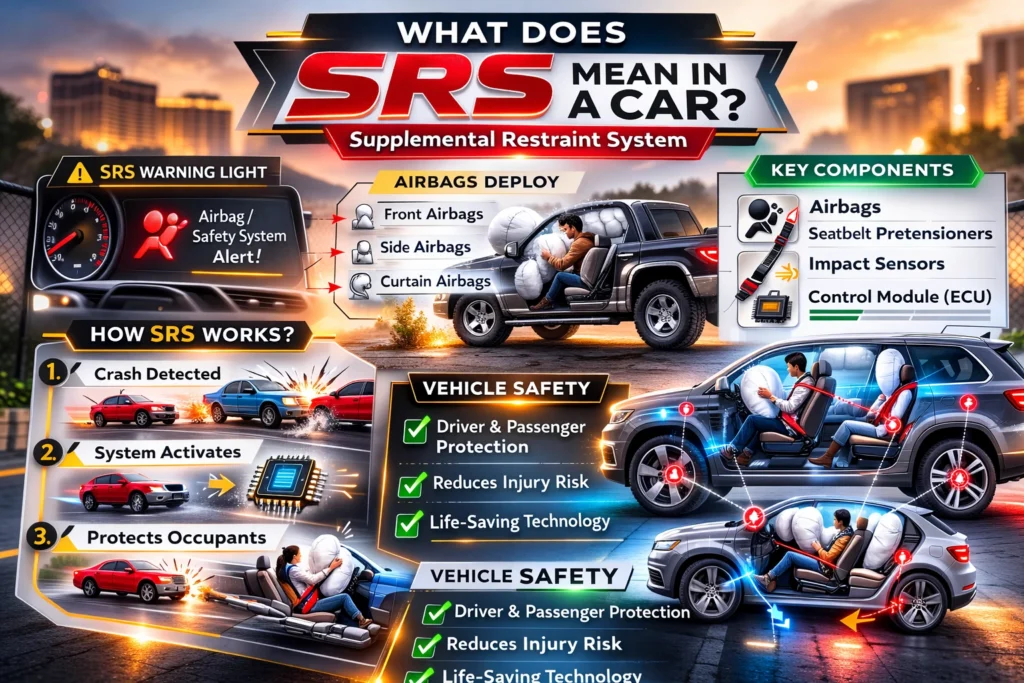
In automotive terms, SRS stands for Supplemental Restraint System.
It refers to a car safety feature designed to enhance protection during collisions, commonly including airbags, seatbelt pretensioners, and other safety components that work alongside regular seatbelts.
If you have ever seen the SRS warning light glow on your dashboard, you probably felt a quick moment of concern. You are not alone. Many drivers search for the answer to what does SRS mean in a car the moment that small red icon appears. In 2026, when vehicles are smarter and more safety focused than ever before, understanding SRS is no longer optional. It is essential for your protection and peace of mind.
SRS stands for Supplemental Restraint System, a critical safety feature designed to work alongside your seatbelts to protect you in the event of a collision. Modern cars rely on advanced sensors, airbag modules, and electronic control units to deploy airbags at precisely the right moment. When the SRS system functions correctly, it can significantly reduce the risk of serious injury. When the SRS light turns on, however, it signals that something in this life saving system may need attention.
In this guide, we will break down exactly what SRS means in a car, how it works, why it matters even more in 2026, and what you should do if the warning light appears.
Many drivers see the SRS warning light on their dashboard and wonder what it means. Understanding SRS helps ensure you know your car’s safety features and the steps to take if the system detects a fault.
Origin of the SRS System
The development of SRS in vehicles stems from the evolution of passive safety technology:
- Airbags: Introduced in the 1970s and became mainstream in the 1990s, airbags are central to the SRS system.
- Seatbelt Pretensioners: These devices tighten seatbelts automatically in a crash, reducing movement and improving protection.
- Supplemental Concept: SRS is called “supplemental” because it does not replace seatbelts; it enhances them.
Car manufacturers like Toyota, Honda, and Ford popularized SRS to meet safety standards worldwide.
How the SRS Works
The SRS system is designed to respond instantly in a crash, often within milliseconds. Its key components include:
- Airbags: Deploy to cushion the driver and passengers.
- Crash Sensors: Detect sudden deceleration or impact.
- Control Module: Determines when airbags and pretensioners should activate.
- Seatbelt Pretensioners: Tighten the seatbelt during a collision to minimize movement.
Friendly tip: The SRS light on your dashboard is a reminder that the system is active. If it stays on after starting the car, it could indicate a malfunction. 🚗⚠️
Common Uses and Significance
SRS is a critical safety feature in modern cars:
- Crash Protection: Reduces the severity of injuries in front and side collisions.
- Child Safety: Many SRS systems interact with child seats or include sensors to prevent airbag deployment when unsafe.
- Regulatory Compliance: Most countries require SRS systems to meet safety standards.
- Insurance: Vehicles with SRS can affect insurance rates because of enhanced safety.
Ignoring SRS warnings can put drivers at higher risk in an accident, so understanding the system is essential.
Examples of SRS in Action
| Scenario | SRS Component Involved | Outcome |
|---|---|---|
| Frontal collision | Front airbags | Cushioning driver and passenger |
| Side impact | Side airbags | Protects torso and head |
| Sudden deceleration | Seatbelt pretensioners | Reduces forward motion |
| Dashboard SRS light on | Control module / sensors | Indicates system check required |
Friendly tip: If the SRS warning light stays on, schedule a professional diagnostic check as soon as possible.
Real-World Observations
- Dashboard Lights: The SRS light usually appears as a small icon with a person and a circle (representing an airbag).
- Maintenance: SRS systems are self-monitoring, but wiring, sensors, or airbag modules may require repair over time.
- Vehicle Age: Older cars might have basic airbags, while newer cars include side-curtain airbags and advanced SRS features.
Ignoring SRS can have serious consequences, even in low-speed collisions.
Common Mistakes About SRS
- Believing it replaces seatbelts: SRS is supplemental, not a replacement. Always wear your seatbelt.
- Ignoring the warning light: A lit SRS light indicates a malfunction or system check is needed.
- DIY repairs: Airbag systems are high-voltage and sensitive; tampering can cause accidental deployment or failure.
- Not considering passenger safety: Children or small adults require awareness of airbag deployment zones.
Tips for Maintaining Your SRS
- Keep seatbelts in good condition.
- Schedule regular vehicle inspections for SRS sensors and modules.
- Ensure airbag recalls are addressed promptly.
- Avoid aftermarket modifications near airbags or sensors.
- Check dashboard warning lights each time you start your car.
Alternate Terms
While SRS is the most common term, similar terms include:
- Airbag System – Often used interchangeably but does not include seatbelt pretensioners.
- Supplemental Airbag System (SAS) – Some manufacturers use this label.
- Passive Restraint System – Older terminology for combined seatbelts and airbags.
Polite professional alternatives when explaining SRS:
- Vehicle safety system
- Crash protection system
- Occupant restraint system
Comparison With Related Safety Features
| Feature | Meaning | Difference from SRS |
|---|---|---|
| Seatbelt | Primary restraint | SRS supplements seatbelt, not replaces |
| ABS (Anti-lock Brakes) | Prevents wheel lock in braking | SRS is about crash protection |
| ESC (Electronic Stability Control) | Prevents skidding and rollover | Not part of crash cushioning |
| SAS / Airbag Only | Airbags without pretensioners | Partial SRS system |
Practical Examples Table
| SRS Component | Function | Real-World Scenario |
|---|---|---|
| Front Airbags | Cushion driver and passenger | Frontal collision |
| Side Airbags | Protect torso and head | Side impact |
| Seatbelt Pretensioners | Tighten seatbelts automatically | Sudden deceleration |
| Dashboard Warning Light | Indicates SRS status | Vehicle startup or system check |
| Knee Airbags | Reduce lower body injuries | Frontal collision |
FAQs
What does SRS mean on my dashboard?
It means Supplemental Restraint System and indicates the status of your car’s airbags and seatbelt pretensioners.
Do I still need to wear a seatbelt if my car has SRS?
Yes, SRS is supplemental. Seatbelts remain the primary protection.
What happens if the SRS light stays on?
It may indicate a malfunction. Have your car checked by a professional immediately.
How long do airbags last?
Most airbags are designed to last the life of the vehicle, but sensors and modules may require inspection over time.
Can I disable my SRS system?
It is not recommended, as it is illegal in many regions and unsafe.
Why did my SRS light come on after an accident?
After a collision, the system may need to be reset or components replaced.
Does SRS include side airbags?
Many modern SRS systems include side-curtain and knee airbags in addition to front airbags.
Are there differences in SRS across car brands?
Yes, some brands offer advanced SRS systems with sensors for occupants, collision type, and even pedestrian detection.
Conclusion
The SRS system is a vital safety component in every modern car. It works alongside seatbelts to provide enhanced protection during collisions, including airbags, pretensioners, and other safety mechanisms.
- SRS = Supplemental Restraint System, never replaces seatbelts.
- Always monitor the SRS warning light and address issues immediately.
- Modern SRS systems vary by manufacturer but all aim to protect occupants in a crash.
- Regular maintenance, inspections, and awareness of recalls ensure safety.
Understanding SRS improves your safety knowledge and helps you react appropriately if a warning light appears. 🚗💡
Read More Related Articles:
- MPG Mean in a Car: From City Driving to Highway Performance
- RPM Mean in a Car: Dashboard Gauge You Shouldn’t Ignore In 2026
- MRN Mean in Medical Terms: Medical Record Number Explained In 2026

Neon Samuel is a digital content creator at TextSprout.com, dedicated to decoding modern words, slang, and expressions. His writing helps readers quickly grasp meanings and understand how terms are used in real conversations across text and social platforms.