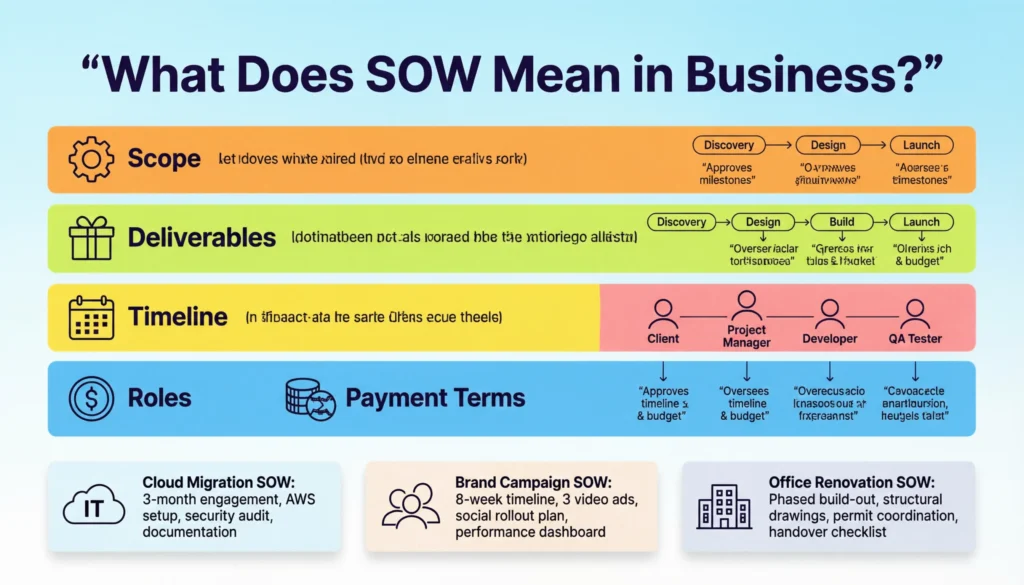
In business, SOW stands for Statement of Work.
It is a formal document that defines project-specific tasks, deliverables, timelines, responsibilities, and expectations between parties involved.
In the fast-paced world of business, acronyms are everywhere. One such acronym that frequently pops up in project management, procurement, and consulting is SOW. But what does SOW mean in business, and why is it important? Understanding this term can help professionals, managers, and stakeholders navigate contracts, projects, and service agreements with confidence.
A well-crafted SOW ensures clarity, minimizes misunderstandings, and sets measurable objectives. Whether you are hiring a vendor, outsourcing services, or managing a large project, knowing how to create and interpret a Statement of Work is essential.
Origin of the Statement of Work (SOW)
The concept of a Statement of Work has its roots in procurement and contract management. As businesses began outsourcing work and engaging consultants in the mid-20th century, there was a growing need to clearly define what exactly was expected.
- Purpose: Provide legal clarity and project scope.
- Adoption: Originally used by government contracts in the 1960s and 1970s. Today, it is widely used across industries, including IT, construction, consulting, and marketing.
- Popularity: Modern project management methodologies like PMBOK, Agile, and PRINCE2 often recommend SOWs to define project boundaries and responsibilities.
By documenting the work in detail, SOWs help businesses avoid scope creep, reduce disputes, and align expectations between clients and vendors.
Key Components of an SOW
A comprehensive Statement of Work typically includes multiple elements that define the project from start to finish.
1. Scope of Work
This section clearly defines the tasks, activities, and deliverables the vendor or team is responsible for.
Example:
- Design and develop a company website.
- Implement a marketing automation platform.
2. Deliverables
Specific outcomes expected at the end of the project.
Table: Deliverables Example
| Deliverable | Description | Deadline |
|---|---|---|
| Website Prototype | Initial wireframes and mockups | Week 2 |
| Final Website Launch | Fully functional live website | Week 6 |
| Marketing Plan | Complete automation workflow | Week 4 |
3. Timeline & Milestones
Outlines deadlines and milestones to track progress.
- Milestone 1: Kickoff meeting – Day 1
- Milestone 2: Prototype review – Day 14
- Milestone 3: Final delivery – Day 45
4. Roles and Responsibilities
Defines who does what to avoid confusion.
Example:
- Client provides branding assets and approvals.
- Vendor completes development, testing, and delivery.
5. Payment Terms
Specifies how and when payments will be made.
- 30% upfront
- 40% after prototype approval
- 30% upon final delivery
6. Acceptance Criteria
Defines what constitutes project completion and success.
Example:
- Website loads within 3 seconds.
- Marketing automation workflows send emails without errors.
7. Assumptions & Constraints
Details conditions that affect the project.
- Assumption: Client will provide timely feedback.
- Constraint: Project completion depends on third-party hosting approvals.
Why SOWs Are Important in Business
A well-defined SOW is more than just a formality; it is a critical tool for business success.
1. Clarity and Alignment
SOWs provide a clear roadmap for all parties, ensuring everyone knows their responsibilities and expectations.
2. Legal Protection
SOWs are often attached to contracts, protecting both the client and vendor in case of disputes.
3. Scope Management
By clearly defining deliverables, SOWs prevent scope creep, a common challenge in projects where tasks expand beyond the original agreement.
4. Performance Measurement
SOWs make it easier to track progress and measure whether the vendor or team has fulfilled their obligations.
5. Budget Control
By listing deliverables, timelines, and payment terms, SOWs help maintain financial discipline and avoid unexpected costs.
Examples of SOW in Business
IT Project Example
Project: Develop a mobile application for a fintech company.
SOW Highlights:
- Deliverables: iOS and Android app, API integration, security testing
- Timeline: 12 weeks with 3 milestones
- Roles: Vendor handles development; client handles branding
- Payment Terms: 40% upfront, 40% after beta release, 20% on final delivery
Marketing Example
Project: Launch a social media campaign for a new product.
SOW Highlights:
- Deliverables: 20 social media posts, influencer outreach, campaign analytics
- Timeline: 8 weeks
- Acceptance Criteria: 100k impressions, 10k engagement actions
Construction Example
Project: Build a warehouse for logistics company.
SOW Highlights:
- Deliverables: Completed building, functional storage systems
- Timeline: 6 months
- Roles: Contractor executes construction; client oversees approvals
Tip: A detailed SOW reduces the risk of disputes and ensures expectations are aligned before work begins.
SOW vs. Other Business Documents
It’s important to understand how SOW differs from similar documents:
| Document | Purpose | Difference from SOW |
|---|---|---|
| Contract | Legally binding agreement | SOW focuses on tasks and deliverables, often attached to a contract |
| MSA (Master Service Agreement) | Governs overall relationship | SOW defines specific project scope under MSA |
| Proposal | Suggests work to be done | SOW confirms agreed work after approval |
| Project Plan | Internal roadmap for team | SOW is formal and client-facing, legally referenced |
Understanding these differences helps in drafting, reviewing, and negotiating SOWs professionally.
How to Write an Effective SOW
Creating an effective Statement of Work requires attention to detail, clarity, and alignment with business goals. Here are steps to follow:
- Understand the Project: Know objectives, stakeholders, and deliverables.
- Define the Scope: Be clear about what is included and excluded.
- Identify Deliverables: Specify measurable and tangible outcomes.
- Set Timelines: Include milestones and deadlines.
- Clarify Roles: Ensure responsibilities are well defined.
- Include Acceptance Criteria: Establish what success looks like.
- Review and Approve: Have all stakeholders approve before work begins.
Tip: Avoid vague terms like “assist” or “support.” Be precise with quantities, dates, and measurable outcomes.
Real-World Scenarios Where SOWs Are Crucial
Scenario 1: Outsourcing IT Services
A company hires a vendor for software development. Without a clear SOW, misunderstandings could arise about features, deadlines, and payment, potentially leading to disputes.
Scenario 2: Marketing Agency Campaign
A brand hires an agency for a campaign. A detailed SOW ensures the client knows exactly how many posts, ads, and reports they will receive.
Scenario 3: Construction Projects
A construction company receives an SOW for a warehouse. Clearly defined deliverables, milestones, and acceptance criteria prevent cost overruns and delays.
Common Mistakes to Avoid in an SOW
- Being too vague: Lack of detail can create misunderstandings.
- Omitting timelines: Deadlines help measure progress.
- Ignoring assumptions: Unstated assumptions may lead to disputes.
- No acceptance criteria: Ambiguous success measures cause disagreements.
- Not involving stakeholders: Everyone affected should review and approve.
Tip: Use clear, concise language and measurable metrics to avoid confusion.
Best Practices for Managing SOWs
- Keep it concise but detailed. Avoid unnecessary jargon.
- Include measurable metrics to define success.
- Attach MSAs or contracts for legal clarity.
- Review regularly and update if project scope changes.
- Ensure all stakeholders sign and agree on the document.
FAQs
1. What does SOW stand for in business?
SOW stands for Statement of Work, a formal document detailing project tasks, deliverables, timelines, and responsibilities.
2. Why is SOW important in project management?
It ensures clarity, prevents scope creep, sets expectations, and provides legal protection.
3. Is an SOW legally binding?
When attached to a contract, yes. It can serve as a reference in disputes.
4. How is SOW different from a contract?
A contract outlines legal obligations, while SOW specifies what work will be done and how.
5. Who writes an SOW?
Typically, project managers, vendors, or consultants draft the SOW, which is then reviewed by all stakeholders.
6. Can an SOW change once approved?
Yes, but changes require formal amendments or approvals to prevent misunderstandings.
7. How detailed should an SOW be?
It should be detailed enough to clearly define responsibilities, deliverables, timelines, and success metrics.
8. Are SOWs used only in IT or consulting?
No, they are used across industries including construction, marketing, logistics, and government projects.
Conclusion
A Statement of Work (SOW) is much more than a formal document; it is a roadmap, a legal safeguard, and a communication tool. By defining tasks, deliverables, timelines, and responsibilities clearly, SOWs help businesses run projects smoothly, avoid conflicts, and maintain professional accountability.
Key Takeaways:
- SOW is critical for clarity, scope control, and legal protection.
- Include scope, deliverables, timeline, roles, payment terms, and acceptance criteria.
- Use clear language, measurable metrics, and formal approval.
- SOWs are versatile, used across IT, marketing, construction, and consulting.
Mastering SOWs ensures projects stay on track, stakeholders stay informed, and businesses achieve their objectives efficiently.
Read More Related Articles:
- Coplanar Mean in Geometry: Simple Idea Behind Complex 3D Figures In 2026
- MK Meaning in Texting: Tone, and When to Use It (2026)
- PP Meaning in Text: Everything You Need to Know (2026)

Luna Hartley is a content creator at TextSprout.com, where she specializes in explaining word meanings, modern phrases, and everyday language used in texts and online conversations. Her writing focuses on clarity and context, helping readers understand how words are actually used in real communication.