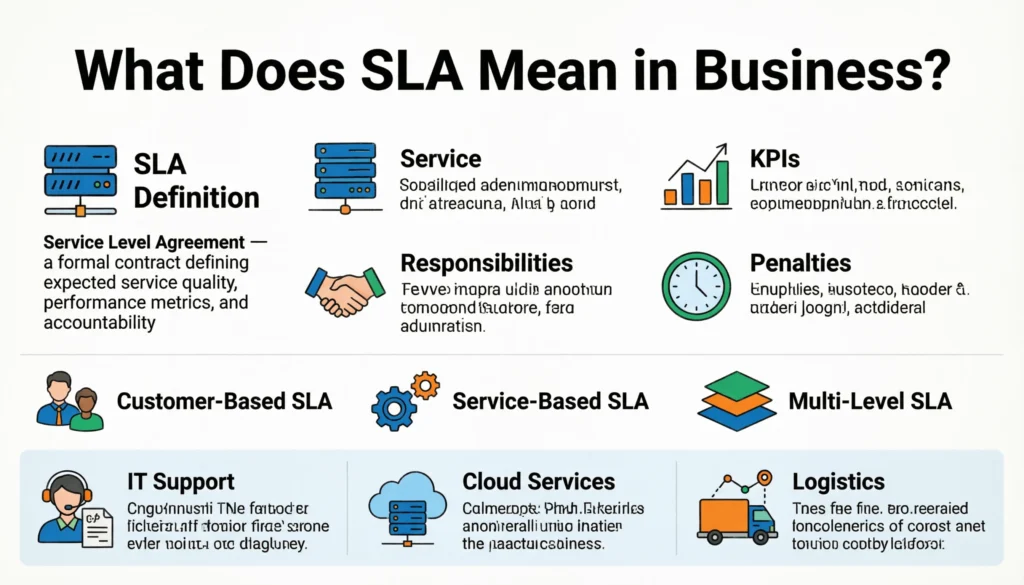
In business, SLA stands for Service Level Agreement. It is a formal contract or agreement between a service provider and a client that defines the expected level of service, performance metrics, responsibilities, and consequences if the agreed standards are not met.
In today’s competitive business environment, delivering consistent and reliable service is not just important, it is essential. Companies rely on external vendors, IT providers, logistics partners, and customer support teams to keep operations running smoothly. But how do businesses ensure that services meet expectations every time? That is where an SLA comes into play.
SLA stands for Service Level Agreement. In business, it refers to a formal agreement between a service provider and a client that clearly defines the expected level of service. This includes performance standards, response times, responsibilities, and what happens if the agreed targets are not achieved. An SLA sets measurable benchmarks so both parties understand exactly what is being delivered.
Service Level Agreements are widely used in industries such as IT, cloud computing, telecommunications, customer support, and outsourcing. They help prevent misunderstandings, improve accountability, and protect business relationships. By outlining clear expectations and consequences, an SLA creates transparency and builds trust between service providers and their clients.
SLAs are essential in setting clear expectations, ensuring accountability, and fostering smooth business operations. Whether in IT services, customer support, logistics, or cloud computing, an SLA is the backbone of professional service relationships.
Origin of SLA in Business
The concept of SLAs originated with the rise of IT services and outsourcing in the 1980s. Businesses needed a formal way to measure and guarantee service quality from third-party providers.
- Early Usage: Originally used in IT and telecom sectors to define uptime guarantees and response times.
- Expansion Across Industries: Over time, SLAs were adopted in various sectors including finance, healthcare, customer service, and manufacturing.
- Modern Importance: With digital services, cloud computing, and remote outsourcing, SLAs are now crucial for business operations worldwide.
Fun Fact: The first documented SLA in IT focused on system uptime, guaranteeing 99.9% availability—a number still popular today.
Components of a Service Level Agreement
An SLA is more than just a contract; it is a detailed document that ensures mutual understanding between parties. Common components include:
1. Service Description
Defines what service is being provided.
- Example: Cloud storage service, IT support, or logistics delivery.
2. Performance Metrics
Specifies measurable standards:
- Uptime or availability (e.g., 99.9% system uptime)
- Response time (e.g., 2-hour response to support tickets)
- Resolution time (e.g., issues resolved within 24 hours)
3. Roles and Responsibilities
Clearly defines who does what:
- Provider responsibilities: Maintenance, updates, troubleshooting
- Client responsibilities: Reporting issues, timely communication
4. Monitoring and Reporting
Specifies how performance will be tracked:
- Tools and dashboards for uptime or ticket resolution
- Reporting intervals, e.g., monthly reports
5. Penalties and Remedies
Defines consequences if SLA standards are not met:
- Service credits
- Financial penalties
- Escalation procedures
6. Duration and Review
Specifies the agreement period and review cycle for performance metrics.
Types of SLAs
SLAs can vary depending on the business model, industry, or service type. Understanding the main types can help companies create the right agreement.
| SLA Type | Definition | Example |
|---|---|---|
| Customer-Based SLA | Covers services provided to a specific customer | IT support SLA for a single company |
| Service-Based SLA | Covers a specific service for all customers | Cloud storage service uptime SLA for all clients |
| Multi-Level SLA | Divides SLA into corporate, customer, and service levels | Telecom SLA for internal support, corporate clients, and premium clients |
1. Customer-Based SLA
Tailored to individual client needs.
- Example: A bank contracts a software company for a custom mobile app. The SLA might include faster response times for critical financial issues.
2. Service-Based SLA
Standardized for all clients using the same service.
- Example: A SaaS platform guaranteeing 99.9% uptime for all users.
3. Multi-Level SLA
Complex agreements that combine multiple layers:
- Corporate level: Overall business commitments
- Customer level: Individual client promises
- Service level: Technical specifications
Why SLAs Are Important in Business
SLAs are not just formalities; they are strategic tools that benefit both providers and clients.
For Service Providers
- Establish clear expectations
- Avoid disputes and misunderstandings
- Improve service quality and accountability
For Clients
- Ensure service reliability
- Have clear recourse if standards are not met
- Evaluate performance objectively
Example: A cloud hosting company promises 99.95% uptime. If they fail to meet it, the SLA may allow clients to claim service credits or refunds.
Real-World Application
- IT Services: Guarantees uptime, response times, and technical support.
- Customer Support: Guarantees ticket response and resolution times.
- Logistics: Ensures delivery times, shipment handling, and customer satisfaction.
- Healthcare: Guarantees timely access to critical services or systems.
Key Performance Indicators (KPIs) in SLAs
SLAs rely on measurable performance indicators to ensure transparency. Common KPIs include:
| KPI | Definition | Typical Target |
|---|---|---|
| Uptime | Time system/service is operational | 99.9% |
| Response Time | Time to respond to client request | 1–2 hours |
| Resolution Time | Time to resolve issue | 24 hours |
| First Call Resolution | Percentage of issues resolved in first contact | 80%+ |
| Customer Satisfaction | Client satisfaction score | ≥90% |
Tip: KPIs should be SMART – Specific, Measurable, Achievable, Relevant, Time-bound – to ensure clarity and enforceability.
Examples of SLA in Business Context
Here are some real-world examples of SLA agreements:
1: IT Support SLA
- Service: 24/7 IT helpdesk support
- Uptime: 99.9% server availability
- Response: Within 2 hours
- Resolution: Within 24 hours
- Penalty: Service credit for downtime exceeding agreed uptime
2: Cloud Computing SLA
- Service: Cloud hosting
- Availability: 99.95% uptime
- Backup: Daily backups with 24-hour recovery
- Monitoring: Real-time dashboards
- Penalty: Refunds or credits for downtime
3: Logistics SLA
- Service: Package delivery
- On-time delivery: 95% of shipments delivered within 3 days
- Customer support: Response within 12 hours
- Penalty: Refunds for late deliveries
Pro Tip: SLA examples vary greatly depending on service type, business size, and client expectations.
Comparison with Related Terms
SLAs are often confused with other business agreements. Here’s how they differ:
| Term | Definition | Difference from SLA |
|---|---|---|
| OLA (Operational Level Agreement) | Internal agreement within departments | Supports SLA internally, not client-facing |
| UC (Underpinning Contract) | Contract with third-party vendors | Supports SLA commitments indirectly |
| Contract | General business agreement | SLA is specific to service performance metrics |
| MOU (Memorandum of Understanding) | Non-binding agreement | SLA is legally binding |
Alternate Meanings of SLA
While SLA usually stands for Service Level Agreement, in some contexts it can have other meanings:
- Second Language Acquisition – in educational or linguistic contexts
- Stereolithography Apparatus – in 3D printing
Tip: In business and IT, SLA almost always refers to Service Level Agreements, so context matters.
Polite or Professional Alternatives to SLA
In formal communication, you can also use:
- Service Agreement
- Performance Agreement
- Operational Commitment
These alternatives may make documents or presentations more readable for non-technical audiences.
Best Practices for Creating SLAs
- Be clear and precise – avoid vague terms.
- Use measurable metrics – KPIs like uptime, resolution time, and response time.
- Define responsibilities – for both provider and client.
- Include penalties and remedies – financial or service credits.
- Review regularly – adjust SLA for evolving business needs.
- Communicate effectively – ensure clients understand terms.
- Ensure legal compliance – involve legal teams if necessary.
Example SLA Table
| SLA Component | Example |
|---|---|
| Service | 24/7 IT Support |
| Uptime | 99.9% |
| Response Time | 2 hours |
| Resolution Time | 24 hours |
| Reporting | Monthly performance report |
| Penalty | Service credit for downtime exceeding 0.1% |
| Review | Quarterly review with client |
Common Mistakes Businesses Make With SLAs
- Setting unrealistic KPIs
- Using ambiguous terms
- Failing to monitor or report performance
- Not defining penalties for unmet standards
- Ignoring client communication
Tip: A poorly defined SLA can damage client relationships, while a well-structured SLA builds trust and accountability.
FAQs
1. What does SLA mean in business?
SLA stands for Service Level Agreement, defining service expectations and standards between a provider and a client.
2. Why is an SLA important?
It ensures clarity, accountability, and measurable performance in business relationships.
3. What industries use SLAs?
IT, telecom, cloud services, logistics, healthcare, finance, and customer support commonly use SLAs.
4. What is the difference between SLA and OLA?
SLA is client-facing, while OLA is an internal agreement supporting the SLA.
5. Can SLA be legally binding?
Yes, most SLAs are legally enforceable if included in contracts.
6. What are common SLA metrics?
Uptime, response time, resolution time, first call resolution, and customer satisfaction.
7. How often should an SLA be reviewed?
Quarterly or annually, depending on service complexity and client needs.
8. Can SLAs include penalties?
Yes, common remedies include service credits, financial penalties, or refunds.
9. What happens if SLA targets are not met?
Providers are obligated to fulfill remedies defined in the agreement.
10. Are SLAs only for IT services?
No, they are used in various industries wherever service performance needs to be guaranteed.
Conclusion
A Service Level Agreement (SLA) is a cornerstone of professional business relationships. It ensures both parties understand service expectations, responsibilities, and consequences.
Key Takeaways:
- SLA = Service Level Agreement
- Defines metrics, roles, and penalties
- Ensures accountability and transparency
- Widely used in IT, logistics, finance, and customer service
- Can be customized or standardized depending on the business model
Practical Tips:
- Make SLAs measurable and realistic
- Communicate clearly with clients
- Review and update regularly
- Use professional alternatives when addressing non-technical audiences
Well-structured SLAs improve trust, satisfaction, and business efficiency, making them essential in modern professional operations.
Read More Related Articles:
- What Does Patent Mean in Medical Terms? Clinical Significance In 2026
- What Does Pick 6 Mean in Football? From Interception to Touchdown In 2026
- What Does SRS Mean in a Car: Why This Safety Feature Matters In 2026

Ivy Madison is a content creator at TextSprout.com, specializing in word definitions, internet slang, acronyms, and text abbreviations. She delivers clear and engaging explanations, helping readers quickly understand modern digital language and trending terms.