In mathematics, quantity refers to an amount or value that can be measured, counted, or expressed numerically. It represents how much or how many of something exists, whether it’s tangible like apples or abstract like distance or probability.
In mathematics, quantity refers to an amount, number, or measurement of something. It tells us how much or how many. Whether you are counting apples, measuring distance, or calculating money, you are working with quantities.
A quantity can be represented by numbers, variables, or expressions. For example, 10 books, 5.5 kilometers, or even x in an equation are all quantities. It may represent a fixed value or something that can change depending on the situation.
Understanding quantity is essential because it forms the foundation of arithmetic, algebra, and real world problem solving. Every calculation in math involves identifying, comparing, or manipulating quantities in some way.
From simple counting in early education to complex equations in advanced mathematics, quantity is a term we encounter every day. This article will explore its meaning, origins, applications, examples, and related terms to give you a comprehensive understanding of the concept.
Origin of the Term “Quantity” in Math
The word quantity comes from the Latin word quantitas, derived from quantus, meaning “how much.” Historically, it was used in philosophy and early scientific writing to describe amounts or extents of things.
In mathematics, the term gained prominence in the 16th and 17th centuries, especially with the rise of algebra and measurement theory. Scholars began distinguishing between quality (the type or nature of something) and quantity (how much of it there is), a distinction that remains critical today in math and science.
Key Points:
- Latin origin: quantitas = how much
- Contrasted with quality
- Adopted in math for measurable and countable concepts
Popularity and Real-World Usage
“Quantity” is not just a textbook term; it’s commonly used in everyday life. Whether shopping, cooking, budgeting, or even tracking your screen time, quantity helps us understand how much of something exists. In math, it allows us to assign numerical values to items, measure distances, compare amounts, or calculate probabilities.
Some real-world contexts include:
- Retail: “We need 50 units of this product.”
- Cooking: “Add 200 grams of sugar to the recipe.”
- Finance: “The portfolio has a quantity of 100 shares.”
- Science: “Measure the quantity of chemical in milliliters.”
Mathematically, this makes quantity an indispensable concept in algebra, arithmetic, geometry, calculus, and statistics.
Understanding Quantity in Math
In mathematics, quantities can be:
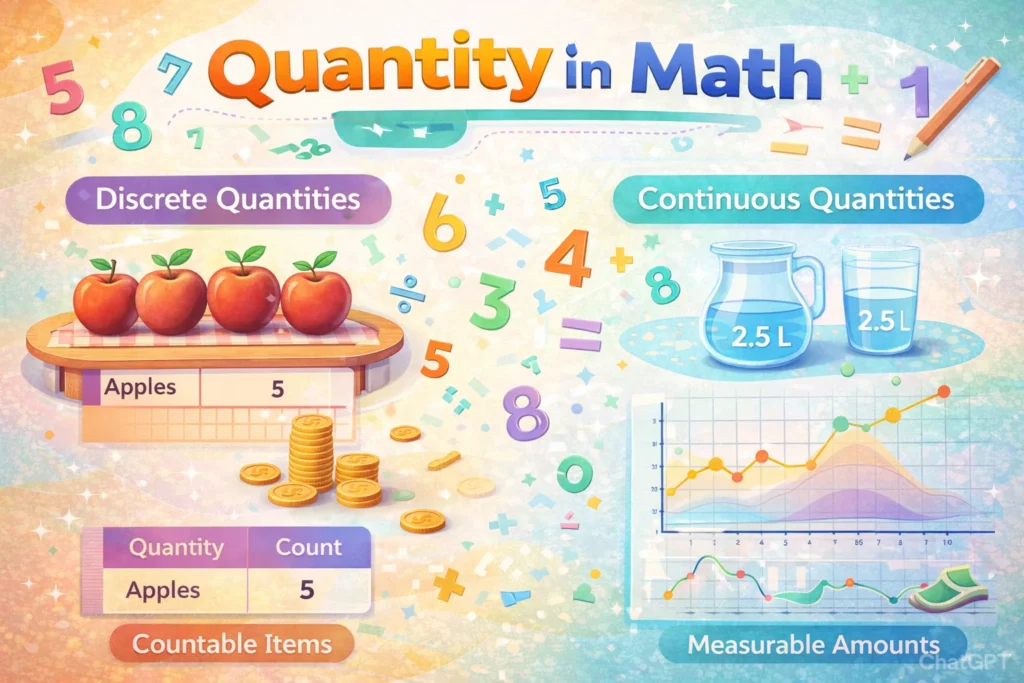
- Discrete: Countable items like books, chairs, or students.
- Continuous: Measurable but not countable items like length, area, or temperature.
| Type of Quantity | Description | Example |
|---|---|---|
| Discrete | Countable individual units | 5 pencils, 12 apples |
| Continuous | Can take any value within a range | 3.5 meters, 7.2 liters |
Quantities can also have units (like meters, liters, kilograms) or be unitless (like ratios or probabilities).
Common Examples of Quantity in Math
Let’s explore some examples with different contexts and tones:
- Friendly tone: “You have 3 oranges 🍊 and 2 bananas 🍌. The total quantity of fruits is 5.”
- Neutral tone: “A car traveled 120 kilometers. The quantity of distance is 120 km.”
- Dismissive tone: “Measuring exactly 0.0001 grams? That quantity is negligible for everyday purposes.”
Example Table: Quantities in Different Scenarios
| Scenario | Quantity | Unit | Notes |
|---|---|---|---|
| Classroom chairs | 30 | pieces | Discrete quantity |
| Water in a bottle | 1.5 | liters | Continuous quantity |
| Probability of event | 0.25 | none | Unitless quantity |
| Money in wallet | 50 | dollars | Discrete with monetary unit |
| Distance run | 10 | km | Continuous, measurable |
Comparison with Related Terms
While quantity may seem straightforward, it’s often compared to other terms:
| Term | Difference from Quantity |
|---|---|
| Amount | Often used interchangeably, but sometimes implies uncountable or mass (like “amount of water”). |
| Number | A specific count, always discrete (e.g., 7 apples). Quantity can be discrete or continuous. |
| Magnitude | Focuses on size or extent rather than just counting (e.g., the magnitude of a vector). |
| Volume | Usually refers to three-dimensional space, while quantity is more general. |
Tip: Use quantity when discussing measurable or countable values in a broad mathematical context, whereas number is more limited to counts.
Alternate Meanings of Quantity
Outside math, quantity can have other meanings:
- In commerce: The number of items purchased or sold.
- In literature/philosophy: The extent or measure of something abstract (e.g., “the quantity of happiness”).
- In law or contracts: Specified amounts in agreements.
Professional alternatives: Depending on context, you can also use terms like amount, count, measure, sum, total, or volume.
Usage Tips
- Always specify the unit if the quantity is measurable.
- Identify whether the quantity is discrete or continuous to choose the right mathematical operations.
- Use quantity as a neutral term in formal writing; replace with number or amount if context is specific.
- In comparisons or equations, make sure the quantities have compatible units.
Practical Examples of Quantity in Math
Consider this simple example:
- Scenario: A grocery store has 12 apples, 8 oranges, and 15 bananas.
- Calculation: Total quantity of fruits = 12 + 8 + 15 = 35
- Analysis: This is a discrete quantity calculation.
In physics or measurement:
- Scenario: A swimming pool holds 10,000 liters of water.
- Calculation: Quantity of water = 10,000 liters
- Analysis: Continuous quantity measured with a unit.
Example Table: Quantity in Math Problems
| Problem | Quantity Type | Solution |
|---|---|---|
| Count chairs in a room | Discrete | 20 chairs |
| Measure water in a tank | Continuous | 500 liters |
| Probability of rolling a 6 | Unitless | 1/6 |
| Distance run in race | Continuous | 5 km |
FAQs
1. What does quantity mean in basic math?
Quantity represents an amount or value that can be counted or measured, like 3 apples or 5 meters.
2. How is quantity different from number?
A number is always a countable figure, while quantity can refer to both countable and measurable values, including continuous ones.
3. Can quantity be negative in math?
Yes, in some contexts, like debt or temperature below zero, quantity can be negative.
4. What are discrete and continuous quantities?
Discrete quantities are countable items like books, while continuous quantities can take any value within a range, like water or distance.
5. What units are used with quantities?
Units depend on the type of quantity: meters for length, liters for volume, kilograms for weight, or unitless for probability.
6. Is quantity the same as amount?
Not exactly. Amount usually refers to uncountable items or mass, while quantity is a broader mathematical term.
7. How do you calculate total quantity?
Add or sum all individual amounts, ensuring the units match.
8. Why is quantity important in math?
It forms the basis for counting, measuring, comparisons, equations, and data analysis, making math practical and applicable.
Conclusion:
- Quantity is a fundamental math concept representing how much or how many.
- It can be discrete (countable) or continuous (measurable).
- Always consider units and context when working with quantities.
- Quantity differs from number, amount, volume, and magnitude but overlaps in certain contexts.
- Real-world applications of quantity are everywhere, from shopping to engineering, data analysis, and science.
Practical Tip: When solving math problems, start by identifying the quantity type, assign proper units, and carefully perform operations while ensuring compatibility. This simple step avoids many common mistakes.
Read More Related Articles:
- Rebuke Mean in the Bible: Learn Its Meaning and Power (2026)
- What Does “BTW” Mean? Texting Acronym You See (2026)
- What Does NIL Stand For? The New Era of College Football In 2026

Neon Samuel is a digital content creator at TextSprout.com, dedicated to decoding modern words, slang, and expressions. His writing helps readers quickly grasp meanings and understand how terms are used in real conversations across text and social platforms.