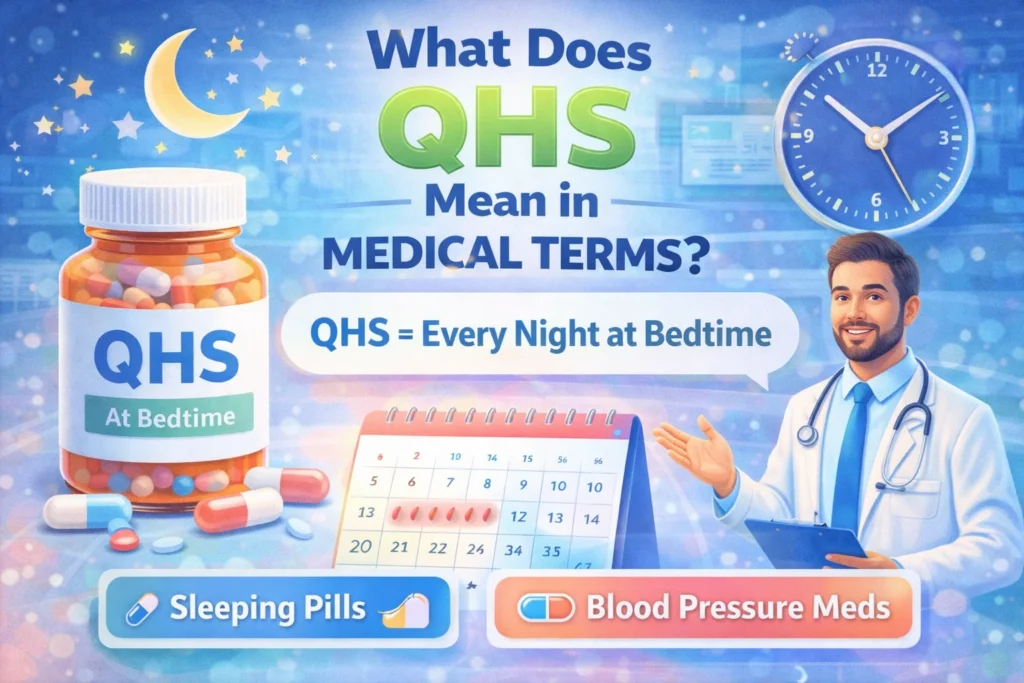
QHS in medical terms stands for “quaque hora somni,” a Latin phrase that means “every night at bedtime.” It is commonly used by healthcare professionals on prescriptions and medical instructions to indicate that a medication should be taken once daily, specifically before sleep.
If you’ve ever looked at a prescription and seen “QHS,” you might have wondered whether it refers to a special type of medication, a specific dosage, or even a complex medical procedure. The truth is far simpler — and incredibly important for safe medication use. In this guide, we’ll break down everything you need to know about QHS, from its origin to real-world usage, examples, comparisons, and alternatives.
Origin of QHS
QHS comes from Latin medical abbreviations that have been used for centuries in Western medicine. Latin phrases were traditionally preferred in medicine to provide consistency across countries and languages.
- Quaque – means “every”
- Hora – means “hour”
- Somni – means “of sleep” or “at bedtime”
Together, quaque hora somni literally translates to “every bedtime” or “each night at sleep.”
This abbreviation became popular because it’s concise and standardized. Pharmacists, doctors, and nurses can quickly note it on prescriptions without writing long instructions, reducing the chance of errors in dosage timing.
Interesting Fact: Many other common prescription abbreviations like BID (twice a day) and TID (three times a day) also originate from Latin, showcasing a long-standing tradition in medicine.
How QHS Is Used in the Medical World
QHS is primarily used in medication prescriptions, especially for drugs that are most effective or safest when taken at night. Some examples include:
- Sleep aids like zolpidem or melatonin
- Certain blood pressure medications that work better overnight
- Cholesterol-lowering medications such as statins (e.g., simvastatin)
- Antidepressants that may cause drowsiness
Healthcare providers rely on QHS instructions to ensure medications are taken consistently at the correct time, enhancing effectiveness and reducing side effects.
Key Points About Usage:
| Key Factor | Details |
|---|---|
| Timing | Nighttime, right before going to sleep |
| Frequency | Once daily |
| Common Medications | Sleep aids, sedating medications, nighttime blood pressure medications, statins |
| Purpose | Aligns medication effect with body’s natural rhythms, reduces side effects |
Using QHS correctly is crucial because taking a medication at the wrong time can diminish its effectiveness or increase adverse effects. For instance, some sedating drugs taken in the morning could cause daytime drowsiness.
Examples of QHS in Context
Let’s see how QHS appears in real prescriptions and instructions.
| Prescription Example | Meaning in Plain English | Tone/Context |
|---|---|---|
| Take 10 mg zolpidem QHS | Take one tablet of zolpidem at bedtime | Neutral/Professional |
| Simvastatin 20 mg QHS | Take one simvastatin tablet every night at bedtime | Friendly/Practical |
| Gabapentin 300 mg QHS | Take one capsule of gabapentin at night to reduce nerve pain | Informative/Helpful |
| Do not take hydrocodone QHS with alcohol | Only take at bedtime and avoid alcohol | Cautionary/Negative |
Notice that QHS provides a clear, unambiguous timing instruction. It helps both the patient and the healthcare provider know exactly when the medication should be consumed.
Comparison With Related Medical Terms
It’s helpful to compare QHS with other common prescription abbreviations:
| Abbreviation | Meaning | Timing/Frequency | Use Case |
|---|---|---|---|
| QD | Quaque die – once daily | Any time of day | General daily medications |
| BID | Bis in die – twice daily | Morning & evening | Medications requiring 12-hour intervals |
| TID | Ter in die – three times daily | Morning, afternoon, evening | Drugs requiring 8-hour intervals |
| QHS | Quaque hora somni – at bedtime | Once daily before sleep | Sleep aids, sedating medications |
Takeaway: QHS is unique because it specifies nighttime dosing, unlike QD, which just indicates “once per day” without specifying when.
Alternate Meanings of QHS
While QHS almost always refers to “every bedtime” in medical contexts, abbreviations can sometimes have alternate meanings in other areas:
- QHS in schools – may refer to “Queen’s High School” or similar acronyms
- QHS in finance – could be used for company ticker abbreviations or codes
However, in prescriptions and healthcare, QHS almost universally refers to medication timing at bedtime.
Polite or Professional Alternatives
If you’re a healthcare provider or patient seeking more modern or understandable alternatives to QHS, you can use:
- “At bedtime” – simple and patient-friendly
- “Take once daily before sleep” – clear for patients who may not understand Latin abbreviations
- “Evening dose” – works for patient instructions in plain English
For example, instead of writing:
“Simvastatin 20 mg QHS”
You could write:
“Take 20 mg simvastatin every night at bedtime.”
This approach improves patient understanding, adherence, and safety.
QHS in Everyday Life: Practical Examples
Sometimes people see QHS in over-the-counter medications or supplements, especially sleep aids. Here are some real-world scenarios:
- Scenario 1 – Sleep Aid: You purchase a melatonin supplement, and the label says “Take 1 tablet QHS.” That simply means you should take it right before bed.
- Scenario 2 – Statins: Your doctor prescribes a statin like simvastatin and notes QHS. This is because your liver naturally produces more cholesterol at night, making bedtime dosing more effective.
- Scenario 3 – Prescription Painkillers: A neuropathic pain medication might say 300 mg QHS, meaning once at night, which helps with overnight discomfort without affecting daytime activities.
Tips for Patients Taking QHS Medications
- Stick to a consistent bedtime: Taking your medicine at the same time every night maximizes benefits.
- Avoid alcohol or heavy meals: Certain QHS medications, especially sedatives, can interact negatively with alcohol or large dinners.
- Set reminders: A phone alarm or pill organizer can help prevent missed doses.
- Understand side effects: Some QHS medications cause drowsiness; plan for uninterrupted sleep.
- Communicate with your doctor: If bedtime dosing isn’t practical, ask for professional guidance.
QHS vs Other Latin Abbreviations: Quick Reference Table
| Latin Abbreviation | Common Meaning | When to Use | Notes |
|---|---|---|---|
| QD | Once daily | General medications | No specific timing required |
| BID | Twice daily | Morning & evening | Approx. 12-hour intervals |
| TID | Three times daily | Morning, afternoon, evening | Approx. 8-hour intervals |
| QHS | At bedtime | Nighttime medications | Enhances effectiveness of sedatives & statins |
| QAM | Every morning | Morning dosing | Useful for energizing medications |
| QPM | Every evening | Evening dosing | Alternative to QHS for clarity |
FAQs
1. What does QHS mean on a prescription?
QHS means “every night at bedtime,” instructing patients to take a medication once daily right before sleep.
2. Is QHS the same as taking a medication once a day?
Not exactly. QHS specifies bedtime dosing, while QD simply means once daily, any time.
3. Can I take a QHS medication in the morning?
No, taking a QHS medication in the morning may reduce effectiveness or cause side effects, especially for sedating drugs.
4. Why do doctors prescribe some medications QHS?
Medications like statins or sedatives work best at night or may cause drowsiness, so bedtime dosing maximizes effectiveness.
5. Are there patient-friendly alternatives to QHS?
Yes. Healthcare providers may write “take at bedtime” or “evening dose” for clarity.
6. Does QHS apply to over-the-counter medications?
Yes. Some OTC sleep aids, supplements, or nighttime medications use QHS for bedtime dosing instructions.
7. How is QHS different from QPM?
QPM also means “every evening,” but QHS is more commonly used in prescription contexts and literally means “at sleep.”
8. Can QHS be used for children or older patients?
Yes, but dosing and safety depend on the specific medication. Always follow healthcare provider instructions.
Conclusion
Understanding QHS is more than just decoding a prescription abbreviation. It ensures medications are taken safely and effectively. Here are the key takeaways:
- QHS means “every night at bedtime”
- Originates from Latin medical terminology
- Commonly used for sleep aids, statins, sedating medications
- Offers a concise way to instruct patients on nighttime dosing
- Alternatives like “at bedtime” improve patient comprehension
When in doubt, always ask your healthcare provider or pharmacist to clarify any abbreviations. Taking medications correctly at the right time ensures maximum benefits and minimum risks.
Read More Related Articles:
- “Dar” Means in Spanish : The Verb That Means More Than “To Give” In 2026
- What Is NSF in Banking? Non-Sufficient Funds Explained Simply (2026)
- Enmity Mean in the Bible: Powerful Biblical Word (2026)

Ivy Madison is a content creator at TextSprout.com, specializing in word definitions, internet slang, acronyms, and text abbreviations. She delivers clear and engaging explanations, helping readers quickly understand modern digital language and trending terms.