In business, PR stands for Public Relations. It refers to the strategic management of communication between a company and its stakeholders including customers, investors, employees, and the general public to build, maintain, and protect a positive reputation.
PR encompasses media relations, brand messaging, corporate communications, and crisis management.
In the business world, reputation can be just as valuable as revenue. A company might offer great products or services, but without a positive public image, long-term success becomes difficult. That’s where PR comes into the picture.
PR stands for Public Relations. In business, it refers to the strategic process of managing communication between a company and the public. The goal of PR is to build, maintain, and protect a positive brand image while fostering strong relationships with customers, media, investors, and the wider community.
Public relations goes beyond advertising. While advertising focuses on paid promotions, PR focuses on credibility, storytelling, and earned media coverage. It includes activities such as press releases, media interviews, crisis management, brand messaging, event coordination, and community engagement. Understanding what PR means in business helps organizations shape public perception, strengthen trust, and support long-term growth.
Public Relations is not just about marketing or advertising; it’s about shaping perceptions, managing reputations, and building trust over time.
Understanding PR in Business
PR is one of the most critical functions in any organization. While marketing focuses on selling products and services, PR focuses on narratives, image, and credibility. The goal is to create a positive perception that indirectly supports business objectives, including sales, customer loyalty, and investor confidence.
Think of PR as the bridge between a company and its audience, ensuring that stakeholders see the brand in the best possible light.
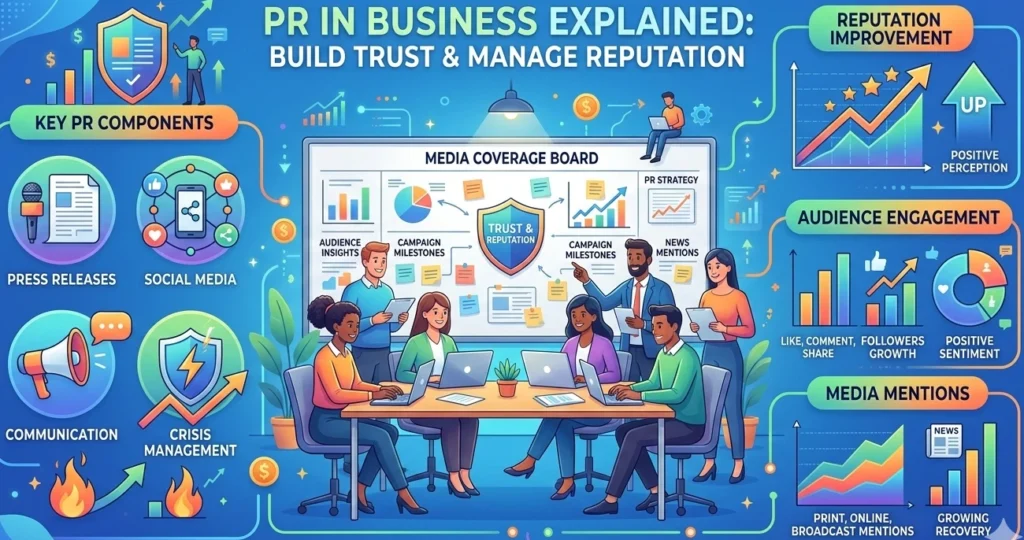
Key Components of PR in Business:
- Media Relations: Communicating with journalists, bloggers, and influencers to get positive coverage.
- Corporate Communications: Sharing information about company news, events, and achievements.
- Crisis Management: Protecting the company’s reputation during scandals, lawsuits, or negative publicity.
- Employee Communications: Keeping staff informed and aligned with company values.
- Community Relations: Engaging with the local community to build goodwill.
In essence, PR helps a business tell its story effectively, influence public opinion, and strengthen relationships with key audiences.
The Origin of PR in Business
PR as a formal business function emerged in the early 20th century. Public Relations pioneer Ivy Lee and later Edward Bernays shaped the concept as a professional practice.
- Ivy Lee (1877–1934): Advocated transparency and proactive communication between companies and the public.
- Edward Bernays (1891–1995): Known as the “Father of Public Relations,” he applied psychology and sociology to influence public opinion.
Initially, PR was primarily press releases and media relations, but it has evolved into a multi-faceted strategy involving digital communications, social media, influencer outreach, and crisis response.
Today, PR is integral to business strategy, particularly in brand-building, investor relations, and corporate responsibility.
Types of PR in Business
PR is not one-size-fits-all. Businesses use various PR strategies depending on goals and audience:
| Type of PR | Purpose | Example |
|---|---|---|
| Media Relations | Secure positive press coverage | Launching a new product in major newspapers or online media |
| Corporate Communications | Inform stakeholders about company news | Announcing a CEO change or quarterly earnings |
| Crisis Management | Handle negative events | Addressing a product recall or social media backlash |
| Employee Relations | Engage and retain employees | Internal newsletters, town halls, and recognition programs |
| Community Relations | Build local goodwill | Sponsoring local events or charity initiatives |
| Investor Relations | Maintain shareholder confidence | Annual reports, shareholder meetings, and earnings calls |
| Digital PR | Online brand management | Social media campaigns, blogs, influencer collaborations |
Each type serves a unique business objective, but together they strengthen the overall reputation and credibility of a company.
How PR Works in Practice
PR combines strategy, storytelling, and relationship-building. Here’s a breakdown of the process:
- Research and Analysis: Understand the company, competitors, and audience perceptions.
- Strategy Development: Define objectives, key messages, and target audiences.
- Tactics and Execution: Issue press releases, organize events, create social media campaigns, and manage digital content.
- Monitoring and Measurement: Track media coverage, social engagement, sentiment analysis, and impact on brand reputation.
- Crisis Response: Respond proactively to negative events with clear, transparent messaging.
Good PR balances proactive storytelling with reactive crisis management, ensuring a brand maintains trust and credibility.
Real-World Examples of PR in Business
Here are some relatable examples showing how PR impacts businesses:
- Friendly Example 😊
A tech company launches a new eco-friendly product. The PR team organizes a media event, shares stories on social media, and secures articles in major tech publications. Customers respond positively, boosting sales and brand perception. - Neutral Example 😐
A retail chain issues a press release about updated store hours during the holidays. Coverage is limited but helps maintain transparency with customers and avoids confusion. - Negative Example 🙁
A fast-food chain faces criticism for a controversial ad. The PR team responds with an apology, clarifies the company’s stance, and implements corrective measures. Reputation is partially restored, but brand perception temporarily suffers.
Importance of PR in Business
PR is more than just media mentions—it directly affects a company’s credibility, trust, and profitability. Some key benefits include:
- Brand Awareness: Spreads the company’s story to potential customers.
- Reputation Management: Builds and protects trust with stakeholders.
- Crisis Mitigation: Minimizes damage during scandals or negative events.
- Employee Engagement: Keeps staff motivated and aligned with the brand mission.
- Investor Confidence: Positive PR attracts investors and maintains stock value.
In short, PR is the unseen engine that powers public perception and drives long-term business success.
PR vs. Marketing: What’s the Difference?
Many people confuse PR with marketing, but there are important distinctions:
| Feature | PR | Marketing |
|---|---|---|
| Primary Goal | Build credibility, trust, and reputation | Drive sales and revenue |
| Approach | Earned media, storytelling, influencer engagement | Paid media, advertising campaigns |
| Focus | Public perception and relationships | Product promotion and conversions |
| Measurement | Media coverage, sentiment, engagement | ROI, leads, sales metrics |
| Examples | Press releases, crisis management, events | Ads, social media promotions, email marketing |
While PR can support marketing objectives, it is not directly focused on selling products, but on creating a favorable environment that supports business growth.
Alternate Meanings of PR in Business
While PR almost always stands for Public Relations, it can have other meanings in specific contexts:
- Purchase Request (PR): In procurement or supply chain, PR refers to a formal request to buy goods or services.
- Performance Review (PR): In HR contexts, PR can refer to employee performance evaluations.
- Press Release (PR): Sometimes PR is used interchangeably with press releases, although this is a specific tactic within public relations.
In most business discussions about communications, branding, or media, PR refers to Public Relations.
PR Strategies for Business Success
Successful PR campaigns require a combination of planning, creativity, and execution. Some practical strategies include:
- Storytelling: Share compelling narratives about your brand’s mission, impact, or products.
- Media Engagement: Build relationships with journalists and influencers for authentic coverage.
- Social Media Management: Monitor brand mentions, respond to inquiries, and create engaging content.
- Crisis Communication Plans: Prepare templates and procedures for rapid response during emergencies.
- Thought Leadership: Position executives as industry experts through interviews, articles, and webinars.
- Event Management: Launch products, host webinars, or sponsor community events to increase visibility.
Metrics to Measure PR Success
Unlike direct sales metrics, PR success is measured by impact on perception, reach, and influence. Common metrics include:
| Metric | Description |
|---|---|
| Media Coverage | Number of articles, mentions, or features |
| Sentiment Analysis | Positive, neutral, or negative tone in media or social platforms |
| Share of Voice | Brand visibility compared to competitors |
| Engagement | Likes, shares, comments, and social interactions |
| Website Traffic | Increases driven by PR campaigns |
| Brand Awareness | Surveys or studies measuring public recognition |
By tracking these metrics, businesses can determine the ROI of PR efforts and adjust strategies accordingly.
Case Studies: PR in Action
- Tesla:
Tesla rarely advertises traditionally. Instead, CEO Elon Musk’s social media and news coverage create earned media, driving awareness and interest. This is a clear example of PR over marketing in building a brand narrative. - Coca-Cola:
Coca-Cola invests heavily in community engagement, sponsorships, and global campaigns that position the brand as a cultural icon. PR strategies like “Share a Coke” strengthen emotional connections with consumers. - Nike:
Nike uses PR to address social issues and support athletes, creating a narrative of brand values that resonates globally. Thoughtful PR enhances reputation beyond product promotion.
Common PR Tools and Platforms
Modern PR relies on a combination of traditional and digital tools:
- Press Release Distribution: PR Newswire, Business Wire
- Media Monitoring: Meltwater, Cision
- Social Media Management: Hootsuite, Sprout Social
- Content Creation: Blogs, videos, podcasts
- Analytics Tools: Google Analytics, Brandwatch
These tools help PR professionals track, measure, and enhance their campaigns effectively.
FAQs
What does PR mean in business?
PR stands for Public Relations, focusing on managing a company’s image, reputation, and communication with stakeholders.
Is PR the same as marketing?
No. Marketing promotes products and services directly, while PR manages public perception and trust.
Why is PR important for businesses?
It helps build credibility, manage crises, engage employees, attract investors, and strengthen brand loyalty.
Can small businesses benefit from PR?
Absolutely. PR helps small businesses gain visibility, credibility, and media attention without large advertising budgets.
What is the difference between PR and advertising?
Advertising is paid promotion. PR is earned or owned media and focuses on reputation rather than direct sales.
How do PR professionals measure success?
Through media coverage, sentiment analysis, engagement metrics, brand awareness, and share of voice.
Can PR help during a crisis?
Yes. Crisis PR involves rapid response, transparent communication, and reputation management to mitigate negative impact.
What skills are essential for PR professionals?
Communication, storytelling, media relations, strategic thinking, social media management, and crisis handling.
What are some PR tactics?
Press releases, media outreach, social media campaigns, influencer engagement, events, sponsorships, and content marketing.
Conclusion:
- PR is Public Relations, not advertising, and focuses on trust, credibility, and perception.
- It involves media relations, corporate communication, crisis management, and stakeholder engagement.
- PR complements marketing but does not replace it—it supports the brand story.
- Businesses of all sizes can benefit from PR to increase visibility, protect reputation, and strengthen relationships.
- Effective PR requires strategy, monitoring, creativity, and clear messaging.
Investing in PR is investing in long-term business success, trust, and sustainable growth.
Read More Related Articles:
- Meaning of Por in Spanish: Practical Examples for Everyday Speech In 2026
- Righteousness Means in the Bible: God’s Character For 2026
- What Does ISG Mean in Text? Context Explained in 2026

Luna Hartley is a content creator at TextSprout.com, where she specializes in explaining word meanings, modern phrases, and everyday language used in texts and online conversations. Her writing focuses on clarity and context, helping readers understand how words are actually used in real communication.