
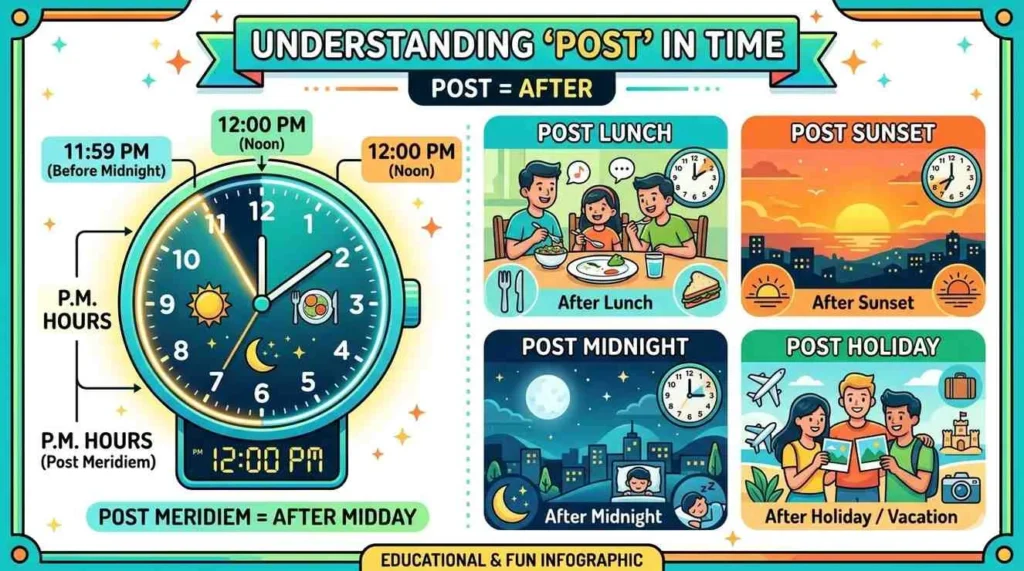
In time-related contexts, “post” means after or following a specific time, event, or point of reference. It is most commonly used in the phrase post meridiem (PM) to indicate times after 12:00 PM, but it can also refer to any period following an event, such as post lunch, post sunset, or post Christmas.
For example:
“The meeting will be held post noon” → The meeting is scheduled after 12:00 PM.
“The festival occurs post winter” → The festival happens after the winter season.
Time is something we experience every day, but the way we talk about it can sometimes be confusing. Words like morning, afternoon, evening, and night are familiar, but then there are terms like post that appear in schedules, formal writing, or even casual speech, and people may wonder exactly what they mean. You might see phrases like post noon, post meridiem, or post sunset and pause to think what they are trying to tell you.
In the context of time, post is a way of saying “after” or “following” a certain reference point. It is a simple yet important term that has been used in English for centuries, especially when referring to formal schedules, events, or historical periods. Understanding what post means can help you read schedules accurately, plan events, and even understand historical texts more clearly.
This article will explain everything you need to know about post in time, from its origin and meaning to everyday usage, examples, and tips for correct use.
Whenever you see post in reference to time, it signals that the action, event, or period occurs after something else.
The Origin of the Word “Post”
The word post comes from Latin, where it originally meant “after” or “behind.” It entered English centuries ago and has been used in multiple contexts, from postal systems to time references. In timekeeping, its most common usage is in post meridiem, abbreviated as PM, which literally translates to after midday.
In Latin, meridiem means midday, and post means after. Together, post meridiem marks the time from 12:00 PM to 11:59 PM. In contrast, ante meridiem (AM) refers to the time before midday, from 12:00 AM to 11:59 AM. This system of AM and PM helps divide the day into two 12-hour periods, making it easier to specify times of day.
The usage of post in time reflects a clear, logical approach: it tells you when something happens after a reference point, whether that point is noon, an event, or a specific time of day.
Common Usage of “Post” in Time
Post Meridiem (PM)
The most common place you will see post is in the abbreviation PM, which stands for post meridiem. This is used to indicate the hours after midday, from 12:00 PM to 11:59 PM.
For example:
- 2:00 PM means 2 hours after midday.
- 7:45 PM means 7 hours and 45 minutes after midday.
In this sense, post is a formal and precise way of indicating the second half of the day. This usage is standard in clocks, schedules, official documents, and digital devices worldwide.
Post Noon
Sometimes, especially in formal writing or event schedules, you may see the phrase post noon. This is a simple way to say after 12:00 PM.
For example:
- “The conference will begin post noon.” → The conference starts after 12 PM.
- “Lunch will be served post noon.” → Lunch will be served in the early afternoon.
While people often say “afternoon” in casual conversation, “post noon” is slightly more formal and may appear in written schedules or invitations.
Post Event References
Another common usage of post is in describing periods following an event or specific occurrence. In these cases, post functions as a preposition meaning after.
Examples include:
- Post lunch meeting → A meeting that takes place after lunch.
- Post sunset walk → A walk that happens after the sun has set.
- Post Christmas sales → Sales that occur after Christmas Day.
- Post exam celebration → Celebrations that take place after exams.
In all of these cases, post clearly signals that the activity or event comes after another event.
Everyday Examples of “Post” in Time
Here are some examples you might encounter in daily life:
| Example | Meaning |
|---|---|
| Post noon | After 12:00 PM |
| 5:00 PM (post meridiem) | Five hours after midday |
| Post breakfast meeting | Meeting after breakfast |
| Post sunset jog | Jogging after the sun has set |
| Post-holiday sale | Sale occurring after a holiday |
| Post bedtime reading | Reading done after bedtime |
| Post evening snack | Snack after dinner or evening |
These examples show that post can apply to a clock time, a meal, or a specific event. It is a flexible term that communicates a clear chronological relationship.
Post vs Other Time Terms
While post indicates a period after something, it is different from other commonly used time terms:
- Afternoon: Usually refers to 12:00 PM to around 5:00 PM. It is casual and less precise than post noon.
- Evening: Typically 5:00 PM to 9:00 PM.
- Later: Informal and relative, meaning at some time after now.
“Post” is often preferred in formal writing, technical documentation, or historical contexts because it is precise, concise, and easy to understand.
Historical and Technical Use of “Post”
Beyond daily schedules, post is frequently used in historical, technical, or military contexts. It can indicate a period following a significant event or milestone.
For example:
- Post 1945 era → The time following the year 1945.
- Post-industrial revolution period → The period after the industrial revolution.
- Post-deployment review → A review conducted after a military deployment.
- Post meridian exercises → Exercises conducted after midday.
In these examples, the meaning remains consistent: post always refers to the period after a reference point or event.
Why “Post” Is Useful
Using post in time references is useful because it provides clarity. Saying something is post noon or post lunch eliminates ambiguity. People understand exactly what period is being referred to.
For example, if a schedule says “Post lunch meeting at 1:30 PM,” there is no confusion about whether the meeting is before or after lunch. Similarly, “post sunset walk” clearly communicates that the walk happens after the sun has gone down.
It is also particularly useful in formal or written communication, such as:
- Event schedules
- Academic or professional reports
- Historical writing
- Technical manuals
By using post, you make it clear that the activity or event occurs after a reference point, which can reduce misunderstandings.
Practical Tips for Using “Post”
- Pair it with a clear reference point: Post noon, post sunset, post breakfast, post meeting.
- Use it in formal or semi-formal contexts: It works better in writing than in casual speech.
- Avoid using it without context: Simply saying “post” without a reference can confuse people.
- Remember it always means after: It is never used to mean before.
- Pair it with events or time: Post event, post hour, post meal, post midday, etc.
For example:
- Correct: “The post dinner discussion will start at 8 PM.”
- Incorrect: “The post dinner discussion will start at 6 PM.” (This would be before dinner in most cases.)
FAQs
What does post mean in time?
Post means after a specific time, event, or reference point.
Is post the same as PM?
Yes. PM stands for post meridiem, which literally means after midday, from 12:00 PM to 11:59 PM.
Can post refer to periods other than hours?
Yes. Post can refer to events, meals, holidays, or other reference points in time.
Is post formal or casual?
Post is generally formal or semi-formal. People often use “after” or “later” in casual speech.
Can I say post noon instead of afternoon?
Yes, especially in schedules or formal writing. In casual conversation, most people simply say afternoon.
What does post midnight mean?
It means any time after 12:00 AM, usually early hours of the day.
Is there an opposite of post?
Yes. The opposite is pre, meaning before. For example, pre noon means before 12:00 PM.
Can post be used in historical contexts?
Absolutely. Post is commonly used to describe periods after significant events or dates, like post-World War II or post-industrial revolution.
Conclusion
In terms of time, post means after or following a reference point. It is most commonly used in post meridiem (PM) to indicate hours after 12:00 PM, but it also works in a wide range of contexts. You can use it to describe periods after meals, events, holidays, or even historical milestones.
The use of post is formal, precise, and versatile. It helps clarify schedules, planning, and historical periods, ensuring that everyone understands the timing being referred to. Whether you are reading a meeting schedule that says post lunch, planning a post sunset walk, or referring to the post-Christmas sales, knowing that post always means after will help you interpret time accurately.
By learning to use post correctly, you can communicate clearly, plan effectively, and even understand historical or professional references with ease. Next time you see post noon or post sunset, you will know it simply means after that specific point in time.
Read More Related Articles:
- Redshirt Means in College: Hidden Year That Changes Everything In 2026
- PRN Means in Jobs: Flexible Work or Unpredictable Hours In 2026
- “Dar” Means in Spanish : The Verb That Means More Than “To Give” In 2026

Ivy Madison is a content creator at TextSprout.com, specializing in word definitions, internet slang, acronyms, and text abbreviations. She delivers clear and engaging explanations, helping readers quickly understand modern digital language and trending terms.