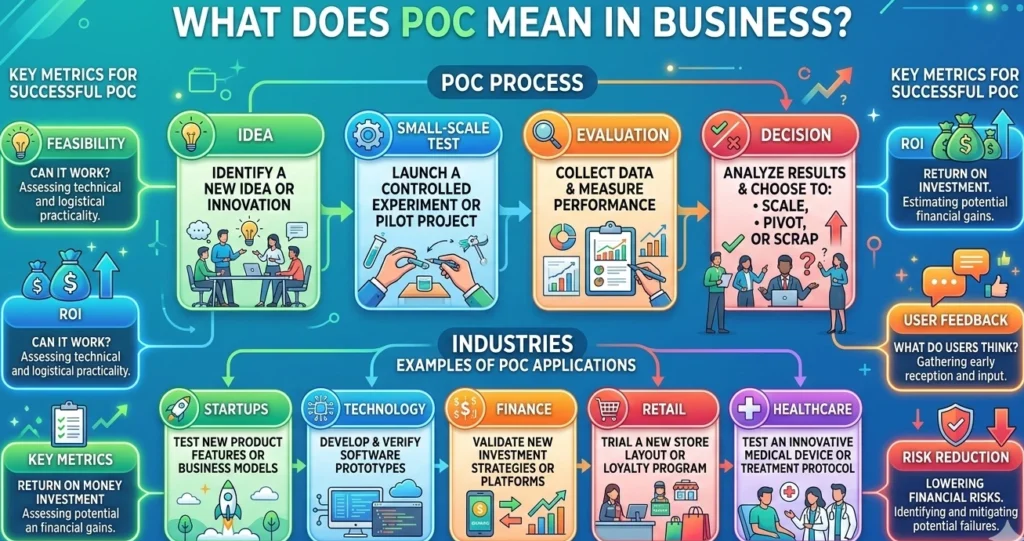
In business, POC stands for Proof of Concept.
It refers to a small-scale project or pilot undertaken to determine whether an idea, product, service, or process is feasible and viable before investing significant time, money, or resources.
The goal is to validate assumptions, test functionality, and demonstrate potential value in a real-world context.
In the business world, abbreviations are everywhere. From emails and contracts to project proposals and meetings, short forms help professionals communicate faster and more efficiently. One abbreviation you may often see is POC. Depending on the context, it can carry different meanings, which makes it important to understand how it’s being used.
In business, POC most commonly stands for Point of Contact or Proof of Concept. A Point of Contact refers to the specific person responsible for communication between two parties, such as a company and its client. A Proof of Concept, on the other hand, is a demonstration or test project designed to show that an idea, product, or solution is feasible before full-scale development begins.
The meaning of POC depends entirely on the situation. In corporate emails, it often refers to a Point of Contact. In project management, startups, or technology discussions, it usually means Proof of Concept. Understanding both definitions helps you avoid confusion and communicate more professionally in business settings.
Origin and Popularity of POC in Business
The concept of Proof of Concept has its roots in engineering and technology industries, where testing ideas on a small scale before full-scale implementation became a standard practice. Over time, its application expanded across all business sectors. Today, POC is widely used in:
- Startups: To demonstrate product viability to investors
- Corporate Projects: To test new systems, technologies, or processes
- Sales and Marketing: To show clients the functionality of a proposed solution
The popularity of POC in modern business stems from its ability to reduce risk and accelerate decision-making. Executives and investors are more likely to fund projects with proven initial results.
Example in Popular Culture:
Many successful tech startups, like Airbnb or Dropbox, started with a small POC or prototype to test user interest before scaling operations. This demonstrates how vital POCs are in validating business ideas.
Understanding the Purpose of a POC
A POC is not a final product or full-scale implementation. Instead, it is designed to:
- Test Feasibility: Determine if the concept can be executed technically and operationally.
- Validate Value Proposition: Assess whether the idea solves the intended problem.
- Reduce Risk: Identify potential roadblocks, costs, or operational challenges early.
- Support Funding Decisions: Convince stakeholders, investors, or leadership to commit resources.
- Guide Strategy: Offer insights for refining the business model, product features, or process design.
POC allows businesses to answer critical questions like:
- Will this technology work as intended?
- Do customers or clients find value in this solution?
- Are the costs and resources required reasonable?
Types of POC in Business
POCs vary based on the type of business, the project scope, and the objectives. Common types include:
| Type | Description | Example |
|---|---|---|
| Technical POC | Focuses on validating technical feasibility | Testing an AI algorithm for accuracy before full-scale integration |
| Market POC | Validates customer interest and market demand | Launching a small batch of products to a limited audience |
| Operational POC | Tests process efficiency and workflow | Implementing a new inventory system in one branch before rolling out company-wide |
| Financial POC | Assesses financial viability | Calculating ROI of a new service offering on a small scale |
Each type of POC addresses a different aspect of business risk, and many projects use a combination to ensure comprehensive validation.
How POC Differs From Similar Terms
Several terms are often confused with POC, but they serve distinct purposes:
| Term | Difference from POC | Example |
|---|---|---|
| Prototype | Focuses on creating a functional model or product | Building a beta version of an app |
| Pilot Project | Small-scale full implementation to test processes | Rolling out a new software in one department |
| MVP (Minimum Viable Product) | A product version with just enough features to attract early users | Releasing an app with core features to collect feedback |
| Feasibility Study | Analytical report on viability, often without execution | Assessing market potential of a service before launch |
Key Insight: A POC is about proof, not perfection. While prototypes and MVPs aim to engage users, a POC is primarily a demonstration to confirm that a concept can work.
Steps to Create a Successful POC
Implementing a POC requires careful planning and execution. The steps include:
- Define Objectives: Clearly identify what you want to prove.
- Set Criteria for Success: Establish measurable outcomes.
- Select Scope: Keep the POC small, focused, and manageable.
- Develop a Plan: Outline timelines, resources, and responsibilities.
- Build the POC: Create a functional prototype or test framework.
- Test and Evaluate: Compare results against success criteria.
- Document Learnings: Capture insights, challenges, and recommendations.
- Decide Next Steps: Determine whether to scale, pivot, or abandon the idea.
Example:
A software startup wants to introduce AI-based customer support. Their POC might include:
- Developing a chatbot for a single department
- Measuring resolution rate and user satisfaction
- Presenting findings to leadership before expanding company-wide
Examples of POC in Different Industries
Technology
- A SaaS company testing a new feature in a limited user group.
- Measuring performance, response time, and user engagement.
Healthcare
- Testing a new medical device on a small patient group to ensure safety.
- Assessing efficacy before mass production and regulatory approval.
Retail
- Launching a small batch of a product line to assess customer response.
- Adjusting marketing strategies based on early feedback.
Finance
- Implementing a new trading algorithm in a simulated environment to test accuracy and risk.
Table: Sample POC Scenarios
| Industry | POC Objective | Key Metrics | Outcome |
|---|---|---|---|
| Technology | Test new AI feature | Response time, accuracy, user engagement | Decide if feature scales |
| Healthcare | Evaluate device safety | Patient feedback, compliance | Regulatory approval or redesign |
| Retail | Assess market demand | Sales numbers, customer reviews | Adjust production and marketing |
| Finance | Validate trading algorithm | ROI, risk exposure | Refine algorithm before full deployment |
Benefits of POC in Business
Conducting a POC offers several advantages:
- Risk Mitigation: Identifies technical, financial, or operational risks early.
- Resource Efficiency: Prevents large-scale investment in unproven ideas.
- Stakeholder Confidence: Provides tangible evidence for investors and management.
- Early Feedback: Allows real-world insights from users or customers.
- Informed Decision-Making: Supports whether to scale, pivot, or abandon the idea.
Example:
A startup demonstrates a POC for a mobile payment solution to investors. Investors see that the system works reliably with early users, making them more likely to fund full-scale development.
Challenges in Implementing a POC
While POCs are beneficial, businesses may face challenges such as:
- Limited Resources: Budget or staff constraints can restrict POC scope.
- Unrealistic Expectations: Stakeholders may expect full-scale results from a small test.
- Technical Limitations: The POC may not accurately reflect large-scale performance.
- Time Constraints: Short timelines may limit thorough testing.
Tip: Managing expectations and clearly communicating the purpose of a POC is crucial for success.
Polite or Professional Alternatives to “POC”
In formal business writing or corporate presentations, the term POC can be replaced with:
- Concept Validation Project
- Pilot Demonstration
- Feasibility Demonstration
- Initial Concept Trial
These alternatives can sound more formal or professional while conveying the same meaning.
FAQs
1. What does POC mean in business?
POC stands for Proof of Concept, a small-scale project to validate an idea, product, or process before full-scale implementation.
2. How is POC different from a prototype?
A prototype is a working model of a product, whereas a POC focuses on demonstrating feasibility, not full functionality.
3. What is the difference between POC and MVP?
An MVP is a product version with minimal features for early users, while a POC is a demonstration to validate that a concept can work.
4. Why is POC important in startups?
It helps reduce risk, attract investors, and refine the product concept before large investments.
5. Can POC be applied outside technology?
Yes, it can be applied in healthcare, retail, finance, manufacturing, and almost any industry.
6. How long does a POC usually last?
Typically 2–6 weeks, depending on the project scope and complexity.
7. What metrics are used to evaluate a POC?
Metrics depend on objectives and can include feasibility, ROI, user engagement, technical performance, and operational efficiency.
8. Can a POC fail?
Yes, failure is common and valuable. It reveals weaknesses, reduces future risk, and informs better decisions.
Conclusion
Proof of Concept (POC) is a critical step in modern business, ensuring that ideas, products, or services are viable before significant investments are made. From startups to large corporations, POCs help reduce risk, gather valuable feedback, and make informed strategic decisions.
Key Takeaways:
- POC validates feasibility and potential value.
- It differs from prototypes, MVPs, pilots, and feasibility studies.
- POCs can be technical, operational, financial, or market-focused.
- Conducting a POC minimizes risk and maximizes efficiency.
- Clear objectives, success criteria, and evaluation metrics are essential.
Businesses that master POC implementation can make smarter decisions, reduce costly mistakes, and improve the success rate of new initiatives.
Read More Related Articles:
- Lament Mean in the Bible: Spiritual Significance (2026)
- What Does GBTS Stand For? Text Meaning Explained (2026)
- “Que” Meaning Explained in English: More Than Just “That” In 2026

Neon Samuel is a digital content creator at TextSprout.com, dedicated to decoding modern words, slang, and expressions. His writing helps readers quickly grasp meanings and understand how terms are used in real conversations across text and social platforms.