
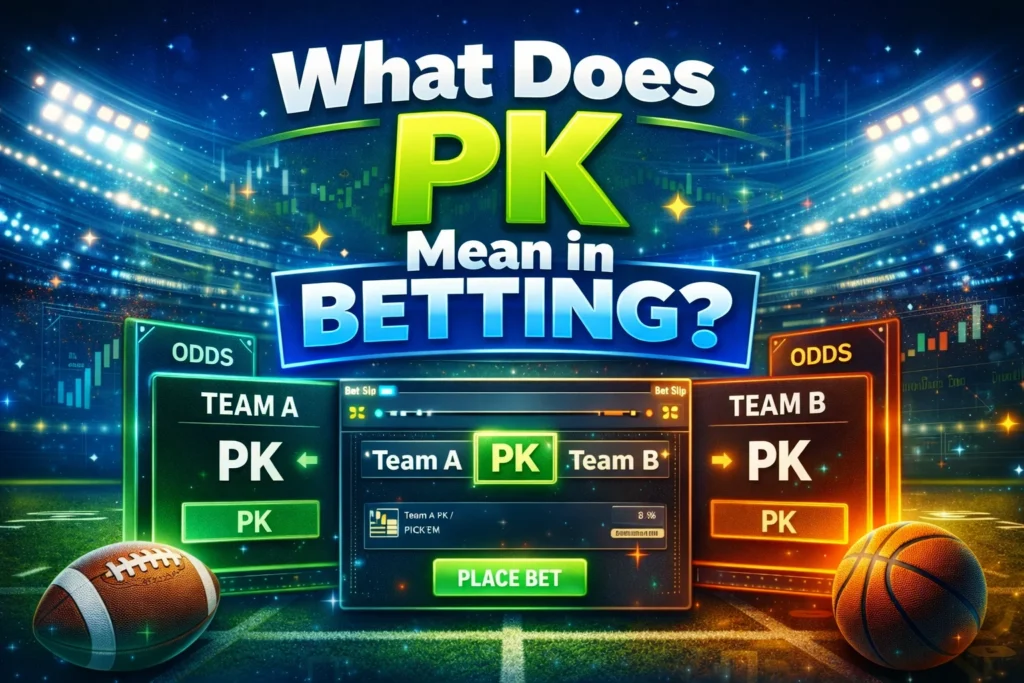
PK in betting stands for “Pick” or “Pick’em.”
It means there is no point spread between two teams. Both sides are considered evenly matched, and the bettor simply chooses which team will win the game. The winner of the match wins the bet.
If you’ve ever browsed through sportsbook odds and noticed “PK” instead of a point spread, you might have paused for a second. What does PK mean in betting? Is it different from a moneyline bet? Is it safer? Does it offer better value?
You’re not alone. PK betting is one of the most commonly misunderstood terms in sports wagering. Yet it’s surprisingly simple once you understand it.
In this comprehensive guide, we’ll break down everything you need to know about PK in betting. We’ll explore its origin, how it works in real games, comparisons with other bet types, examples, strategies, tone usage, alternate meanings, and frequently asked questions.
Let’s dive in.
What Does PK Mean in Betting?
PK stands for Pick or Pick’em in sports betting.
When a game is listed as PK:
- There is no point spread
- Both teams are viewed as evenly matched
- You simply pick the team you believe will win
- The winner of the game wins the bet
Unlike traditional spread betting, where a team must win by a certain number of points, a PK bet removes that margin entirely.
How PK Works in Real Sportsbooks
In a standard point spread, one team is favored and must win by a specific number of points.
For example:
| Team | Spread |
|---|---|
| Team A | -3.5 |
| Team B | +3.5 |
Team A must win by 4 or more points for the bet to win.
But in a PK scenario:
| Team | Spread |
|---|---|
| Team A | PK |
| Team B | PK |
There is no spread. Just pick the winner.
Most sportsbooks will attach standard juice, often around -110 on each side.
Origin of PK in Betting
The term “Pick” or “Pick’em” comes from the idea that bettors simply “pick” the winner.
It became widely used in American sportsbooks during the rise of spread betting in football and basketball.
When oddsmakers cannot confidently assign a favorite due to equal strength, injury uncertainties, or balanced team metrics, they post the game as PK.
PK betting gained popularity with the growth of online sportsbooks. It’s especially common in:
- NFL games
- College football
- NBA matchups
- Soccer betting in certain markets
Why Sportsbooks Use PK Lines
Oddsmakers post PK lines for several reasons:
- Teams are statistically equal
- Public betting is evenly split
- Key players are questionable
- Home field advantage is minimal
- Market uncertainty exists
It creates a clean betting option.
It also avoids pushing heavy action to one side.
PK vs Moneyline: What’s the Difference?
At first glance, PK betting looks identical to a moneyline bet. Both require you to pick the winner. However, there are subtle differences.
Here’s a comparison:
| Feature | PK Bet | Moneyline Bet |
|---|---|---|
| Spread Involved | No | No |
| Focus | Winner only | Winner only |
| Odds | Usually -110 both sides | Can vary widely |
| When Used | Even matchups | Any matchup |
| Underdog Value | Rare | Common |
In many PK situations, the odds are nearly identical to a -110 moneyline on both teams.
However, moneyline odds can vary significantly depending on perceived strength.
PK Betting Examples in Context
Let’s look at real-world style examples.
Example 1 Friendly Tone
The Lakers vs Clippers game is listed as PK tonight.
Both teams are healthy and evenly matched.
You pick the Clippers.
They win 105 to 102.
Your bet wins.
Simple and clean.
Example 2 Neutral Tone
The Chiefs and Bills are PK this week.
Bettors must select the outright winner.
The Chiefs win by 3 points.
All Chiefs PK wagers cash.
Example 3 Slightly Negative Tone
You thought the PK line meant the game would be close.
You picked Team A.
They lost by 21 points.
PK does not guarantee a tight game. It only reflects oddsmaker expectation.
PK Betting in Different Sports
PK appears across multiple sports.
| Sport | How PK Works |
|---|---|
| NFL | Pick the winner, no spread |
| NBA | Pick the winner |
| College Football | Winner takes bet |
| Soccer | Often used in Draw No Bet markets |
| NHL | Equivalent to even matchup |
In soccer, PK is sometimes tied to “Draw No Bet” options depending on the sportsbook format.
Advantages of PK Betting
Many bettors like PK lines for their simplicity.
Here’s why:
- No need to calculate point margins
- Straightforward decision making
- Ideal for close matchups
- Easier for beginners
- Less confusing than spreads
It feels intuitive.
You pick who you believe will win.
Disadvantages of PK Betting
PK is not automatically safer.
Consider these downsides:
- Juice still applies
- No payout boost like underdog moneylines
- You lose if your team loses by even one point
- No buffer like + points spreads
Just because teams are evenly matched doesn’t mean the game will be close.
PK vs Spread Betting
Let’s compare PK to traditional spread betting.
| Feature | PK | Standard Spread |
|---|---|---|
| Margin Requirement | None | Must cover spread |
| Simplicity | Very simple | Requires margin analysis |
| Risk Type | Straight winner risk | Margin risk |
| Strategy Focus | Matchup analysis | Scoring projections |
Spread betting may provide more value when you believe the favorite will dominate.
PK is ideal when you believe one team simply wins.
Is PK the Same as Even Odds?
Not necessarily.
PK refers to the absence of a spread.
Even odds refer to payout structure.
For example:
- PK line might be -110 both sides.
- Even odds would be +100 payout.
They are related but not identical.
Alternate Meanings of PK
PK can mean other things depending on context.
Here are alternate meanings:
- Penalty Kick in soccer
- Player Kill in gaming
- Public Knowledge in finance discussions
- Price Kicker in investing
In betting specifically, it almost always means Pick or Pick’em.
Context matters.
Professional Alternatives to Saying PK
If you’re writing professionally or explaining to beginners, you might use:
- Even matchup
- No point spread
- Pick’em line
- Straight winner market
- Level spread
These alternatives make explanations clearer in articles or presentations.
PK Betting Strategy Tips
Want to use PK effectively? Keep these tips in mind.
- Study matchup data carefully.
- Consider home advantage.
- Monitor injury reports.
- Compare PK to moneyline odds.
- Look for line movement.
Sometimes a PK line moves to -1 or -2.5 before kickoff.
That shift can signal smart money action.
When Should You Bet PK?
PK makes sense when:
- Teams are evenly ranked
- You strongly favor one side
- You want simplicity
- Spread offers no value
- You’re confident in outright victory
It works best when you have strong conviction.
Common Misconceptions About PK
Let’s clear up confusion.
Misconception 1: PK means guaranteed close game
Not true. Blowouts can happen.
Misconception 2: PK has no juice
False. Standard sportsbook commission applies.
Misconception 3: PK is safer than spread
Not always. Risk is simply structured differently.
FAQs
What does PK mean in betting spreads?
PK means Pick or Pick’em. There is no point spread assigned. Bettors simply choose the team that will win the game outright.
Is PK the same as moneyline?
It is very similar because both require picking the winner. However, PK is typically used when the spread is set to zero, while moneyline odds can vary widely based on team strength.
What happens if the game ends in a tie in PK betting?
In sports where ties are possible, most sportsbooks treat PK as a push and refund the bet unless otherwise stated in the rules.
Does PK mean even odds?
No. PK refers to no spread. Even odds refer to payout structure such as +100.
Is PK betting safer than spread betting?
Not necessarily. You still lose the bet if your team loses the game, regardless of margin.
Why do sportsbooks use PK lines?
They use PK lines when teams appear evenly matched or when betting action is balanced.
Can PK lines move before the game starts?
Yes. A PK line can move to -1 or +1 depending on betting activity and new information.
Is PK good for beginners?
Yes. PK betting is simple and easy to understand since it focuses only on picking the winner.
Conclusion:
So what does PK mean in betting? It means the oddsmakers see no clear favorite. And it means you pick the winner. It means simplicity with standard sportsbook juice. PK betting is ideal for evenly matched contests.
It removes complexity but still requires smart analysis. Whether you’re betting on the NFL, NBA, college football, or soccer, understanding PK gives you a stronger grasp of sportsbook terminology.
Knowledge builds confidence. Confidence builds better decisions. Bet responsibly and always research before placing wagers. PK in betting means Pick or Pick’em. It removes the point spread entirely. You simply choose the winning team. It’s popular in evenly matched games. It offers simplicity but not reduced risk. It resembles moneyline betting but is technically tied to spread structure.
Understanding PK helps you read sportsbook lines confidently. It also prevents confusion when spreads disappear. If you enjoy straightforward bets, PK may suit your style. If you prefer higher payouts or margin advantages, explore moneyline or spread alternatives. Always compare odds across sportsbooks. Smart betting is informed betting.
Read More Related Articles:
- What Does NGL Means in Texting? Common Uses (2026)
- What Does PF Mean in Football? Points Explained Simply In 2026
- What Does “Lo” Mean in Spanish? How to Use It Like a Native (2026)

Ivy Madison is a content creator at TextSprout.com, specializing in word definitions, internet slang, acronyms, and text abbreviations. She delivers clear and engaging explanations, helping readers quickly understand modern digital language and trending terms.