
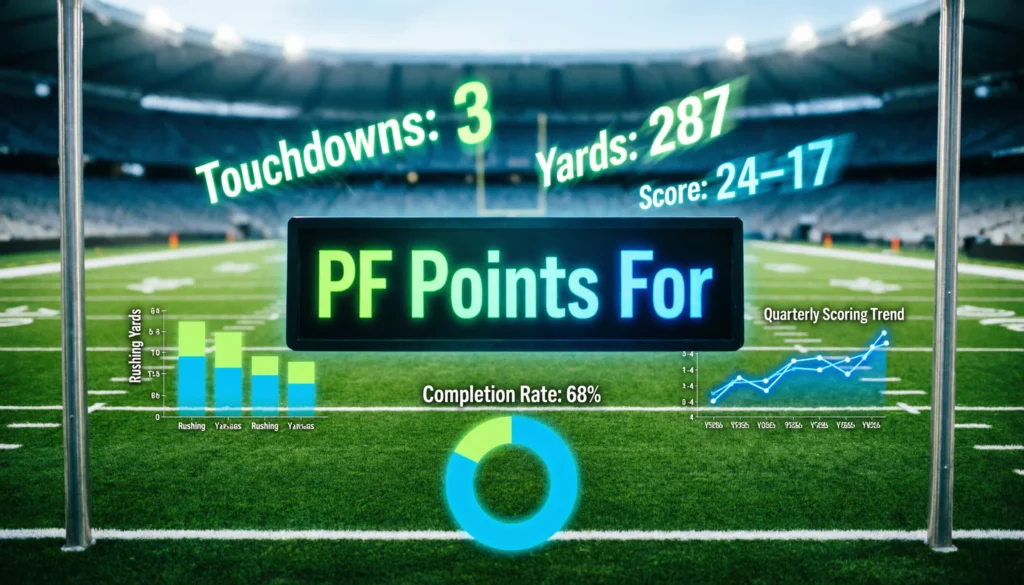
PF in football most commonly stands for “Points For,” a statistical term used to represent the total number of points a team has scored over a season or during a specific period.
If you have ever checked league tables, fantasy football standings, or post match analysis and wondered what “PF” actually means, you are not alone.
The abbreviation shows up everywhere in football data, yet many fans gloss over it without understanding its real value.
This guide breaks it all down in plain language.
You will learn where PF comes from, how it is used in real football settings, how it differs from similar stats, and why it matters more than many fans realize.
What Does PF Mean in Football?
PF means Points For in football, referring to the total number of points a team has scored against its opponents.
The term is used mainly in league standings, statistical breakdowns, and fantasy football formats.
PF focuses only on offensive output rather than defensive performance.
Simple explanation
If a team scores 24 points in one game and 17 in another, its PF after two games is 41.
It is that straightforward.
PF does not care how many points were conceded.
That responsibility belongs to a different stat entirely.
Why PF Matters in Football
Points For is more than a number sitting quietly in a table.
It tells a story about a team’s attacking strength and scoring consistency.
PF is often used to:
• Compare offensive performance between teams
• Break ties in league standings
• Rank fantasy football teams
• Analyze season long trends
• Predict future success or decline
High PF usually signals an aggressive or efficient offense.
Low PF may point to scoring struggles, tactical issues, or weak finishing.
Origin and Background of PF in Football
PF originates from early sports statistics systems used to standardize performance analysis.
As leagues grew more competitive, raw win loss records were no longer enough.
Statisticians needed a way to show:
• How dominant a team was
• Whether wins were narrow or convincing
• Which teams consistently outscored opponents
Points For emerged as a clean solution.
It allowed analysts and fans to quickly identify scoring power.
The term became even more popular with the rise of fantasy football.
Fantasy platforms needed simple abbreviations that worked across sports, so PF stuck.
Where You Will See PF Used Most Often
PF appears in several football related environments.
Its meaning stays consistent, but its importance can vary.
League standings
Many leagues list PF alongside points against and goal or point differential.
It helps separate teams with identical records.
Fantasy football
PF is crucial in fantasy leagues.
It often determines playoff seeding when win loss records tie.
Team analytics
Coaches and analysts track PF to evaluate offensive schemes.
It helps measure whether changes are producing results.
Media and commentary
Sports writers reference PF when discussing high powered offenses.
Broadcasters use it to add depth during match coverage.
PF vs Similar Football Statistics
PF often gets confused with related terms.
Understanding the differences prevents misinterpretation.
Commonly confused stats
• PA
• PD
• GF
• GA
Each stat serves a different purpose.
Here is a clear comparison.
Table 1: PF vs Related Football Terms
| Term | Full Form | Meaning | Focus Area |
|---|---|---|---|
| PF | Points For | Total points scored | Offense |
| PA | Points Against | Total points conceded | Defense |
| PD | Point Differential | PF minus PA | Overall strength |
| GF | Goals For | Total goals scored | Soccer offense |
| GA | Goals Against | Goals conceded | Soccer defense |
PF looks only at scoring output.
It does not account for defensive resilience or margin of victory.
PF in Different Types of Football
The meaning of PF stays the same, but the scoring system changes.
American football
In American football, PF reflects touchdowns, field goals, and extra points.
High PF often indicates explosive passing or rushing offenses.
College football
College football uses PF extensively due to high scoring games.
It helps compare teams across conferences.
Fantasy football
Fantasy PF includes points from player performances.
Touchdowns, yards, and bonuses all contribute.
Soccer context
In soccer discussions, PF is rare.
Fans usually use Goals For instead, though the concept is identical.
How PF Is Calculated
PF is calculated by adding up all points a team scores.
No formulas or adjustments are involved.
Basic example
Game 1 score: 21
Game 2 score: 28
Game 3 score: 14
PF after three games equals 63.
The simplicity makes PF easy to track and compare.
That simplicity is also why it remains so popular.
Real World Examples of PF Usage
PF can appear in different tones depending on context.
Friendly or neutral tone
“Our team leads the division in PF, which shows how consistent the offense has been.”
This sounds informative and positive.
It highlights performance without bragging.
Analytical tone
“Despite a winning record, their PF is lower than expected.”
This signals concern or deeper analysis.
It invites discussion rather than judgment.
Critical or dismissive tone
“They are winning games, but the PF is inflated by weak opponents.”
This questions the legitimacy of the stat.
Tone depends heavily on delivery and context.
Emojis are rarely used in professional analysis.
Fans might use them casually in forums or chats.
PF in Fantasy Football Explained
Fantasy football fans interact with PF constantly.
In many leagues, PF becomes the ultimate tie breaker.
Why PF matters in fantasy leagues
• Determines playoff qualification
• Rewards consistent scoring
• Reduces luck based outcomes
Two teams can finish with the same record.
The one with higher PF often advances.
Table 2: PF Example in Fantasy Football
| Team | Wins | Losses | PF |
|---|---|---|---|
| Team Alpha | 8 | 6 | 1540 |
| Team Bravo | 8 | 6 | 1485 |
Team Alpha ranks higher due to stronger PF.
This system rewards weekly performance.
PF vs PA: Understanding the Balance
PF shows how well you score.
PA shows how well you defend.
A team with high PF and high PA may win shootouts.
A team with moderate PF and low PA relies on defense.
Table 3: PF and PA Comparison Example
| Team | PF | PA | Style |
|---|---|---|---|
| Team X | 420 | 390 | Offensive focused |
| Team Y | 350 | 300 | Defense oriented |
Neither approach is automatically better.
Context matters.
Does a High PF Guarantee Success?
Not always.
High PF improves chances, but football is complex.
A team might score heavily against weak opponents.
Another team might score modestly but defeat stronger competition.
PF should be evaluated alongside:
• Strength of schedule
• Turnover margin
• Defensive efficiency
• Game management
Smart analysis looks at the full picture.
Alternate Meanings of PF in Football
PF usually means Points For, but alternate meanings exist in other contexts.
Player position abbreviation
PF can sometimes mean Power Forward in basketball.
This does not apply to football, but confusion happens in mixed sports discussions.
Personal foul
In officiating notes, PF may refer to personal foul.
This is rare in fan facing stats.
Context clarifies meaning almost every time.
In standings and stats, PF equals Points For.
Polite or Professional Alternatives to PF
When writing formally, you may prefer full phrases.
• Total points scored
• Offensive scoring output
• Team scoring total
These alternatives improve clarity for beginners.
They also reduce confusion in international audiences.
Common Misunderstandings About PF
Many fans assume PF equals league points.
That is incorrect.
League points come from wins and draws.
PF reflects scoring only.
Another misconception involves fairness.
PF does not account for opponent strength.
Understanding these limits prevents misuse.
Tips for Using PF Correctly in Conversation
• Always clarify context
• Avoid using PF alone in arguments
• Pair PF with PA or PD
• Explain abbreviations to new fans
Clear communication builds credibility.
Stats should inform, not confuse.
FAQs
What does PF stand for in football standings?
PF stands for Points For, meaning the total number of points a team has scored during the season.
Is PF the same as goals scored?
PF is similar in concept but usually applies to point based football systems rather than goal based ones.
Why is PF important in fantasy football?
PF often breaks ties and rewards consistent scoring across the season.
Can a team with low PF still succeed?
Yes, strong defense and game management can offset lower scoring totals.
Does PF include overtime points?
Yes, any points scored during official game time count toward PF.
Is PF used in soccer leagues?
Soccer prefers Goals For, though PF carries the same idea conceptually.
How is PF different from point differential?
PF measures scoring only, while point differential compares scoring and defense together.
Should beginners focus on PF first when learning stats?
Yes, PF is one of the easiest and most intuitive stats to understand.
Conclusion:
PF may look like just another abbreviation.
In reality, it plays a major role in how football performance is evaluated.
Points For highlights offensive strength, consistency, and scoring efficiency.
It becomes especially powerful when combined with other metrics.
Whether you follow professional leagues, college football, or fantasy competitions, understanding PF gives you an edge.
Use it wisely, explain it clearly, and always view it in context.
Read More Related Articles:
- English Meaning of “Puta”: Definition, Usage and Cultural Notes In 2026
- “Poco” Means in Spanish: How It’s Used In 2026
- BCE Meaning in Bible: Historical Context (2026)

Ivy Madison is a content creator at TextSprout.com, specializing in word definitions, internet slang, acronyms, and text abbreviations. She delivers clear and engaging explanations, helping readers quickly understand modern digital language and trending terms.