
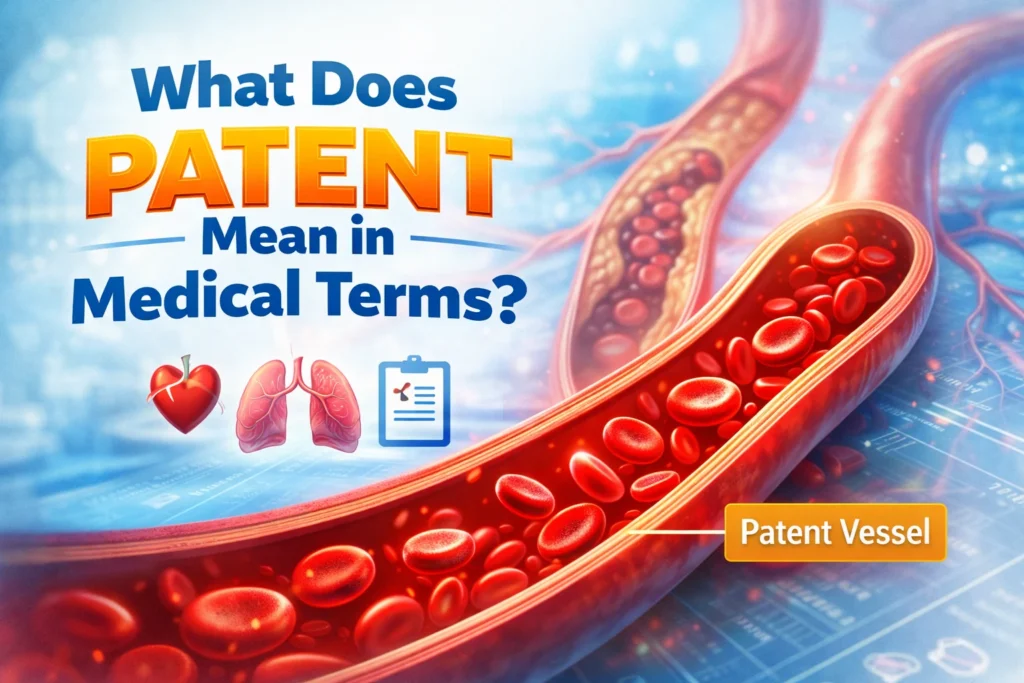
In medical terms, “patent” means open, unobstructed, or allowing free flow.
It is commonly used to describe blood vessels, airways, ducts, or passages in the body that are functioning normally without blockage.
For example, if a doctor says an artery is patent, it means blood is flowing through it properly.
When you first hear the word “patent,” you might think of inventions or legal rights. That is completely understandable. In healthcare, however, the word carries a very different meaning. Doctors, nurses, and radiologists frequently use the term during examinations, imaging reports, and surgical notes.
If you recently read a medical report that said “the airway is patent” or “the graft remains patent,” you may be wondering what that actually means for health and recovery.
Understanding patent meaning medical helps clarify that it refers to something being open or unobstructed, especially in terms of blood vessels or airways. In healthcare, the term is commonly used to describe normal flow, such as when an artery remains open and allows proper circulation.
Let’s break it down in simple, clear language.
What Does Patent Mean in Medical Terms?
In medicine, patent describes something that is open and allows normal flow.
The term is typically used for:
- Blood vessels
- Airways
- Surgical grafts
- Heart valves
- Tubes or drains
- Ducts within organs
If something is patent, it is functioning as it should.
If something is not patent, it is likely blocked, narrowed, or obstructed.
For example:
- “The patient’s airway is patent.” → The patient is breathing without obstruction.
- “The coronary artery remains patent.” → Blood flow to the heart muscle is not blocked.
This term is especially important in emergency medicine and surgery.
Origin of the Word “Patent”
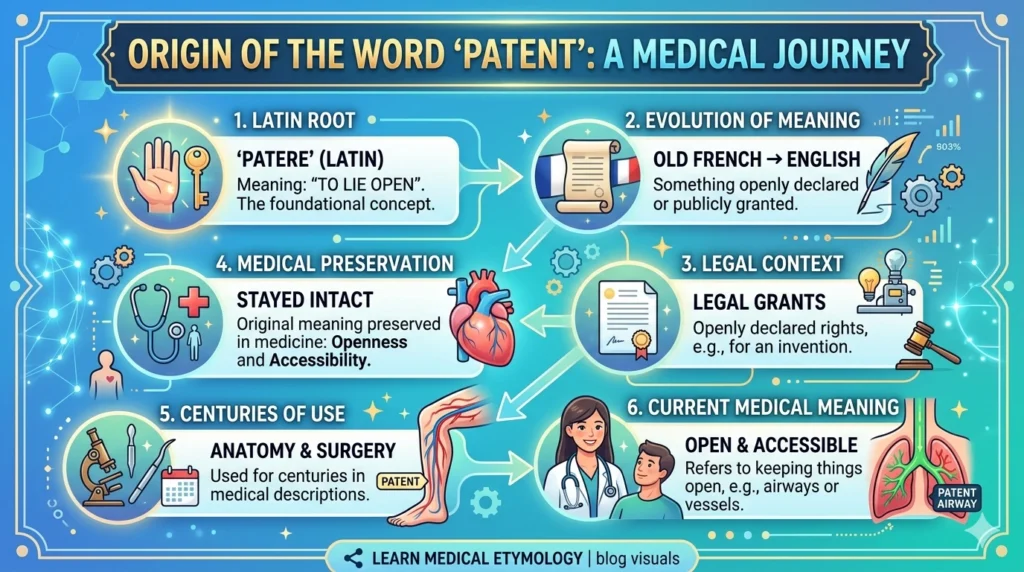
The medical term “patent” comes from the Latin word patere, which means “to lie open.”
Over time, the word entered Old French and later English.
In legal contexts, it came to mean something openly declared or publicly granted, such as a patent for an invention.
In medical language, the original meaning stayed intact. It still refers to openness and accessibility.
Medical professionals have used the term for centuries, particularly in anatomy and surgical descriptions.
Why Is the Term “Patent” So Important in Healthcare?
In medicine, flow equals life.
Blood must flow.
Air must move.
Fluids must drain.
When something becomes blocked, serious health risks can occur.
A patent structure ensures:
- Oxygen reaches organs
- Nutrients circulate properly
- Waste products are removed
- Organs function normally
Even a partial blockage can cause complications.
That is why doctors pay close attention to whether a structure remains patent after surgery or treatment.
Common Medical Contexts Where “Patent” Is Used
Below is a table showing where you may commonly see this term.
Table 1: Common Uses of “Patent” in Medicine
| Medical Area | Example Phrase | What It Means |
|---|---|---|
| Cardiology | Coronary artery is patent | Blood flows normally to the heart |
| Emergency Medicine | Airway is patent | The patient can breathe without obstruction |
| Surgery | Bypass graft remains patent | The surgical connection is still open |
| Neurology | Carotid artery patent | Blood is reaching the brain |
| Pediatrics | Patent ductus arteriosus | A fetal vessel remains open after birth |
| Urology | Catheter remains patent | The tube is not blocked |
Notice how the term always relates to openness and proper function.
Patent in Cardiology
In heart health, “patent” often appears in imaging reports such as angiograms.
If a cardiologist says a coronary artery is patent, it means blood flow is not restricted.
This is good news for the patient.
After procedures like angioplasty or bypass surgery, maintaining a patent artery is the goal.
If the artery becomes blocked again, it is no longer patent.
Patent in Emergency Medicine
In emergency care, one of the first assessments is whether the airway is patent.
Without a patent airway, oxygen cannot reach the lungs.
Medical professionals may say:
“Airway patent and breathing stable.”
That phrase indicates the patient is not choking or obstructed.
If the airway is compromised, immediate intervention is required.
Patent Ductus Arteriosus Explained
One well known medical condition that includes this word is Patent Ductus Arteriosus.
In newborns, the ductus arteriosus is a normal blood vessel that connects two major arteries in the heart before birth.
It usually closes shortly after birth.
If it remains open, it is called a patent ductus arteriosus.
This condition may require monitoring or treatment depending on severity.
Examples of “Patent” in Real Medical Reports
Understanding tone helps reduce anxiety when reading reports.
Table 2: Example Sentences and Tone
| Example Statement | Tone | What It Implies |
|---|---|---|
| The stent remains patent | Positive | Treatment is working |
| The airway is patent | Neutral | No obstruction detected |
| The graft is no longer patent | Concerning | Blockage has developed |
| Central line remains patent and functional | Neutral positive | Medical device working correctly |
Most of the time, seeing the word “patent” in a report is reassuring.
Patent vs Related Medical Terms
Medical language can be confusing because several words may sound similar.
Here is a comparison to clarify differences.
Table 3: Patent vs Related Terms
| Term | Meaning | Difference |
|---|---|---|
| Patent | Open and unobstructed | Describes normal flow |
| Occluded | Blocked or closed | Opposite of patent |
| Stenosed | Narrowed | Partial obstruction |
| Obstructed | Blocked by something | Flow is restricted |
| Functional | Working properly | Broader than patent |
For example, a vessel can be functional but partially stenosed.
A vessel that is patent has no blockage affecting flow.
Alternate Meaning of “Patent”
Outside medicine, the word “patent” usually refers to intellectual property.
A patent gives someone legal rights to an invention.
In everyday language, it can also mean obvious.
For example: “It was patent that he was upset.”
Medical usage is completely separate from these meanings.
Professional Alternatives and Clear Communication
Doctors may use simpler language with patients.
Instead of saying “the artery is patent,” they might say:
- The artery is open
- Blood flow is normal
- There is no blockage
Clear communication helps reduce confusion and anxiety.
If you do not understand a report, it is always appropriate to ask your provider for clarification.
Real World Scenario Examples
Imagine a patient recovering from heart surgery.
The doctor reviews the scan and says the bypass graft remains patent.
That statement means the new pathway for blood flow is still open and functioning properly.
Now consider a trauma patient in the emergency room.
A nurse documents that the airway is patent and breathing is stable.
This indicates immediate life threatening airway blockage is not present.
In contrast, if a report says the vessel is no longer patent, further evaluation or treatment may be necessary.
Why Patients Often Misinterpret the Word
The legal meaning of patent is more familiar to many people.
Seeing the word in a medical context can cause confusion.
It may even cause unnecessary stress.
Fortunately, in healthcare documentation, the term usually signals normal function.
Context always matters.
FAQs
What does patent mean in medical terms?
In medical language, patent means open and allowing normal flow without obstruction.
Is patent good or bad in a medical report?
It is usually good. A patent structure means it is open and functioning properly.
What does airway patent mean?
It means the airway is open and the person can breathe without blockage.
What is the opposite of patent in medicine?
The opposite is occluded or obstructed, meaning blocked.
What does patent artery mean?
It means the artery is open and blood is flowing normally.
What is patent ductus arteriosus?
It is a condition where a fetal blood vessel remains open after birth.
Does patent mean healed?
Not necessarily. It only means open and unobstructed, not fully healed.
Why do doctors use the word patent instead of open?
Medical terminology provides precision and consistency in clinical documentation.
Conclusion:
The word patent in medical terms means open and unobstructed. It describes normal flow in blood vessels, airways, or tubes. Seeing this word in a report is usually positive. Understanding medical vocabulary empowers patients to interpret reports more confidently.
Patent meaning in medical is important because it describes whether a body structure, like a blood vessel or airway, is open and functioning properly.
In clinical settings, the term highlights how patent meaning in medical is used to indicate that normal flow or passage is not blocked or restricted.
When in doubt, ask your healthcare provider to explain findings in simple language. Clear communication supports better healthcare decisions.
Read More Related Articles:
- What Does GG Mean in Text? Discover the Hidden Meaning (2026)
- Meaning of Mercy in the Bible: Core Biblical Teaching (2026)
- What “Ustedes” Really Means in Spanish Conversations In 2026

Neon Samuel is a digital content creator at TextSprout.com, dedicated to decoding modern words, slang, and expressions. His writing helps readers quickly grasp meanings and understand how terms are used in real conversations across text and social platforms.