
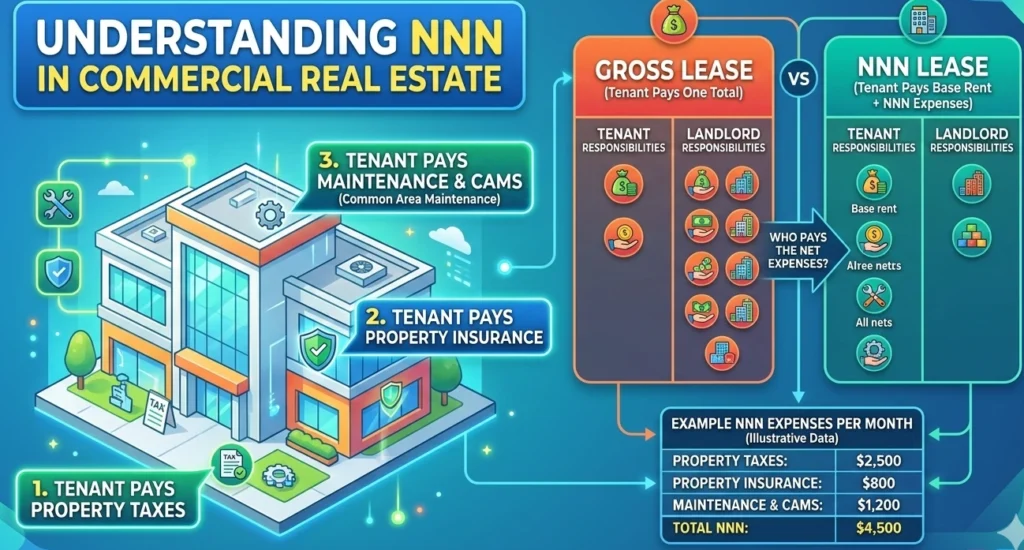
In real estate, NNN stands for Triple Net. It is a type of lease where the tenant pays the base rent plus three additional costs which are property taxes, building insurance, and maintenance. The tenant covers these expenses in addition to the rent.
For example, a property listed as twenty dollars per square foot NNN means the tenant pays rent plus all applicable taxes, insurance, and maintenance costs.
NNN leases are common in commercial real estate. Understanding how they work helps both investors and tenants make informed decisions. Knowing the details of NNN can prevent unexpected expenses and make leasing a property more predictable and manageable.
The Origin of NNN
The term NNN or Triple Net comes from the commercial real estate industry as a way to describe leases that pass operating costs to tenants. Originally landlords covered property expenses in full service leases. Over time, real estate professionals needed a simpler way to shift costs while keeping rent predictable.
Triple Net is called NNN because each N represents a net cost. The first net is property taxes. The second net is building insurance. The third net is maintenance. The abbreviation makes it easy to communicate the type of lease in listings, contracts, and discussions.
NNN has become the standard in commercial real estate terminology. Tenants and landlords recognize that NNN indicates a tenant’s responsibility for most property expenses in addition to rent.
Understanding NNN Leases
A NNN lease is one of several lease types in commercial real estate. Gross leases have the tenant pay only rent while the landlord covers all property expenses. Single net leases require the tenant to pay property taxes. Double net leases require property taxes and insurance. Triple net leases, or NNN, require the tenant to pay taxes, insurance, and maintenance.
The Three Nets Explained
| Net Category | Explanation |
|---|---|
| Property Taxes | The tenant pays all real estate taxes for the property |
| Insurance | The tenant pays building insurance including liability coverage |
| Maintenance | The tenant covers repairs, upkeep, and common area maintenance |
In a NNN lease the tenant can either pay these costs directly or reimburse the landlord. Either way the financial responsibility lies with the tenant.
How NNN Leases Work
NNN leases are structured to separate base rent from additional property expenses. Base rent is the amount paid to the landlord for leasing the space. On top of the base rent the tenant pays property taxes, insurance, and maintenance.
For example if a property is listed as twenty dollars per square foot NNN a tenant renting one thousand square feet would pay twenty thousand dollars in base rent. Then they would pay additional amounts for property taxes insurance and maintenance which could add several thousand dollars depending on the property.
Some NNN leases collect estimated monthly payments for taxes insurance and maintenance and reconcile at the end of the year. If actual costs are higher than estimated the tenant pays the difference. If costs are lower the tenant receives a credit.
Types of Commercial Properties That Use NNN
NNN leases are common in freestanding retail buildings industrial warehouses and single tenant office buildings. National retail chains such as fast food restaurants often prefer NNN leases because they can control property expenses and plan long-term budgets.
Common Property Types Table
| Property Type | Reason for NNN Lease |
|---|---|
| Retail stores | Long-term tenants manage their own property expenses |
| Office buildings | Single tenants take responsibility for taxes insurance and maintenance |
| Industrial warehouses | Clear allocation of operating costs between tenant and landlord |
| Quick-service restaurants | Predictable property cost management |
NNN leases give landlords predictable income with lower management involvement while giving tenants more control over property operations.
NNN Compared to Other Lease Types
Lease Type Comparison Table
| Lease Type | Tenant Responsibility | Typical Use |
|---|---|---|
| Gross Lease | Rent only | Office buildings with landlord-managed expenses |
| Single Net Lease | Rent plus property taxes | Less common commercial properties |
| Double Net Lease | Rent plus property taxes and insurance | Multi-tenant shopping centers |
| Triple Net Lease | Rent plus property taxes insurance and maintenance | Freestanding retail stores and industrial buildings |
NNN leases are the most comprehensive net lease because the tenant assumes almost all operating costs. Gross leases are simpler for tenants but more work for landlords.
Benefits of NNN Leases for Landlords
NNN leases reduce a landlord’s management responsibilities because the tenant handles taxes insurance and maintenance. Landlords receive stable rental income without worrying about operating cost increases. NNN properties are attractive to passive investors who prefer predictable cash flow and minimal involvement.
Other benefits for landlords include long-term tenants and the ability to market properties as low-maintenance investments. Many institutional investors purchase NNN properties for this reason.
Benefits of NNN Leases for Tenants
Tenants pay lower base rent because they assume property expenses. They gain control over maintenance decisions and can choose insurance providers. NNN leases can be beneficial for businesses that want transparent costs and the ability to manage property expenses directly.
Tenants in NNN leases may also have the advantage of negotiating caps on certain costs to prevent unexpected expense increases.
Examples of NNN Leases
Retail NNN Lease Example
| Expense Category | Amount |
|---|---|
| Base Rent | 30,000 per year |
| Property Taxes | 5,000 per year |
| Insurance | 2,000 per year |
| Maintenance | 3,000 per year |
| Total Annual Payment | 40,000 per year |
Industrial NNN Lease Example
A warehouse rents ten thousand square feet at fifteen dollars per square foot NNN. Base rent is 150,000 per year. Property taxes are 15,000 per year. Insurance is 4,000 per year. Maintenance is 10,000 per year. The total annual payment is 179,000 per year.
These examples illustrate how NNN leases shift operating costs to tenants while providing predictable income for landlords.
Things to Watch in NNN Leases
Tenants should understand how expenses are calculated. Many leases require monthly estimates with year-end reconciliation. Tenants may need to pay more if actual expenses exceed estimates.
Common area maintenance charges may have annual caps to prevent large increases. Absolute NNN leases go further by making the tenant responsible for almost all property costs including structural repairs.
Landlords and tenants should carefully review lease terms and consult legal professionals to avoid surprises. Clear definitions of expenses, maintenance responsibilities, and payment schedules are essential.
Pros and Cons of NNN Leases
Pros for Landlords
- Lower management responsibilities
- Predictable rental income
- Attractive to long-term investors
Cons for Landlords
- Must verify tenant’s ability to pay expenses
- Vacancies can affect income stability
Pros for Tenants
- Lower base rent
- Control over property maintenance
- Predictable cost structure if managed carefully
Cons for Tenants
- Responsible for variable expenses
- May require careful monitoring and budgeting
FAQs
1. What does NNN mean in real estate?
It is a Triple Net lease where the tenant pays rent plus property taxes insurance and maintenance.
2. Is NNN only for commercial properties?
Yes, it is most commonly used in retail industrial and office properties.
3. Are utilities included in NNN leases?
Not necessarily. Utilities may be separate depending on lease terms.
4. What is CAM in an NNN lease?
CAM stands for common area maintenance and covers shared property costs.
5. Can NNN leases be negotiated?
Yes. Rent, expense caps and responsibilities can be negotiated.
6. Do landlords still have responsibilities in NNN leases?
Sometimes landlords retain structural repair or roof responsibilities.
7. Are NNN expenses tax-deductible for tenants?
Yes. Expenses such as property taxes insurance and maintenance are usually deductible business expenses.
8. What is the difference between NNN and absolute NNN leases?
Absolute NNN leases assign nearly all property expenses to the tenant including structural and major repairs.
Conclusion
NNN or Triple Net leases are an important part of commercial real estate. They shift property expenses to tenants while offering landlords predictable income and lower management responsibility. NNN leases benefit tenants with lower base rent and control over property expenses. Understanding how NNN leases work, what costs are included, and how to negotiate terms is essential for both tenants and investors.
Practical tips include reviewing all lease terms carefully understanding estimates and reconciliations, negotiating caps on expenses, and seeking professional advice before signing. NNN leases provide a transparent and predictable leasing structure for long-term planning.
Read More Related Articles:
- Lament Mean in the Bible: Spiritual Significance (2026)
- What Does GBTS Stand For? Text Meaning Explained (2026)
- “Que” Meaning Explained in English: More Than Just “That” In 2026

Luna Hartley is a content creator at TextSprout.com, where she specializes in explaining word meanings, modern phrases, and everyday language used in texts and online conversations. Her writing focuses on clarity and context, helping readers understand how words are actually used in real communication.