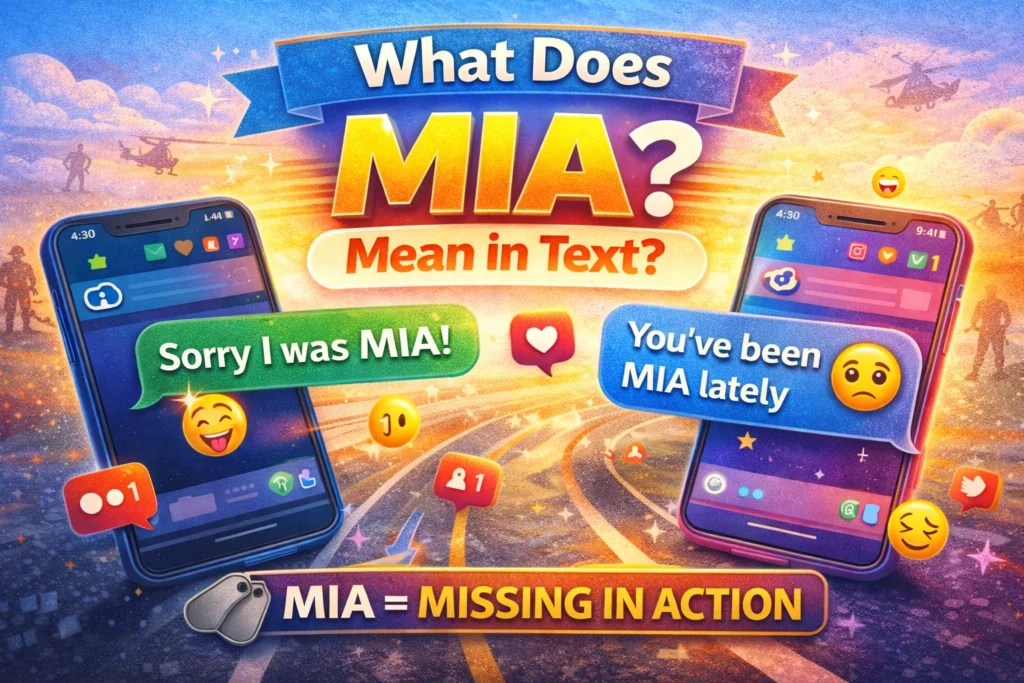
In texting and online communication, MIA stands for “Missing In Action.”
It is used to describe someone who has suddenly disappeared, stopped responding, or has been absent from communication without explanation.
If you have ever sent a message and received no reply for hours or days, you might joke that your friend is “MIA.” The phrase is widely used in casual texting, social media, gaming chats, and even workplace messaging platforms.
Understanding what MIA means in text helps you interpret tone, context, and intent correctly. It can be playful, concerned, or even slightly annoyed depending on how it is used.
Origin of MIA
The abbreviation MIA did not begin as internet slang. It has a much deeper historical background.
Military Roots
MIA originally comes from military terminology. It was widely used during wartime to describe soldiers who were unaccounted for.
- First recorded in military use during the 20th century
- Popularized during World War II and the Vietnam War
- Officially meant “Missing In Action” in combat reports
In military terms, MIA carried serious emotional weight. It described soldiers whose whereabouts were unknown after battle.
Evolution Into Everyday Language
Over time, the phrase shifted from military seriousness to casual conversation.
People began using “MIA” metaphorically to describe anyone who disappeared temporarily. Texting culture shortened phrases even further, making MIA a quick and convenient way to explain absence.
Today, MIA is common in:
- Text messages
- Social media captions
- Workplace chats
- Gaming platforms
- Online forums
The transformation from formal military terminology to casual slang shows how language evolves with culture.
What Does MIA Mean in Texting Today
In modern texting, MIA usually means someone has been:
- Not replying to messages
- Absent from social media
- Disconnected from a group chat
- Ignoring communication
- Busy without explanation
It often carries a casual tone rather than a serious one.
For example:
- “You’ve been MIA all weekend.”
- “Sorry I was MIA, work has been shocking.”
- “Where did you go? You went totally MIA.”
The meaning depends heavily on context and tone.
Examples of MIA in Different Tones
The abbreviation can feel friendly, neutral, or slightly negative depending on how it is used.
Friendly Tone 😊
- “Hey stranger, you’ve been MIA lately!”
- “Sorry I was MIA, I needed a social media break.”
- “She went MIA during exams but she’s back now.”
In friendly use, it often suggests temporary absence without blame.
Neutral Tone
- “The manager has been MIA for two days.”
- “He went MIA after submitting the report.”
- “Customer support was MIA during the outage.”
Here it simply describes absence.
Slightly Negative or Frustrated Tone 😐
- “You’ve been MIA when I needed help.”
- “He goes MIA every time there’s work to do.”
- “Don’t disappear and go MIA again.”
In these cases, it can imply irresponsibility or avoidance.
Tone matters more than the abbreviation itself.
Common Contexts Where MIA Is Used
| Context | Example | Meaning |
|---|---|---|
| Friendships | “You were MIA last night.” | Absent from social event |
| Dating | “He went MIA after our date.” | Stopped communicating |
| Workplace | “The supervisor is MIA.” | Not reachable |
| Gaming | “Our teammate went MIA.” | Disconnected or inactive |
| Social Media | “I’ve been MIA for a week.” | Took a break from posting |
| Family | “Dad went MIA during movie night.” | Temporarily unavailable |
MIA adapts easily to different communication environments.
Comparison With Similar Text Abbreviations
MIA is often confused with other slang terms. Understanding the differences helps avoid misunderstandings.
| Abbreviation | Meaning | How It Differs From MIA |
|---|---|---|
| AFK | Away From Keyboard | Usually temporary and intentional |
| BRB | Be Right Back | Short absence |
| Ghosting | Suddenly cutting contact | More intentional and often permanent |
| Offline | Not connected to internet | Technical status |
| Busy | Engaged in tasks | Not necessarily disappeared |
MIA suggests unexplained absence. AFK and BRB imply short and expected absence.
Ghosting carries a more negative and relationship-focused meaning.
Alternate Meanings of MIA
Although “Missing In Action” is the most common meaning in text, MIA can have other interpretations depending on context.
1. Airport Code
MIA is the airport code for Miami International Airport.
2. Music Reference
M.I.A. is also the stage name of British rapper and singer M.I.A.
In texting, however, these meanings are rare unless the context involves travel or music.
Professional or Polite Alternatives to MIA
In formal communication, using “MIA” may sound too casual. Consider these alternatives:
- “Unavailable”
- “Out of office”
- “Not reachable”
- “Temporarily absent”
- “Inactive”
For example:
Instead of writing
“You’ve been MIA at work”
A professional alternative would be
“You’ve been unavailable during working hours.”
Tone adjustment matters in workplace communication.
Detailed Usage Table With Scenarios
| Scenario | Text Example | Tone | Interpretation |
|---|---|---|---|
| Apology | “Sorry I was MIA yesterday.” | Friendly | Busy or overwhelmed |
| Checking In | “Why have you been MIA?” | Curious | Concerned or confused |
| Relationship | “He went MIA after the argument.” | Negative | Avoidance |
| Gaming | “Our squad leader is MIA.” | Neutral | Disconnected |
| Social Media | “I’ve been MIA from Instagram.” | Casual | Taking a break |
| Work | “The project lead is MIA.” | Frustrated | Not responding |
This table highlights how tone changes meaning.
Is MIA Rude in Texting
MIA itself is not rude. However, how you say it determines the impact.
Friendly tone makes it playful.
Harsh tone makes it accusatory.
For example:
“Hey, you’ve been MIA 😂” feels lighthearted.
“You’re always MIA when I need you” feels critical.
Always consider your relationship with the person before using it.
When Not to Use MIA
There are situations where MIA might be inappropriate:
- During serious emergencies
- In formal business emails
- When someone is dealing with personal issues
- When addressing authority figures
Using “MIA” casually in serious contexts can appear insensitive.
Why MIA Became Popular in Texting
Several reasons explain its popularity:
- Short and easy to type
- Expresses absence quickly
- Recognizable from media and movies
- Adaptable to casual speech
Texting culture favors abbreviations. MIA fits perfectly into fast digital communication.
Psychological Meaning Behind MIA Usage
Sometimes calling someone MIA reflects deeper emotions.
It can signal:
- Concern
- Loneliness
- Frustration
- Humor
- Passive aggression
Understanding emotional context helps interpret intent correctly.
Extended Example Conversations
Example 1 Friendly
A: Where have you been
B: Sorry I was MIA all weekend
A: No worries I figured you were busy
Example 2 Frustrated
A: You didn’t show up again
B: I had things going on
A: You can’t just go MIA every time
Example 3 Neutral
A: Is Mark joining the meeting
B: Not sure he’s been MIA today
These examples show tone variation clearly.
FAQs
1. What does MIA mean in text messages
It means Missing In Action and describes someone who has disappeared or stopped responding.
2. Is MIA a rude abbreviation
Not usually. Tone determines whether it feels playful or critical.
3. Does MIA mean someone is ignoring you
Sometimes yes, but it can also mean they are busy or unavailable.
4. What is the origin of MIA
It originated as a military term meaning Missing In Action.
5. Is MIA the same as ghosting
No. Ghosting implies intentional and often permanent silence. MIA can be temporary.
6. Can MIA be used in professional emails
It is better avoided in formal business communication.
7. Why do people say sorry I was MIA
It is a casual way to apologize for delayed responses.
8. Is MIA only used in texting
No. It is also used in speech, social media, gaming, and informal conversations.
Conclusion
The phrase MIA has evolved from serious military terminology to one of the most common texting abbreviations in everyday communication.
In text messages, it usually describes someone who has been absent or unresponsive.
It can be playful, concerned, neutral, or frustrated depending on tone and context.
Knowing when and how to use MIA ensures you communicate clearly without sounding insensitive or unprofessional.
Language continues to evolve with technology.
Abbreviations like MIA show how historical terms adapt to fit modern digital life.
Read More Related Articles:
- Arrow Mean in a Chemical Equation: Complete Student Guide In 2026
- What Does PK Mean in Betting? How Pick’em Lines Work in Sportsbooks In 2026
- Exclamation Point Mean in a Car: Don’t Ignore This Warning In 2026

Neon Samuel is a digital content creator at TextSprout.com, dedicated to decoding modern words, slang, and expressions. His writing helps readers quickly grasp meanings and understand how terms are used in real conversations across text and social platforms.