
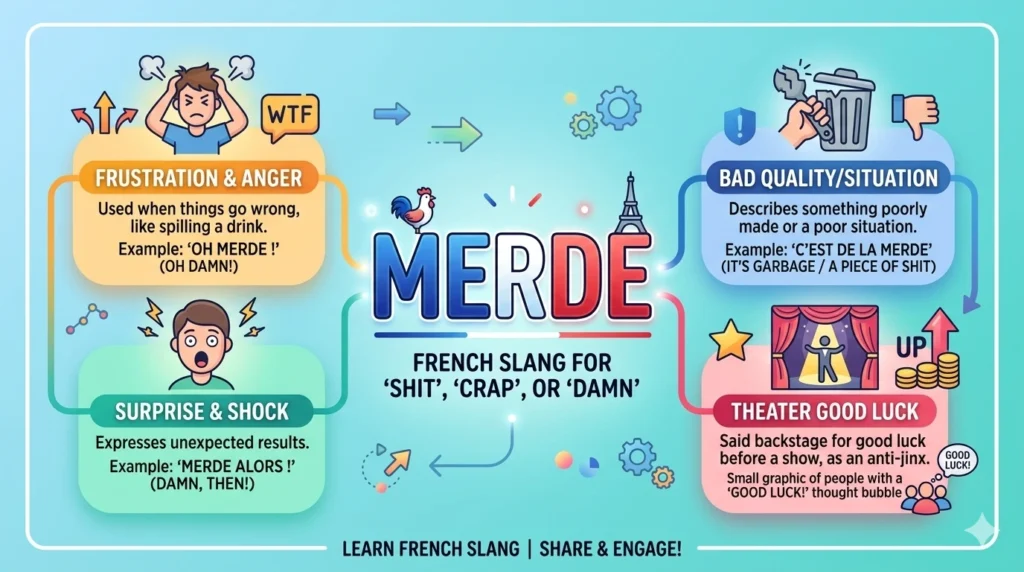
In French, “merde” literally means “shit” or “crap” in English. It is a widely used expletive or slang term, expressing frustration, surprise, anger, or even encouragement, depending on the context.
If you’ve ever watched a French movie, listened to French music, or traveled to France, there’s a good chance you’ve heard the word “merde.” It’s short, expressive, and surprisingly common in everyday speech. While it may sound harmless at first, merde is actually a French swear word that carries different meanings depending on the situation, tone, and context.
At its most basic level, “merde” literally translates to “shit” in English. It is used to express frustration, anger, disappointment, or surprise. However, like many slang or profanity terms in languages around the world, its meaning goes far beyond the literal translation. In casual conversation, it can function as an exclamation similar to “damn,” “crap,” or “oh no.”
Interestingly, the word also has a unique cultural twist in French traditions. In the theater world, performers often say “merde!” to each other before going on stage as a way of wishing good luck, similar to the English phrase “break a leg.” This unusual tradition dates back centuries and highlights how language can evolve in unexpected ways.
In modern French communication, merde appears in everyday speech, pop culture, films, and even social media. Some speakers use it casually among friends, while others avoid it in formal situations because it is still considered vulgar language. Understanding how and when the word is used helps learners grasp both the linguistic meaning and the cultural nuance behind one of the most recognizable French expressions.
In this guide, we’ll explore the full meaning of “merde,” its origins, how it is used in real conversations, and the different contexts where the word can sound humorous, dramatic, or offensive.
Understanding “Merde” in French
The word “merde” is one of the most common French expletives. It’s versatile, carrying multiple connotations depending on tone, context, and body language. While it literally refers to feces, its figurative use is extensive in the French language.
Common uses include:
- Expressing frustration: “Oh merde !” → “Oh crap!”
- Wishing luck: “Merde !” → Equivalent to “Break a leg!” in theater.
- Expressing surprise or disbelief: “Merde, vraiment ?” → “Shit, really?”
Merde is often spoken rather than written in formal contexts, though it occasionally appears in literature or informal writing.
The Origin and History of Merde
“Merde” is derived from Latin “merda”, meaning excrement. Over centuries, it evolved into a common vulgar term in French. Interestingly, while many cultures avoid literal expletives in public, the French have embraced merde in certain social rituals, especially in theater and arts.
Historical insights:
- Theater Tradition: Actors would say “merde!” to wish each other luck, dating back to the 19th century. The origin comes from horse-drawn carriages: a large audience implied many horses and thus more horse droppings outside the theater—a sign of a busy, successful performance.
- Casual Speech: In modern French, merde is used like “damn” or “crap” in English, expressing annoyance or surprise.
Pronunciation and Usage Tips
Pronunciation:
- Phonetically: [mɛʁd]
- The “r” is a guttural French r, common in standard Parisian French.
Usage Tips:
- Friendly tone: Among friends, merde is casual and humorous.
- Neutral tone: Slight frustration or surprise, not offensive.
- Negative tone: Can be strong if directed at someone aggressively.
Common Expressions with Merde
| Expression | Literal Translation | Meaning / Usage |
|---|---|---|
| Oh merde ! | Oh shit! | Expressing surprise or frustration |
| C’est de la merde | It’s shit | Something is bad or worthless |
| Merde alors ! | Damn it! / Well, I’ll be! | Surprise or disbelief |
| Foutu merde | F***ing crap | Anger or extreme frustration |
| Bonne merde ! | Good shit | Rarely, humorous positive use |
| Faire sa merde | Make one’s crap | To mess up or cause trouble |
These phrases show that context and tone are essential to using merde correctly.
Real-World Examples
Merde is extremely common in spoken French, movies, and literature. Here are some scenarios:
- Friendly example 😊
During a casual soccer match, Jules misses an easy goal and says, “Merde !” His teammates laugh, and the mood stays light. - Neutral example 😐
Claire accidentally spills coffee: “Oh merde…” She’s frustrated but not angry. - Negative example 🙁
During a heated argument, Marc shouts, “C’est de la merde !” The insult feels stronger and conveys annoyance. - Theatrical/luck example 🎭
Before a stage performance, actors say “Merde !” to each other as a way to wish good luck, much like saying “Break a leg!” in English.
Polite and Professional Alternatives
Since merde is a swear word, there are situations where polite alternatives are preferable:
| Polite Alternative | When to Use | Notes |
|---|---|---|
| Zut ! | Mild frustration | Equivalent to “darn” |
| Mince ! | Mild surprise | Gentle and polite |
| Flûte ! | Disappointment | Less harsh, whimsical |
| Bon courage ! | Encouragement | For work or effort, instead of “merde” for luck |
| Sacré nom d’une pipe ! | Mild expletive | Old-fashioned, humorous |
Cultural Context: Why Merde is More Than Just a Curse
In France, swearing is woven into daily life, but the type of expletive and tone determines its impact. Merde is considered:
- Casual and widely understood across all ages.
- Stronger than “zut” but weaker than harsher words.
- Integral in theater and arts as a ritual of good luck.
For travelers or learners, understanding when and how to use merde can prevent social faux pas while still sounding natural in conversation.
Comparison With Other French Expletives
| French Expletive | Literal Meaning | Strength / Usage | Notes |
|---|---|---|---|
| Merde | Shit | Medium | Widely used, versatile |
| Zut | Darn | Mild | Polite alternative |
| Putain | F*** | Strong | Often anger or surprise, not polite |
| Bordel | Brothel | Medium-strong | Frustration or mess, casual |
| Salaud / Salope | Bastard / B**** | Strong | Insulting, personal |
| Nom de Dieu | God’s name | Strong | Blasphemous, rarely polite |
Merde occupies a middle ground, versatile but not excessively offensive.
Examples of Merde in Literature and Media
Merde appears in books, films, and songs, illustrating French life and culture:
- Movies: French comedies often use merde humorously.
- Novels: Authors like Marcel Pagnol and Émile Zola include merde in dialogues to convey realism.
- Music: In modern French rap and pop, merde is used for emphasis or humor.
Example dialogue:
“Oh merde ! J’ai oublié mes clés.” → “Oh crap! I forgot my keys.”
Alternate Meanings and Misinterpretations
Although primarily meaning shit, merde can also convey:
- Luck: “Merde !” before performances.
- Mild surprise: “Merde alors !” similar to “Well, I’ll be!”
- Annoyance: “C’est de la merde” to describe a bad situation or object.
Misinterpretations often occur for learners who translate literally instead of contextually.
Pronunciation Tips for English Speakers
- Avoid saying “merd” – French requires the final “e” to be pronounced softly.
- Use the guttural “r” – Common in Parisian and standard French.
- Listen and mimic natives – Context and tone define meaning more than literal translation.
Practical Examples Table
| Situation | French Phrase | English Translation | Tone |
|---|---|---|---|
| Frustration spilling coffee | Oh merde ! | Oh crap! | Neutral |
| Theater good luck | Merde ! | Break a leg! | Positive |
| Angry complaint | C’est de la merde ! | This is crap! | Negative |
| Surprised reaction | Merde alors ! | Well, I’ll be! | Neutral/Surprise |
| Messed up work | Faire sa merde | Mess things up | Negative |
Tips for Using Merde Like a Native
- Use it casually among friends or in informal settings.
- Avoid in formal business or diplomatic contexts.
- Combine with gestures or tone to convey correct emotion.
- Remember that context defines meaning—it’s versatile but sensitive.
- Learn idioms with merde to sound more natural.
Cultural Note: Charm of French Swearing
French people often say that swearing adds color to speech. Words like merde are not just expletives—they are tools to express nuance, humor, and emotion.
- Theater, arts, and everyday conversation have preserved its place.
- Understanding when to use it signals cultural literacy.
- It’s widely understood globally thanks to French films, literature, and media.
FAQs:
What does merde mean in French?
It literally means “shit,” but contextually can express frustration, surprise, or encouragement.
Is it offensive to say merde?
It’s moderately offensive but widely accepted in casual conversation. It’s stronger than “zut” but weaker than harsher curses.
Can merde be used to wish luck?
Yes. In theater, saying “merde !” is equivalent to “Break a leg!” in English.
How do you pronounce merde?
Phonetically: [mɛʁd], with a soft “e” and a guttural French “r”.
What are polite alternatives to merde?
Zut, mince, flûte, bon courage, or humorous old-fashioned expressions.
Is merde used in French literature?
Yes, especially in dialogue, to convey realism and emotion.
Can I use merde with friends?
Absolutely. Among friends, it’s casual, humorous, or expressive.
Does merde have different meanings in French-speaking countries?
Slightly. In Quebec, Belgium, or Switzerland, it retains similar meaning but regional slang variations may exist.
How is merde used in idioms?
- “Être dans la merde” → “To be in deep trouble.”
- “Faire sa merde” → “To mess up or cause problems.”
- “C’est de la merde” → “It’s terrible / worthless.”
Conclusion:
- Merde literally means shit, but context determines tone and meaning.
- It can express frustration, surprise, annoyance, or even encouragement.
- The word is common in French culture, especially in theater and informal speech.
- Polite alternatives exist for formal contexts, such as zut, mince, or flûte.
- Learning idiomatic expressions with merde enhances fluency and cultural understanding.
By understanding merde, learners can navigate French conversations naturally, recognizing nuance and humor in everyday speech.
Read More Related Articles:
- What Does PR Mean in Business: How It Shapes Company Reputation In 2026
- What Does “Diff” Mean in Gaming: How Gamers Compare Skills in Chat In 2026
- What Does IHY Mean in Text: Joke, Flirt, or Genuine Anger In 2026

Neon Samuel is a digital content creator at TextSprout.com, dedicated to decoding modern words, slang, and expressions. His writing helps readers quickly grasp meanings and understand how terms are used in real conversations across text and social platforms.