
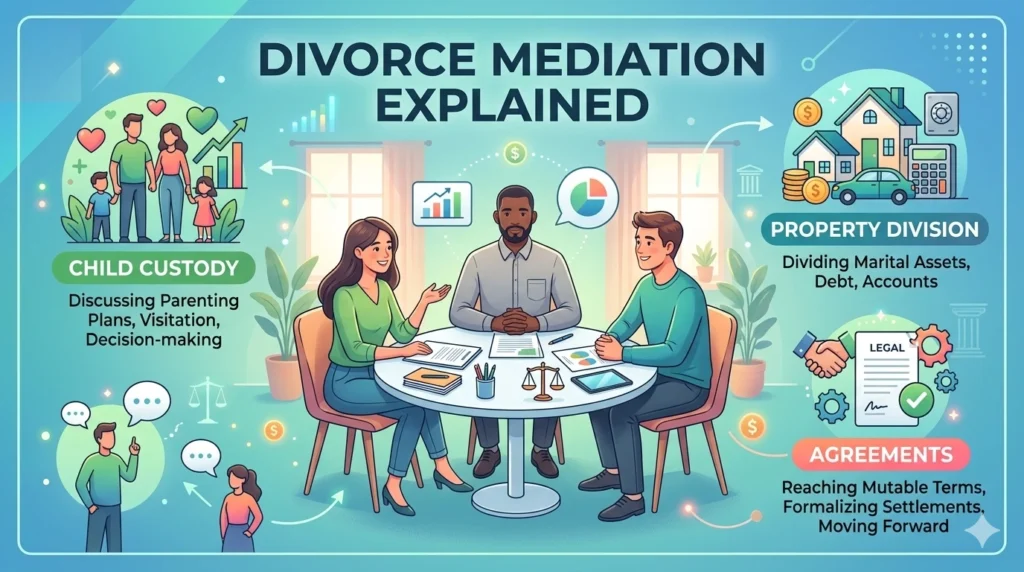
Mediation in a divorce is a voluntary process in which a neutral third party, called a mediator, helps divorcing spouses discuss issues such as property division, child custody, and finances in order to reach a mutually acceptable agreement without going to court.
The mediator does not make decisions for the couple. Instead, they guide conversations and help both parties find solutions that work for everyone involved.
Divorce can be emotionally draining, financially stressful, and legally complex. Many couples assume that divorce automatically means going to court and fighting over everything from property to child custody. In reality, a growing number of couples choose a calmer and more cooperative approach called mediation.
Mediation in divorce has become increasingly popular because it focuses on communication, compromise, and mutual agreement rather than confrontation. Instead of letting a judge decide the outcome, both spouses work with a neutral professional who helps them negotiate solutions. This process often saves time, money, and emotional stress.
Understanding what mediation means in a divorce can help couples make informed decisions during one of the most difficult periods in their lives. Whether you are researching divorce options or simply trying to understand legal terminology, this guide explains mediation in simple and practical terms.
What Mediation Means in a Divorce
In simple terms, mediation is a structured conversation designed to resolve conflict.
When couples divorce, they often disagree about many issues. These disagreements may include:
• Child custody and visitation schedules
• Division of property and debts
• Child support or spousal support
• Parenting responsibilities
• Financial arrangements
Rather than arguing these matters in court, mediation provides a private and controlled setting where both spouses can talk through these issues.
The mediator’s role is not to judge who is right or wrong. Their job is to keep the discussion balanced and productive.
This approach often leads to solutions that both spouses feel comfortable accepting.
The Origin and Growth of Divorce Mediation
Mediation has roots in traditional conflict resolution practices that have existed for centuries. Communities historically relied on neutral elders or leaders to settle disputes before modern legal systems developed.
Modern divorce mediation started gaining popularity in the 1970s and 1980s, particularly in North America and Europe. Courts began recognizing that many family disputes could be resolved more peacefully outside the courtroom.
Several factors helped mediation grow in popularity.
• Rising legal costs made court battles expensive
• Courts became overloaded with family cases
• Families wanted less adversarial solutions
• Child psychologists emphasized the importance of cooperative parenting
Today, mediation is widely used across many countries and is often recommended by family courts before litigation.
In some regions, judges even require couples to attempt mediation before allowing the case to proceed to trial.
How Divorce Mediation Works
The mediation process usually follows a series of structured steps. While the exact procedure may vary by country or state, the general format remains similar.
Typical Divorce Mediation Process
| Step | What Happens | Purpose |
|---|---|---|
| Initial meeting | Both spouses meet the mediator | Understand goals and explain rules |
| Information gathering | Financial details and concerns are shared | Ensure transparency |
| Discussion sessions | Issues like custody or property are discussed | Find common ground |
| Negotiation | Solutions are proposed and refined | Reach mutually acceptable agreements |
| Final agreement | Terms are written into a settlement document | Prepare for legal approval |
Many couples complete mediation in three to six sessions, although complex cases may take longer.
What a Divorce Mediator Actually Does
A mediator is a neutral professional trained in conflict resolution.
They often have backgrounds in law, psychology, or family counseling.
The mediator helps by guiding discussions in a constructive way.
Their responsibilities include:
• Encouraging open communication
• Preventing arguments from escalating
• Clarifying legal or financial issues
• Suggesting practical solutions
• Helping both parties understand each other’s perspectives
It is important to understand that mediators do not take sides.
They also cannot impose decisions. The final agreement must come from the couple themselves.
Issues That Can Be Resolved Through Mediation
Many aspects of divorce can be addressed through mediation.
Below is a breakdown of common topics discussed during mediation sessions.
Common Divorce Issues in Mediation
| Issue | Example Discussion |
|---|---|
| Child custody | Determining where children will live |
| Parenting schedules | Planning holidays and school schedules |
| Property division | Deciding who keeps the house or vehicles |
| Debt allocation | Assigning responsibility for loans |
| Child support | Calculating financial support |
| Spousal support | Determining alimony if necessary |
Because mediation encourages collaboration, solutions are often more flexible than court rulings.
Real Life Examples of Divorce Mediation
Understanding mediation becomes easier when looking at real scenarios.
Example 1 Friendly tone 🙂
Maria and David are divorcing but want to maintain a healthy environment for their children. During mediation, they discuss work schedules and create a shared parenting plan.
Both feel satisfied because the arrangement fits their family lifestyle.
Example 2 Neutral tone
Two spouses disagree about selling their house. The mediator helps them review financial options and they eventually decide to sell the home and divide the profits.
Example 3 Frustrated tone
One spouse initially refuses compromise and repeatedly interrupts discussions. The mediator steps in to redirect the conversation and encourage respectful communication.
Even difficult situations can often be resolved when a neutral guide keeps the conversation productive.
Benefits of Divorce Mediation
Mediation offers several advantages compared to traditional court litigation.
Key Benefits
| Benefit | Why It Matters |
|---|---|
| Lower costs | Mediation is usually far cheaper than courtroom trials |
| Faster resolution | Agreements can be reached in weeks instead of months |
| Privacy | Sessions remain confidential |
| Reduced conflict | Encourages cooperation instead of confrontation |
| Better parenting outcomes | Parents create plans together |
Many couples find that mediation allows them to maintain dignity and respect during a difficult transition.
When Mediation May Not Work
Although mediation is effective in many cases, it is not always suitable.
Situations where mediation may be difficult include:
• Domestic violence or abuse
• One spouse refusing to cooperate
• Hidden finances or dishonesty
• Extreme power imbalance between partners
In these circumstances, traditional legal proceedings may provide better protection.
Mediation vs Other Divorce Methods
Many people confuse mediation with other legal processes. Understanding the differences helps clarify how it works.
Divorce Resolution Methods Compared
| Method | Who Makes the Decision | Cost Level | Conflict Level |
|---|---|---|---|
| Mediation | The spouses | Low to moderate | Low |
| Litigation | A judge | High | High |
| Arbitration | An arbitrator | Moderate to high | Medium |
| Collaborative divorce | Lawyers and spouses | Moderate | Low to medium |
Mediation stands out because the couple maintains control over the final outcome.
Professional Alternatives to Mediation
Some couples prefer different methods for resolving divorce disputes.
Common alternatives include:
Collaborative Divorce
Both spouses hire specially trained lawyers and commit to resolving issues without going to court.
Arbitration
A neutral arbitrator listens to both sides and then makes a binding decision.
Traditional Litigation
The dispute is handled entirely through the court system and decided by a judge.
While these options exist, mediation remains one of the most flexible and cost effective solutions.
Alternate Meanings of Mediation
The word mediation is not limited to divorce law.
It can also refer to other forms of dispute resolution.
Examples include:
• Workplace mediation between employees
• Business conflict mediation
• International diplomatic mediation
• Community dispute resolution
In every context, mediation involves a neutral party helping others reach agreement.
Helpful Communication Tips During Divorce Mediation
Successful mediation often depends on how both parties communicate.
Here are practical tips that can improve outcomes.
• Focus on solutions instead of blame
• Be honest about finances and concerns
• Listen actively without interrupting
• Stay calm even when discussions become emotional
• Remember that compromise benefits both sides
Approaching mediation with a cooperative mindset dramatically increases the chances of reaching a fair agreement.
FAQs
What does mediation mean in a divorce settlement
Mediation in a divorce settlement refers to the process where spouses negotiate and finalize agreements about finances, children, and property with the help of a neutral mediator instead of relying on a court ruling.
Is divorce mediation legally binding
Mediation itself is not binding. However, once both spouses sign the final agreement and the court approves it, the terms become legally enforceable.
How long does divorce mediation take
Most divorce mediation cases are resolved within three to six sessions. Complex cases involving large assets or custody issues may take longer.
Do both spouses need lawyers in mediation
Lawyers are not always required during mediation sessions. However, many people consult lawyers separately to review the final agreement before signing it.
Is mediation cheaper than going to court
Yes. Mediation is usually far less expensive because it avoids long court proceedings and reduces legal fees.
What happens if mediation fails
If mediation does not produce an agreement, the couple can pursue other legal options such as arbitration or court litigation.
Can mediation decide child custody
Mediation helps parents discuss and agree on custody arrangements. A judge usually approves the final parenting plan to ensure it protects the child’s best interests.
Is divorce mediation confidential
Yes. Mediation sessions are private, and discussions cannot usually be used as evidence in court if the process fails.
Conclusion
Divorce mediation offers a practical and compassionate alternative to courtroom battles. Instead of letting a judge make decisions, couples work together to resolve important issues with the help of a neutral mediator.
This process promotes cooperation, reduces legal expenses, and often leads to faster and more satisfying outcomes. Mediation also allows parents to create customized solutions that protect their children’s well being.
While mediation may not be suitable for every situation, it remains one of the most effective ways to resolve divorce conflicts respectfully.
For couples willing to communicate and compromise, mediation can transform a stressful legal process into a constructive path toward a new chapter in life.
Read More Related Articles:
- Open Interest Mean in Options: How It Impacts Options Trading In 2026
- What Does Evergreen Mean in Business: Long-Term Growth Explained In 2026
- GPT Meaning in Chat GPT: What the Letters Actually Stand In 2026

Luna Hartley is a content creator at TextSprout.com, where she specializes in explaining word meanings, modern phrases, and everyday language used in texts and online conversations. Her writing focuses on clarity and context, helping readers understand how words are actually used in real communication.