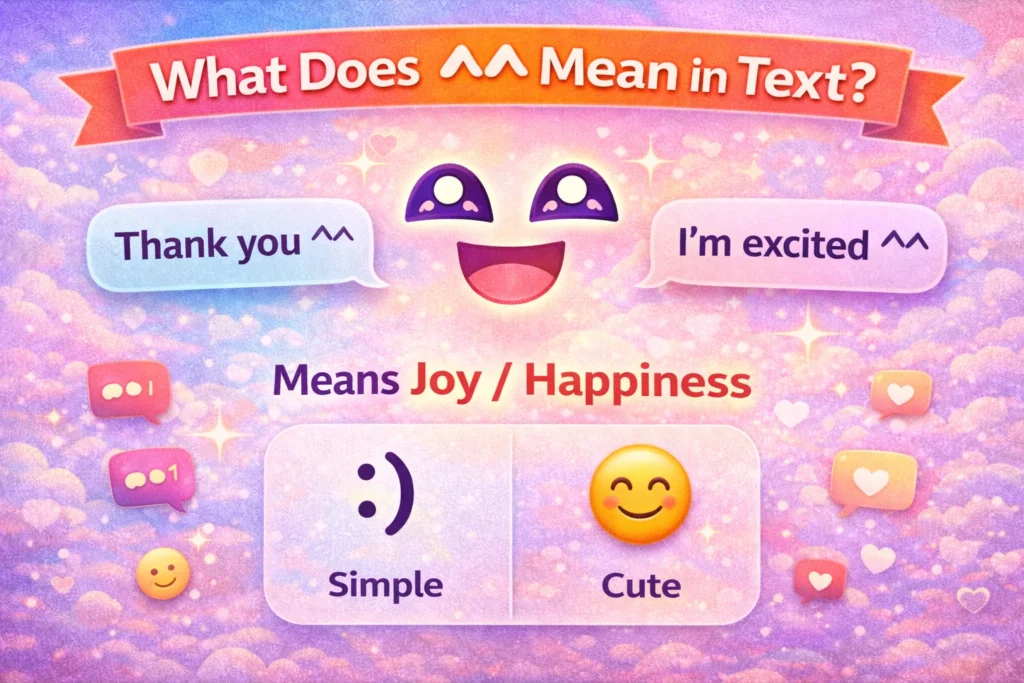
In texting and online messaging, “^^” is an emoticon that represents happiness, excitement, friendliness, or a smiling expression. It visually resembles closed, smiling eyes and is often used to show positivity, gratitude, or cheerful tone in digital conversations.
At first glance, “^^” may look like two random symbols. It might even seem confusing if you are not familiar with internet slang. However, this small pair of characters carries a surprisingly warm and expressive meaning in online communication.
From casual chats to gaming communities and social media comments, “^^” helps add emotional tone to text that would otherwise feel plain or neutral. Since written messages lack facial expressions and vocal tone, symbols like “^^” help people communicate feelings clearly.
Let’s explore where it came from, how it is used, what tone it conveys, and how it compares to similar text expressions.
Origin and Popularity of “^^”
The emoticon “^^” originated in early internet culture and online chatrooms, particularly influenced by East Asian digital communication styles. In Japanese and Korean messaging culture, facial expressions are often represented using the eyes rather than the mouth.
For example:
- ^_^
- ^^
- ^.^
These expressions symbolize smiling or happy eyes.
Unlike Western emoticons such as 🙂 which focus on the mouth, “^^” emphasizes cheerful eyes, which culturally represent joy or friendliness.
Why It Became Popular
Several reasons contributed to its popularity:
- It is simple and quick to type
- It feels softer than traditional emojis
- It adds friendliness without being overly dramatic
- It works well in gaming and online forums
In the early 2000s, before emojis were widely available on smartphones, text-based emoticons like “^^” were a creative way to express emotion.
Even today, many people prefer “^^” because it feels cute, nostalgic, and subtle.
What Does “^^” Mean in Texting?
In most contexts, “^^” expresses:
- Happiness
- Gratitude
- Excitement
- Friendliness
- Playfulness
- Politeness
It softens the tone of a sentence and makes the message feel warmer.
For example:
- “Thank you so much ^^”
- “I’m excited to see you tomorrow ^^”
- “That’s so kind of you ^^”
Without the emoticon, these sentences might sound neutral. With “^^”, they feel more cheerful and genuine.
Tone Explanation: Friendly, Neutral, or Dismissive?
Tone matters in digital communication. Here is how “^^” typically feels:
Friendly Tone 😊
“Thanks for helping me ^^”
This sounds warm and appreciative.
Playful Tone
“You finally replied ^^”
This may suggest light teasing.
Excited Tone
“I passed my exam ^^”
It expresses happiness and pride.
Passive-Aggressive Tone (Rare but Possible)
“Oh really ^^”
Depending on context, it might sound sarcastic.
Context always determines meaning. Most of the time, however, “^^” is positive.
Examples of “^^” in Conversations
Casual Friendship Example
Friend 1: “I brought your favorite snack.”
Friend 2: “Aww thank you ^^”
Online Gaming Example
Player 1: “Good match!”
Player 2: “You played well ^^”
Workplace Friendly Chat
Colleague: “I’ve sent the document.”
Reply: “Got it, thanks ^^”
Flirty Example
“I like talking to you ^^”
In romantic or flirty conversations, “^^” can signal sweetness and affection without being too intense.
Table: Common Situations Where “^^” Is Used
| Situation | Meaning | Emotional Tone |
|---|---|---|
| Saying thank you | Gratitude | Warm and polite |
| Sharing good news | Happiness | Excited and cheerful |
| Light teasing | Playfulness | Friendly |
| Responding kindly | Friendliness | Soft and positive |
| Flirty texting | Sweetness | Cute and subtle |
How “^^” Compares to Similar Text Expressions
Understanding related symbols helps clarify its meaning.
| Expression | Meaning | Difference from “^^” |
|---|---|---|
| 🙂 | Simple smile | More neutral and classic |
| 😊 | Smiling emoji | More expressive and modern |
| ^_^ | Happy face | More detailed version |
| XD | Laughing hard | Stronger humor expression |
| :3 | Cute playful face | More mischievous |
“^^” is softer and more subtle than many emoji options. It feels less dramatic than a full smile emoji.
Is “^^” Still Relevant in the Emoji Era?
Yes, absolutely.
Even though emojis are widely available, many users still prefer text emoticons for several reasons:
- They feel nostalgic
- They load faster on older devices
- They blend better into casual online culture
- They appear less exaggerated than emojis
In gaming communities, anime fandoms, and Discord chats, “^^” remains common.
Generational and Cultural Differences
Different age groups use “^^” differently.
Teens and Young Adults
Used casually in chats and gaming.
Millennials
Often used out of nostalgia for early internet days.
Older Adults
May not recognize it immediately.
Culturally, it is more common in Asian-influenced online communities due to its origin.
Alternate Meanings of “^^”
While “^^” usually means happiness, it can have alternative meanings in specific contexts:
- Directional reference
In forums, “^^” can point to something written above.
Example: “I agree with the comment above ^^” - Sarcasm
Rare but possible when tone is ambiguous. - Cute aesthetic choice
Sometimes used simply to make text appear softer.
Professional or Polite Alternatives
In formal communication, it is better to avoid emoticons like “^^”.
Instead, you can use:
- Thank you very much
- I appreciate it
- I’m happy to help
- That’s great news
- Looking forward to it
In workplace emails, professionalism matters. Emoticons may appear too casual unless company culture allows it.
Table: Casual vs Professional Usage
| Context | Use “^^”? | Better Alternative |
|---|---|---|
| Texting friends | Yes | Totally fine |
| Gaming chat | Yes | Very common |
| Instagram comments | Yes | Acceptable |
| Work email | No | Use polite wording |
| Academic writing | No | Avoid emoticons |
Psychological Impact of “^^” in Messages
Adding “^^” can:
- Reduce perceived harshness
- Increase friendliness
- Encourage emotional connection
- Make messages feel more personal
Research in digital communication suggests small positive signals increase message warmth and trust.
Even tiny symbols influence how text is interpreted.
Common Mistakes When Using “^^”
- Overusing it in every sentence
- Using it in serious conversations
- Misinterpreting sarcasm
- Sending it in professional emails
Moderation is key.
Table: Correct vs Incorrect Usage
| Sentence | Correct Use? | Why |
|---|---|---|
| “Thanks for helping ^^” | Yes | Friendly context |
| “Your report is wrong ^^” | No | May sound sarcastic |
| “Meeting starts at 9 AM ^^” | No | Too casual |
| “I’m so excited for the trip ^^” | Yes | Matches happy tone |
FAQs
1. What does “^^” mean in text messages?
It represents happiness, friendliness, or a smiling expression.
2. Is “^^” flirting?
It can be flirty depending on context, but usually it is just friendly.
3. Is “^^” outdated?
No, it is still used, especially in gaming and anime communities.
4. Can “^^” be sarcastic?
Rarely, but context can change tone.
5. Is it appropriate for work emails?
Generally no, unless the workplace culture is very casual.
6. What is the difference between “^^” and “:)”?
“^^” focuses on happy eyes, while “:)” focuses on a smiling mouth.
7. Why do some people prefer “^^” over emojis?
It feels subtle, nostalgic, and less exaggerated.
8. Does “^^” have a negative meaning?
Usually no. It is mostly positive.
Conclusion
The symbol “^^” in text means happiness, friendliness, or a smiling expression. Though simple, it adds warmth and emotion to digital conversations.
It originated from early internet culture and remains popular today, especially in casual chats and online communities.
While it is perfect for friendly texting, it should be avoided in formal communication.
Understanding small expressions like “^^” improves digital communication skills and helps prevent misunderstandings.
In the world of text where tone can easily be misread, even two tiny characters can make a big difference.
Read More Related Articles:
- What Does Patent Mean in Medical Terms? Clinical Significance In 2026
- What Does Pick 6 Mean in Football? From Interception to Touchdown In 2026
- What Does SRS Mean in a Car: Why This Safety Feature Matters In 2026

Neon Samuel is a digital content creator at TextSprout.com, dedicated to decoding modern words, slang, and expressions. His writing helps readers quickly grasp meanings and understand how terms are used in real conversations across text and social platforms.