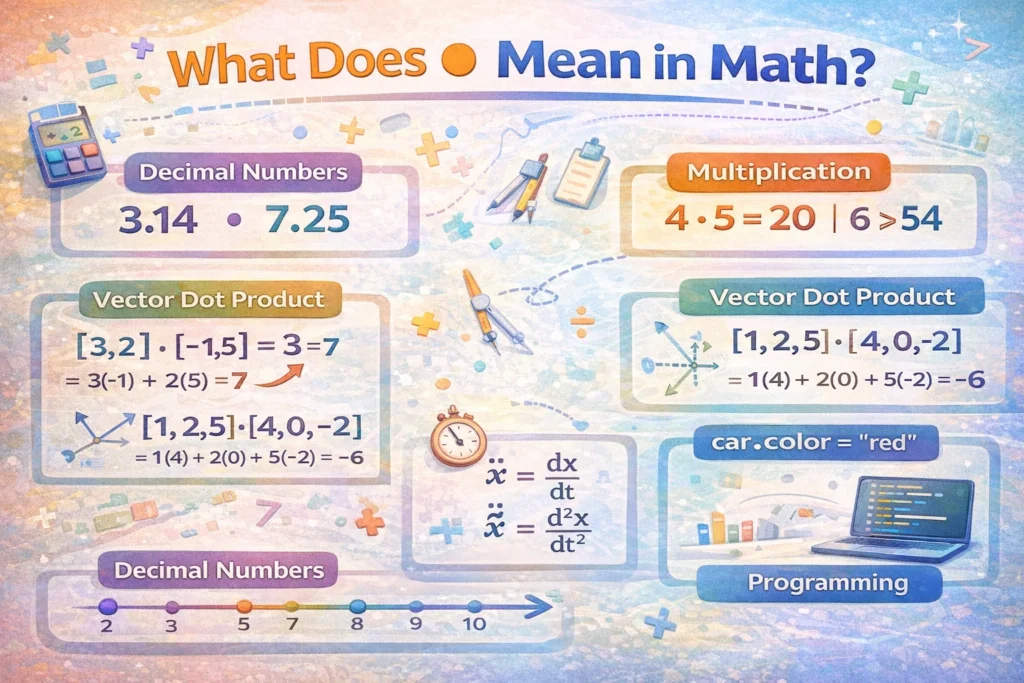
In mathematics, the symbol “.” (dot) has multiple meanings depending on context. Most commonly, it represents multiplication, decimal points, dot products in vectors, or derivatives in calculus. Its use varies across arithmetic, algebra, physics, and advanced mathematics.
At first glance, a dot might seem trivial. But this tiny symbol carries significant meaning in formulas, equations, and real-world applications. Knowing exactly what a dot represents ensures clarity in calculations, problem-solving, and programming.
Let’s explore its origins, practical applications, examples, and nuances to master its use in math.
Origin of the Dot in Mathematics
The dot has a fascinating history in math, evolving over centuries to serve multiple purposes:
- Multiplication: The multiplication dot (·) was introduced by the German mathematician Gottfried Wilhelm Leibniz in the 17th century. Before that, the “×” symbol was commonly used, but it could be confused with the variable x. The dot was simpler and less ambiguous.
- Decimal points: The concept of decimal notation became widely recognized thanks to Simon Stevin in the late 1500s. He introduced a clear separation between whole numbers and fractions, a system that remains in use today.
- Dot products and derivatives: In vector mathematics, the dot product (·) represents a scalar product, combining vectors into a single value. In physics, particularly classical mechanics, a dot over a variable represents its derivative with respect to time, indicating rates of change like velocity and acceleration.
The dot’s versatility is a testament to mathematics’ evolving language. From arithmetic to advanced calculus, it adapts seamlessly to different contexts.
Common Uses of the Dot in Math
Depending on the situation, a dot can represent different mathematical operations or concepts:
1. Decimal Point
The most familiar use is the decimal separator, which divides whole numbers from fractional parts.
- Example: 3.14 → 3 units plus 14 hundredths.
- Friendly tip: In some countries like Germany and France, a comma is used instead of a dot (e.g., 3,14).
Decimals are essential in everyday math for money, measurements, and scientific calculations. Without the dot, understanding precise values would be more cumbersome.
2. Multiplication
In arithmetic and algebra, the dot can replace the “×” symbol for multiplication:
- Example: 4 · 5 = 20
- Why use it? It avoids confusion with the variable x, especially in algebraic expressions such as x · y.
Pro tip: In typed documents or programming, a centered dot (·) is preferred over a period (.) to denote multiplication clearly.
3. Dot Product in Vectors
The dot also serves a critical role in linear algebra. The dot product multiplies corresponding components of two vectors and sums the results, producing a scalar value.
- Example:
Let A = (2, 3) and B = (4, 1)
Then A · B = (2×4) + (3×1) = 8 + 3 = 11
| Vector A | Vector B | Dot Product |
|---|---|---|
| (2, 3) | (4, 1) | 11 |
| (1, 2, 3) | (4, 0, -1) | 1 |
| (0, 5) | (3, 2) | 10 |
Dot products are widely used in physics, engineering, and computer graphics, especially for calculating angles, projections, and lighting in 3D models.
4. Derivatives in Physics
A dot over a variable in calculus indicates the derivative with respect to time, particularly in mechanics:
- Example: x˙ means the rate of change of position x over time (velocity).
- Example: x¨ means the second derivative, or acceleration.
Think of the dot as shorthand for “speeding up” your variable! 🚀
5. Programming and Technical Notation
In computer science and programming, the dot accesses object properties or methods:
- Example:
car.coloraccesses the color property of a car object in programming languages like Python or JavaScript.
Even in logic or Boolean algebra, the dot can denote the AND operation, showing its versatility beyond traditional arithmetic.
Real-World Applications
Understanding the dot in math has many practical applications:
Everyday Math
- Prices: $5.99 → dot separates dollars from cents
- Measurement: 2.5 meters → fractions of units
- Percentages: 0.75 → 75%
Science & Engineering
- Physics uses dots to indicate derivatives, such as velocity (s˙) and acceleration (s¨)
- Engineering uses dot products to calculate forces, torque, or projections in 3D space
- Computer graphics use dot products to determine angles between surfaces for shading and lighting effects
Finance & Accounting
- Decimal points indicate money, ratios, and interest rates.
Programming
- Object-oriented languages use dots to access attributes and methods, making it central to coding logic.
Examples in Context
Here’s a closer look at different dot usages in various scenarios:
| Context | Expression | Meaning | Tone/Comment |
|---|---|---|---|
| Decimal | 7.25 | Seven and twenty-five hundredths | Neutral, everyday use |
| Multiplication | 6 · 9 | 6 multiplied by 9 | Friendly, simple arithmetic |
| Vector Dot Product | (1,2) · (3,4) | Scalar result of vector multiplication | Neutral, technical usage |
| Derivative | v˙=9.8 | Change of velocity over time | Positive/neutral, physics |
| Programming | car.color | Access property of an object | Technical, neutral tone |
Pro tip: Always read the surrounding symbols and context. The same dot could mean a decimal in one equation and a derivative in another.
Comparison With Related Symbols
| Symbol | Use | Difference from Dot |
|---|---|---|
| × | Multiplication | Cross can be confused with variable x |
| , | Decimal separator | Used in Europe instead of dot |
| : | Ratio or division | Not a multiplication dot |
| ⊗ | Tensor product | Advanced linear algebra operator |
| … | Ellipsis | Typographic, not mathematical |
The dot is small but incredibly versatile. Understanding related symbols helps prevent errors in calculation and notation.
Common Mistakes and Misunderstandings
- Confusing dot with decimal and multiplication: 4.5 could be misread as 4×5 without context.
- Using period instead of centered dot: In professional math notation, the dot (·) is preferred over a period for multiplication.
- Assuming dot always means multiplication: In vectors or physics, it could indicate a dot product or derivative.
- Regional confusion: 1.234 in the US is 1,234 in Europe, which can mean a thousand instead of a decimal.
Tips for Using the Dot Correctly
- Always check context: decimal, multiplication, derivative, or dot product.
- Use a centered dot (·) in formal mathematical writing for multiplication.
- Pay attention to regional decimal conventions.
- In programming, understand that a dot is property access, not multiplication.
- When explaining math to students, clarify which meaning of the dot you are using.
Alternate Meanings Beyond Math
Although primarily mathematical, the dot appears in other areas:
- Logic: Denotes AND in Boolean algebra
- Morse code: Represents a short signal
- Typography: Used in ellipses (…) or bullet points
Polite alternatives for “dot” in formal or professional contexts include:
- Decimal point
- Multiplication symbol
- Scalar product
- Derivative notation
Practical Examples Table
| Expression | Meaning | Real-World Use Example |
|---|---|---|
| 2.75 | Decimal number | Price, length, weight |
| 5 · 12 | Multiplication | Area of rectangle 5×12 |
| A · B | Dot product of vectors | Physics, engineering forces |
| s˙ | Derivative w.r.t time | Velocity in motion equations |
| car.color | Property access in code | Programming |
| 3.14 | Decimal approximation of π | Geometry, science calculations |
FAQs
What does the dot mean in 3.5?
It represents the decimal point, separating the whole number 3 from the fractional part 0.5.
How do you read 7 · 8 in math?
It is read as seven times eight, equal to 56.
Is the dot the same as multiplication?
Often yes, but in vectors, it may indicate a dot product, and in physics, a derivative.
What is the dot product?
A calculation combining vectors to get a scalar, useful in physics, engineering, and graphics.
Why do physicists put a dot over variables?
It denotes a derivative with respect to time, like velocity (x˙) or acceleration (x¨).
Is dot used differently in programming?
Yes, it accesses object properties or methods, like car.color.
Can a dot mean something in geometry?
Yes, it may represent a point on a plane or line, different from multiplication.
Why do some countries use a comma instead of a dot?
It’s a regional decimal separator convention, common in Europe.
How do you distinguish multiplication and decimal in handwritten math?
Multiplication often uses a centered dot (·) or x symbol, while decimals are placed on the line with digits.
Are there rules for using dots in algebra?
Yes, avoid confusing x with multiplication, and use parentheses or centered dot for clarity.
Conclusion
The dot in mathematics is small but mighty. Whether as a decimal point, multiplication symbol, vector dot product, or derivative notation, it plays a pivotal role in calculations, science, and programming.
Key takeaways:
- Identify the context first.
- Use a centered dot for multiplication in formal math.
- Be aware of regional differences in decimal notation.
- Recognize its uses in vectors, derivatives, programming, and logic.
Mastering the dot ensures clarity, precision, and confidence in mathematics and related fields.
Read More Related Articles:
- True Meaning of “Quiero” in Spanish and How It’s Used In 2026
- “Of” Mean When Someone Texts It: Detailed Explanation in 2026
- Low MCHC Mean: Understanding Your Blood Test Results In 2026

Luna Hartley is a content creator at TextSprout.com, where she specializes in explaining word meanings, modern phrases, and everyday language used in texts and online conversations. Her writing focuses on clarity and context, helping readers understand how words are actually used in real communication.