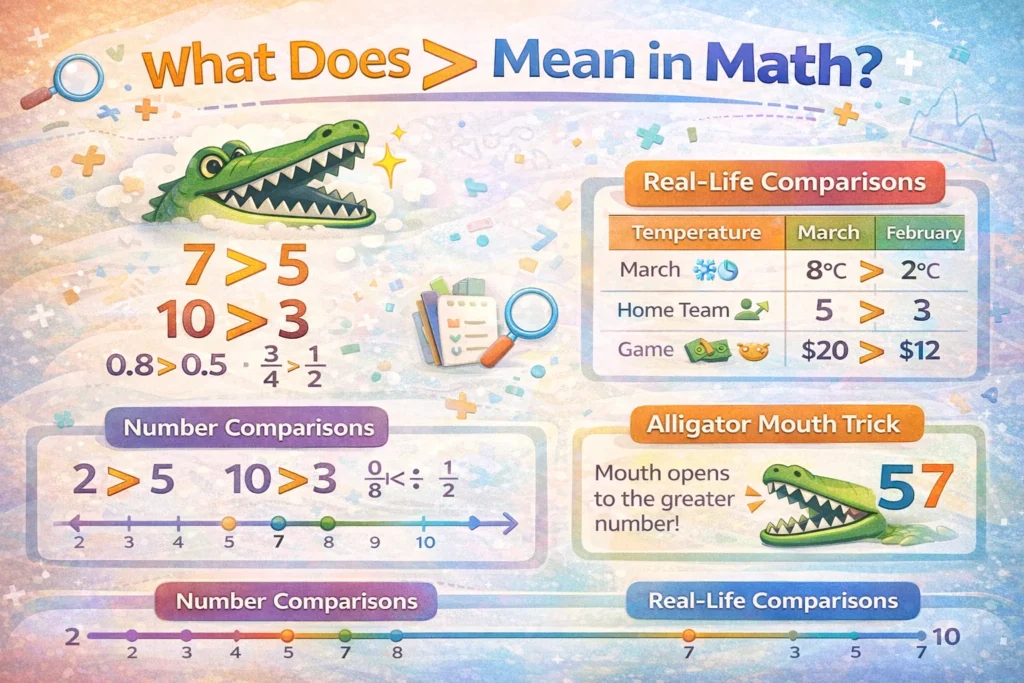
In mathematics, the symbol “>” represents “greater than.” It is used to compare two numbers, expressions, or quantities, showing that the value on the left side of the symbol is larger than the value on the right side. For example,
7 > 5indicates that 7 is greater than 5.
The “greater than” symbol is a foundational concept in arithmetic, algebra, and advanced mathematics, helping us understand numerical relationships, inequalities, and even real-world situations like finances, measurements, or statistics.
The Origin of the “>” Symbol
The symbol “>” has a long and interesting history that illustrates how mathematical notation evolved for simplicity and clarity.
- 17th Century Europe: Mathematicians wanted a shorthand way to write “is greater than” without lengthy words. The first documented use of symbols similar to
>and<appeared in manuscripts in the early 1600s. - Popularization: Over the centuries, the symbol became widely adopted in textbooks, research papers, and eventually, global mathematics standards.
- Symbol Design: The “greater than” symbol was designed so the wide open end points toward the larger number and the narrow tip toward the smaller number. This visual cue is memorable and intuitive.
- Modern Standardization: Today,
>is universally recognized in mathematics, sciences, computer programming, finance, and education.
Fun Memory Trick: Think of the symbol as a hungry alligator that always wants to eat the bigger number. This simple analogy helps students quickly remember which side is larger. 🐊
Understanding “>” in Mathematics
The “>” symbol is central to inequalities, which are mathematical statements showing the relative sizes of two numbers, expressions, or variables.
Rules for Using >
- The larger value must be on the left of the symbol.
- The smaller value must be on the right.
- Read the expression as: “the left value is greater than the right value.”
Basic Examples
| Expression | Meaning | Context |
|---|---|---|
| 10 > 3 | 10 is greater than 3 | Simple number comparison |
| 15 > 7.5 | 15 is greater than 7.5 | Decimal comparisons |
| x > 0 | x is greater than zero | Variable constraints in algebra |
| 20 > 18 > 10 | 20 is greater than 18, which is greater than 10 | Chain comparisons |
Real-World Applications of “>”
The “greater than” symbol isn’t just limited to classrooms. It appears in finance, science, technology, and everyday life:
Finance
- “Revenue this year > last year” indicates growth.
- “Stock price > $100” shows a threshold value for investors.
Science
- “Temperature > 100°C” signals boiling water.
- “Pressure > 1 atm” may indicate specific lab conditions.
Education
- “Your score > class average” indicates above-average performance.
- “x > 50” could represent a passing grade or benchmark.
Technology & Programming
- In programming,
>is used in conditions likeif (score > 75) { pass = true; }. - In data sorting,
>helps determine order in algorithms.
Examples in Different Tones
The meaning of > remains the same, but context and tone can influence how it’s interpreted.
Friendly Tone
- 8 > 3 → You scored more points than your friend! 🎉
- 12 > 7 → Great job drinking more water today! 💧
Neutral Tone
- 5 > 2 → Standard numeric comparison.
- x > 10 → A variable exceeding a threshold.
Slightly Negative or Playful Tone
- 2 > 1 → Slightly better, but still minimal 😐
- 100 > 99 → Barely greater, almost equal
Tip: Using emojis or casual language can make learning inequalities more fun for younger audiences.
Comparing “>” with Other Mathematical Symbols
Understanding how “>” differs from other symbols is crucial for clarity in math.
| Symbol | Meaning | Example |
|---|---|---|
| > | Greater than | 7 > 5 |
| < | Less than | 3 < 6 |
| ≥ | Greater than or equal to | 8 ≥ 8 |
| ≤ | Less than or equal to | 4 ≤ 5 |
| = | Equal to | 7 = 7 |
Remember: The “alligator mouth” analogy works for < as well—the wide side always faces the larger number.
Using “>” in Chains
Inequalities can be chained to show a range of values:
- Example:
10 > x > 2means x is a number between 2 and 10, but not including 2 or 10. - This is helpful in algebra, statistics, and constraints in programming or science experiments.
Alternate Meanings of “>”
While the primary meaning is “greater than,” the symbol also appears in other contexts:
- Programming: In languages like Python, Java, or C++,
>is used in conditional statements, loops, or sorting algorithms. - Email or Internet Texting: Sometimes
>indicates quoting text from previous messages. - HTML & Code: The symbol is used in tags and syntax for web development (
<div>and>closing brackets).
Despite these variations, in mathematics, “greater than” remains the main interpretation.
Professional Alternatives to “>”
When writing reports, essays, or content for general audiences, it can be helpful to replace the symbol with words:
- “is greater than” → 7 is greater than 5
- “exceeds” → Revenue this quarter exceeds last quarter
- “more than” → The temperature is more than 30°C
These alternatives improve readability for people unfamiliar with mathematical symbols.
Detailed Examples Table
| Scenario | Expression | Explanation |
|---|---|---|
| Shopping | $50 > $30 | The first item costs more than the second |
| Test Scores | 85 > 70 | Score comparison between students |
| Temperature | 37°C > 35°C | Fever detection in medical contexts |
| Sports | Team A 3 goals > Team B 1 goal | Team A scored more goals |
| Budgeting | $1200 > $1000 | Your expenses exceeded last month’s budget |
| Weight | 75kg > 60kg | Indicates increase in mass |
| Speed | 120 km/h > 100 km/h | Faster vehicle speed |
| Age | 30 > 25 | Comparing age of two individuals |
Extended Tips for Using “>”
- Check order carefully: Always place the larger number on the left.
- Combine with variables: Inequalities like
x > 5are common in algebra. - Use visual cues: Think of the “alligator mouth” eating the bigger number.
- Chain comparisons: Expressions like
20 > x > 10indicate a range. - Combine with other symbols: Greater than can be paired with less than, greater than or equal to, etc.
- Decimal and fractions:
0.75 > 0.5or3/4 > 1/2is valid. - Negative numbers: -2 > -5 (since -2 is greater than -5 on the number line).
Common Mistakes to Avoid
- Reversing the order: writing
5 > 7instead of7 > 5. - Confusing with
≥or<. - Forgetting that negative numbers can also be compared.
- Assuming
>implies equality (it does not).
Fun Memory Tricks
- Alligator Trick: The open side always faces the bigger number.
- Number Line Trick: The number further to the right on a number line is greater.
- Emoji Trick: Add 🎉 to bigger numbers for students or learners.
FAQs
1. What does > mean in math?
It represents “greater than,” showing the left value is larger than the right.
2. How is > different from ≥?> is strictly greater, while ≥ allows equality.
3. Can > be used with variables?
Yes, for example, x > 5 means x can be any number larger than 5.
4. What is the history of >?
It originated in 17th-century Europe to simplify numeric comparisons.
5. Can > be used with decimals and fractions?
Absolutely. For example, 0.9 > 0.5 or 3/4 > 1/2.
6. How can I remember > vs <?
Think of the “alligator mouth” eating the larger number.
7. Are there other meanings of >?
Yes, in programming and online text, it may indicate conditions or quotes.
8. Can > be chained with other inequalities?
Yes, for example, 10 > x > 2 shows x is between 2 and 10.
9. Can > be used with negative numbers?
Yes, -2 > -5 because -2 is to the right of -5 on the number line.
10. Can > appear in real-world measurements?
Yes, from temperature thresholds to finance and statistics, it’s widely used.
Conclusion
The “>” symbol may look simple, but it is an essential part of mathematics, finance, science, and daily life. By understanding its use:
- You can compare numbers, decimals, and variables.
- You can represent inequalities in algebra or statistics.
- You can interpret thresholds and limits in real-world applications.
- Always ensure the larger value is on the left.
- Combine with other symbols for complex inequalities.
- Use professional wording like “greater than” for readability.
Mastering > is a stepping stone to more advanced mathematical concepts like functions, equations, and optimization.
Read More Related Articles:
- Meaning of Por in Spanish: Practical Examples for Everyday Speech In 2026
- Righteousness Means in the Bible: God’s Character For 2026
- What Does ISG Mean in Text? Context Explained in 2026

Ivy Madison is a content creator at TextSprout.com, specializing in word definitions, internet slang, acronyms, and text abbreviations. She delivers clear and engaging explanations, helping readers quickly understand modern digital language and trending terms.