
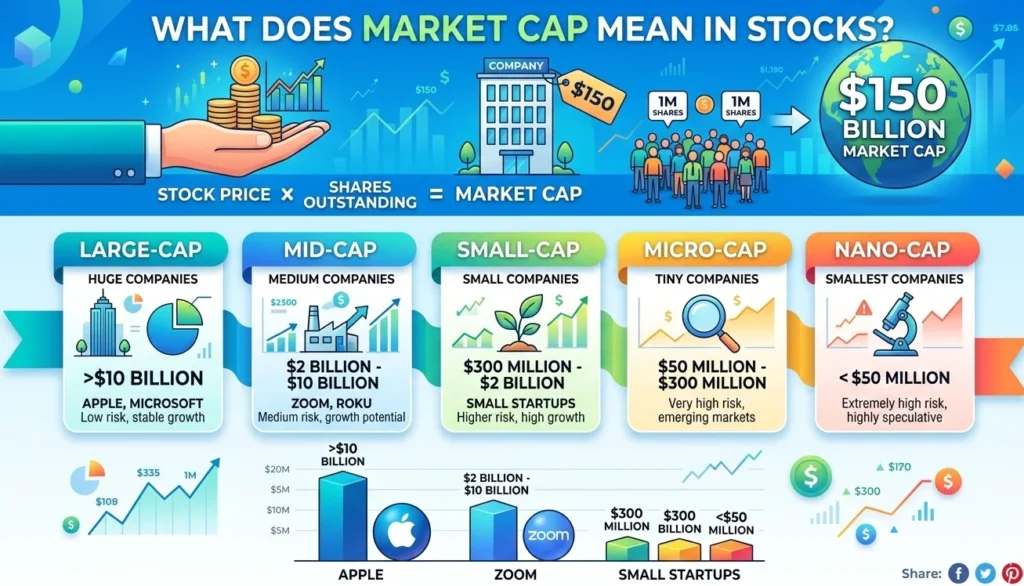
Market cap, or market capitalization, is the total market value of a company’s outstanding shares of stock. It is calculated by multiplying the current stock price by the total number of outstanding shares.
If you’ve ever read about stock markets, you’ve likely come across the term market cap or market capitalization. But what does market cap mean in stocks, and why is it so important for investors? Understanding this key concept can help you make smarter investment decisions, analyze companies, and gauge the size and stability of a business.
Market capitalization is more than just a number. It’s a quick way to classify companies, assess risk, and compare businesses of different sizes. From blue-chip giants to small startups, market cap is a cornerstone concept for anyone navigating the stock market.
Origin and Popularity of Market Cap
The concept of market capitalization emerged as stock markets grew in the 20th century. Investors and analysts needed a simple metric to measure the size of a company relative to others. Unlike revenue, profit, or assets, market cap reflects investor perception and market sentiment.
Why is market cap so popular?
- Quick comparison: Investors can instantly compare company sizes.
- Risk assessment: Market cap gives clues about volatility and stability.
- Portfolio diversification: Helps investors balance investments across small, mid, and large-cap stocks.
Today, market cap is a standard metric in financial news, stock analysis, and investment platforms, often appearing alongside price, P/E ratio, and dividend yield.
How Market Cap is Calculated
Calculating market capitalization is straightforward:
Formula:Market Cap=Current Stock Price×Total Outstanding Shares
Example:
- A company has 10 million shares outstanding.
- Current stock price is $50.
- Market Cap = 10,000,000 × $50 = $500,000,000
Table: Market Cap Calculation Example
| Company | Shares Outstanding | Stock Price | Market Cap |
|---|---|---|---|
| Company A | 10,000,000 | $50 | $500,000,000 |
| Company B | 2,000,000 | $200 | $400,000,000 |
| Company C | 50,000,000 | $10 | $500,000,000 |
Notice that companies with very different stock prices can have the same market cap, showing that stock price alone doesn’t indicate the company’s size.
Types of Market Cap
Companies are typically categorized based on their market capitalization. This helps investors evaluate risk, growth potential, and stability.
1. Large-Cap Stocks
- Definition: Companies with a market cap of $10 billion or more.
- Characteristics: Stable, often industry leaders, lower risk, steady dividends.
- Examples: Apple, Microsoft, Amazon.
2. Mid-Cap Stocks
- Definition: Market cap between $2 billion and $10 billion.
- Characteristics: Moderate growth potential, some risk, good balance between stability and opportunity.
- Examples: Zoom, Spotify, Under Armour.
3. Small-Cap Stocks
- Definition: Market cap between $300 million and $2 billion.
- Characteristics: High growth potential, higher volatility, less stability.
- Examples: Regional banks, emerging tech startups.
4. Micro-Cap and Nano-Cap Stocks
- Micro-cap: $50 million – $300 million
- Nano-cap: Less than $50 million
- Characteristics: Very high risk, often speculative, illiquid, but potentially high rewards.
Table: Market Cap Categories
| Category | Market Cap Range | Risk & Growth Potential | Example Companies |
|---|---|---|---|
| Large-Cap | $10B+ | Low risk, stable, steady growth | Apple, Microsoft |
| Mid-Cap | $2B – $10B | Moderate risk, moderate growth | Zoom, Spotify |
| Small-Cap | $300M – $2B | High risk, high growth | Local startups |
| Micro-Cap | $50M – $300M | Very high risk, speculative | Emerging tech |
| Nano-Cap | < $50M | Extremely high risk | Tiny startups |
Why Market Cap Matters for Investors
Understanding market cap is critical because it affects:
1. Investment Risk
- Large-cap companies are typically safer investments during economic downturns.
- Small-cap companies are more volatile and susceptible to market swings.
2. Portfolio Diversification
- Investing across different market cap categories can balance risk and growth potential.
- Example: Mix of 50% large-cap, 30% mid-cap, 20% small-cap stocks.
3. Company Comparison
- Market cap allows investors to compare companies regardless of stock price.
- Example: A $50 stock with 10M shares vs. a $500 stock with 1M shares can have the same market cap.
4. Acquisition and Mergers
- Market cap helps determine company valuation in mergers or acquisitions.
Real-World Examples of Market Cap
- Apple (Large-Cap): Market cap over $2 trillion. Stable, low-risk investment.
- Zoom (Mid-Cap): Market cap around $5 billion. Moderate growth potential.
- Local Startup (Small-Cap): Market cap $150 million. High risk, potentially high reward.
Observation: Market cap gives an instant sense of size, but it doesn’t tell the full story about revenue, debt, or profitability.
Market Cap vs. Other Metrics
While market cap is useful, it’s not the only metric to evaluate a company. Here’s a comparison:
| Metric | Meaning | Difference from Market Cap |
|---|---|---|
| Market Cap | Total value of outstanding shares | Reflects investor sentiment |
| Revenue | Total income from sales | Shows company performance |
| Net Income | Profit after expenses | Indicates profitability |
| P/E Ratio | Price-to-earnings ratio | Measures valuation relative to profit |
Tip: Always use market cap alongside other metrics for a complete analysis.
Market Cap and Stock Price
It’s important to understand that market cap and stock price are not the same:
- Stock price: Price of a single share.
- Market cap: Total value of all shares combined.
Example:
- Company A: $100 per share, 1M shares → Market cap = $100M
- Company B: $10 per share, 10M shares → Market cap = $100M
Even though Company B’s stock price is lower, its total market cap is equal to Company A.
Pros and Cons of Using Market Cap
Pros
- Simple and easy to calculate.
- Provides a quick measure of company size.
- Useful for risk assessment and portfolio planning.
Cons
- Doesn’t reflect debt, revenue, or profit.
- Can fluctuate with stock price volatility.
- Doesn’t account for private company valuations.
Table: Pros and Cons of Market Cap
| Pros | Cons |
|---|---|
| Easy to calculate | Stock price fluctuations affect it |
| Quick measure of company size | Ignores debt and revenue |
| Helps classify companies | Not suitable for private companies |
| Useful for risk assessment | Doesn’t show profit margins |
Tips for Investors Using Market Cap
- Diversify: Don’t rely only on large-cap stocks; include mid and small-cap for growth.
- Use with P/E ratio: High market cap but high P/E ratio may indicate overvaluation.
- Understand volatility: Small-cap stocks can rise fast but drop quickly.
- Compare within industry: Market cap is best used to compare companies in the same sector.
FAQs
1. What does market cap mean in stocks?
It’s the total value of a company’s outstanding shares, showing its size and market value.
2. How is market cap calculated?
Multiply the current stock price by the total number of outstanding shares.
3. What are large-cap, mid-cap, and small-cap stocks?
Categories based on market capitalization:
- Large-cap: $10B+
- Mid-cap: $2B–$10B
- Small-cap: $300M–$2B
4. Does market cap indicate company performance?
Not fully. It shows size and investor perception but not profit, revenue, or debt.
5. Can market cap change?
Yes, market cap fluctuates with stock price movements and issuance of new shares.
6. Why is market cap important for investors?
It helps assess risk, compare companies, and diversify portfolios.
7. Is a high market cap always better?
Not necessarily. High market cap can indicate stability, but growth potential may be higher in mid or small-cap stocks.
8. How is market cap different from enterprise value?
Market cap only considers stock value, while enterprise value includes debt, cash, and other financial factors.
Conclusion
Market cap is a cornerstone concept in stock market investing. It tells you the size, stability, and perceived value of a company at a glance. While it’s easy to calculate and widely used, market cap should always be considered alongside revenue, profit, P/E ratios, and debt to make informed investment decisions.
Key Takeaways:
- Market cap = Stock price × Total outstanding shares.
- Large-cap, mid-cap, small-cap, micro-cap, and nano-cap help classify companies.
- Provides a snapshot of company size and investor perception.
- Not a complete indicator of financial health—use alongside other metrics.
- Essential for portfolio diversification, risk assessment, and company comparison.
With a solid understanding of market cap, investors can make smarter, more informed decisions while navigating the complex world of stocks.
Read More Related Articles:
- Arrow Mean in a Chemical Equation: Complete Student Guide In 2026
- What Does PK Mean in Betting? How Pick’em Lines Work in Sportsbooks In 2026
- Exclamation Point Mean in a Car: Don’t Ignore This Warning In 2026

Ivy Madison is a content creator at TextSprout.com, specializing in word definitions, internet slang, acronyms, and text abbreviations. She delivers clear and engaging explanations, helping readers quickly understand modern digital language and trending terms.