
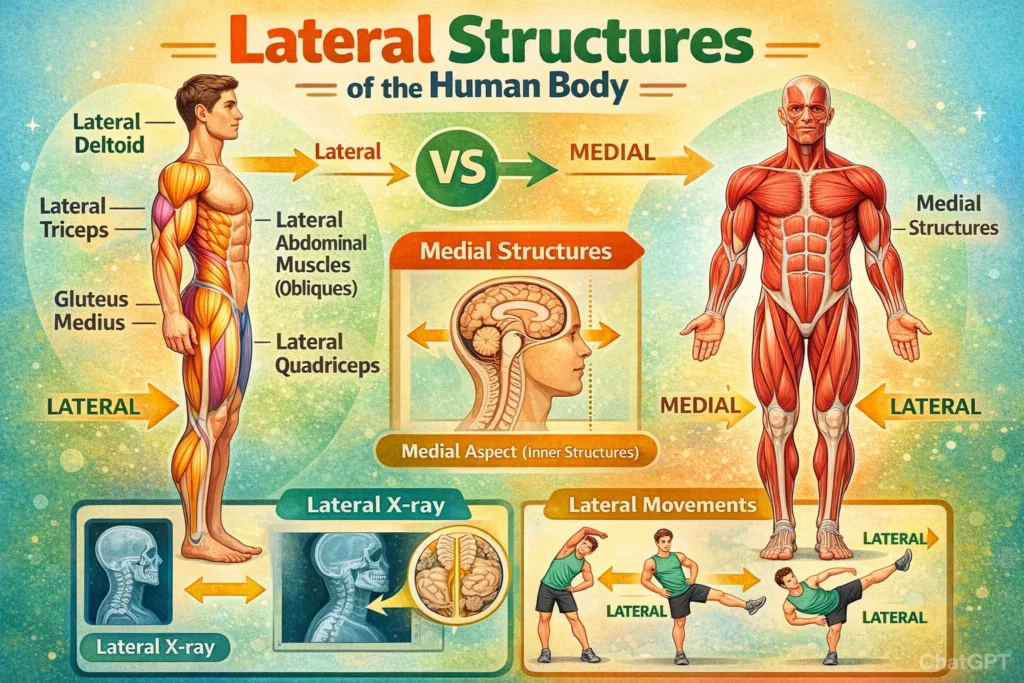
In anatomy, lateral refers to a position or direction that is away from the midline of the body. Structures on the outer sides of the body, compared to those closer to the center, are described as lateral. For example, the arms are lateral to the chest.
Understanding anatomical terminology is essential for students, healthcare professionals, and fitness enthusiasts. Among these terms, lateral plays a critical role in describing location, orientation, and movement within the human body. Let’s explore this concept in detail, its origins, practical usage, examples, and related terms.
Origin of the Term “Lateral”
The term lateral comes from the Latin word lateralis, which means “of the side.” Its adoption in anatomy dates back to classical medical texts, where precise descriptions of body parts were crucial for surgery, anatomy studies, and medical training.
Over time, lateral became a universally recognized directional term in medicine and biology, providing clarity when describing the position of organs, muscles, bones, and movements relative to the body’s midline.
Usage of Lateral in Anatomy
Anatomical terminology is full of directional descriptors that help professionals communicate accurately. Lateral is often paired with other terms to describe location, movement, and symmetry.
- Primary Usage: Indicating a body part situated away from the midline.
- Example: The ears are lateral to the nose.
- Movement Context: Movements directed toward the side of the body are called lateral movements.
- Example: Lateral raises in fitness target the shoulder muscles.
- Clinical Context: Doctors use lateral imaging or X-rays to view side aspects of organs.
- Example: A lateral chest X-ray provides a side view of the lungs and heart.
Lateral vs. Related Anatomical Terms
Understanding lateral requires comparing it with similar terms to avoid confusion. Here’s a simple table to clarify:
| Term | Meaning | Example |
|---|---|---|
| Medial | Toward the midline of the body | The nose is medial to the eyes |
| Lateral | Away from the midline | The ears are lateral to the eyes |
| Proximal | Closer to the point of attachment | The elbow is proximal to the wrist |
| Distal | Farther from the point of attachment | The fingers are distal to the wrist |
| Superior | Above or higher | The head is superior to the neck |
| Inferior | Below or lower | The stomach is inferior to the chest |
Using these terms correctly ensures clear communication, particularly in medical, educational, and fitness settings.
Examples of Lateral in Context
Let’s look at some practical examples of how lateral is used:
- Friendly / Neutral Tone:
- “Your thumb is lateral to your pinky when the palm faces forward.”
- “Lateral leg lifts are great for strengthening your outer thighs.”
- Clinical / Professional Tone:
- “A lateral view of the knee joint can help identify meniscus tears.”
- “The lateral malleolus refers to the outer part of the ankle bone.”
- Negative / Critical Tone:
- “Incorrect lateral positioning during surgery can lead to misdiagnosis or complications.”
These examples show that lateral is versatile and appears in anatomy, sports, and medical imaging.
Lateral Movements in Exercise
In fitness and rehabilitation, lateral movements help target muscles on the outer side of limbs or the torso. Here’s a breakdown:
| Exercise | Target Muscle | How It Uses Lateral Concept |
|---|---|---|
| Lateral Raises | Deltoids (shoulders) | Lifts arms away from the body’s midline |
| Side Lunges | Glutes, quadriceps | Moves legs laterally, away from the center |
| Lateral Band Walks | Hip abductors | Side-to-side movement enhancing hip stability |
| Side Plank | Obliques | Engages muscles along lateral aspects of the torso |
These exercises not only highlight the practical meaning of lateral but also its role in movement science.
Lateral in Medical Imaging
Medical professionals frequently use the term lateral in diagnostic imaging:
- X-rays: Lateral views show structures from the side.
- CT and MRI scans: Lateral slices help visualize organs and tissues from side perspectives.
- Ultrasound: Lateral positioning of the probe can capture cross-sectional images of muscles or organs.
Example:
“The lateral chest X-ray revealed fluid accumulation behind the lungs that wasn’t visible on the frontal view.”
Comparison with Other Directions
Understanding lateral in contrast to other directional terms is key to avoiding errors:
| Position | Relation to Midline | Common Confusion |
|---|---|---|
| Lateral | Away from midline | Often confused with external |
| Medial | Toward midline | Opposite of lateral |
| Anterior | Front of the body | Can overlap with lateral in diagonal planes |
| Posterior | Back of the body | Lateral posterior is the side-back area |
Remembering these relationships improves anatomical literacy and accuracy in professional communication.
Alternate Meanings and Usage
Though primarily anatomical, lateral has other uses:
- Linguistics: Referring to sounds produced with airflow along the side of the tongue (e.g., lateral consonants like “l”).
- Business/Organization: Lateral moves indicate a change of position without promotion.
- Technology: Lateral refers to movement across a plane, such as in lateral scanning or lateral transfer of data.
In anatomy, sticking to position and direction away from the midline is safest and most precise.
Professional Alternatives
In medical writing or teaching, you can also use:
- Sideward / Side-facing (less formal)
- Outer (descriptive, non-technical)
- Peripheral (context-specific, often for nerves or vessels)
Example:
“The outer aspect of the thigh corresponds to the lateral thigh region in anatomical terms.”
Example Table: Common Lateral Structures in the Body
| Body Part | Lateral Structure | Description |
|---|---|---|
| Arm | Lateral epicondyle | Outer projection of the elbow bone |
| Leg | Lateral malleolus | Outer part of the ankle bone |
| Torso | Lateral abdominal muscles | Muscles on the sides of the abdomen |
| Head | Lateral canthus | Outer corner of the eye |
FAQs
What does lateral mean in simple terms?
It means “on the side” or away from the center of the body. For example, your ears are lateral to your nose.
What is the opposite of lateral in anatomy?
The opposite is medial, which means closer to the midline of the body.
Is lateral the same as external?
Not exactly. External refers to the outside of the body or structure, while lateral specifically means away from the midline.
Where is the lateral side of the leg?
It is the outer side of the leg, including structures like the lateral malleolus (outer ankle bone).
What does lateral mean in movement exercises?
It describes side-to-side movements away from the midline, like lateral raises or side lunges.
Why are lateral X-rays used?
They provide a side view of structures, revealing details not visible in front-facing (anteroposterior) images.
Can lateral refer to the head?
Yes, for example, the lateral canthus is the outer corner of the eye.
Are there other meanings of lateral outside anatomy?
Yes, in linguistics, technology, and business, lateral can describe side sounds, movements, or job changes.
Conclusion
Lateral is a fundamental anatomical term that communicates direction away from the body’s midline. From understanding body parts and performing exercises to interpreting medical imaging, grasping the concept of lateral ensures precision and clarity.
- Lateral always relates to the side or away from the midline.
- Opposite of lateral is medial.
- Lateral movements and structures are vital in fitness, rehabilitation, and diagnostics.
- Use alternative terms like sideward or outer for non-technical communication.
By mastering this term, students, professionals, and enthusiasts can describe anatomy and movement with confidence.
Read More Related Articles:
- MRN Mean in Medical Terms: Medical Record Number Explained In 2026
- ADL Means in Medical Terms: Assessment & Clinical Use In 2026
- HMB Meaning in Text Messages: What It Stands For, When to Use It &Better Alternatives (2026)

Neon Samuel is a digital content creator at TextSprout.com, dedicated to decoding modern words, slang, and expressions. His writing helps readers quickly grasp meanings and understand how terms are used in real conversations across text and social platforms.