
ISG in text usually means “I Swear to God.”
It is used to emphasize honesty, frustration, surprise, or strong emotion in casual digital conversations such as texting, social media, and chat apps.
ISG is one of those short text abbreviations that can feel confusing the first time you see it. It looks simple, yet its meaning can change depending on tone, platform, and the relationship between the people texting. In texting, understanding isg meaning text helps you recognize that it usually stands for “I swear to God,” which people use to emphasize honesty or strong feelings in a conversation.
In texting, understanding isg meaning in text helps clarify that it usually stands for “I swear to God,” often used to emphasize honesty or strong feelings in a message.
If you have ever seen ISG in a message and paused to wonder what the sender really meant, you are not alone.
This guide breaks it down clearly, naturally, and in real world terms so you always know how to read it and when or if to use it yourself.
Why ISG Is Common in Text Messages Today
Modern texting favors speed, emotion, and shorthand.
People want to say more with fewer words while still showing how strongly they feel.
ISG works because it adds emotional weight without needing a long explanation.
It can show sincerity, annoyance, excitement, disbelief, or urgency depending on how it is written and where it appears.
On social media, understanding what does isg mean on instagram helps you recognize that it usually stands for “I swear to God,” used to express emphasis, honesty, or strong emotion in posts and messages.
On social media, understanding what does isg mean on snapchat helps you see that it usually stands for “I swear to God,” used to emphasize seriousness or honesty in a message.
In many cases, ISG functions as an intensifier rather than a literal religious statement.
Origin and Background of ISG
ISG comes directly from the spoken phrase “I swear to God.”
This phrase has been used for centuries to express honesty or emphasis.
As texting culture evolved, long phrases were shortened to initials for convenience.
ISG became popular in the early 2010s alongside similar abbreviations like OMG and ISTG.
The term spread quickly on platforms like Twitter, Snapchat, Instagram captions, and private messaging apps.
What Does ISG Mean in Text Conversations?
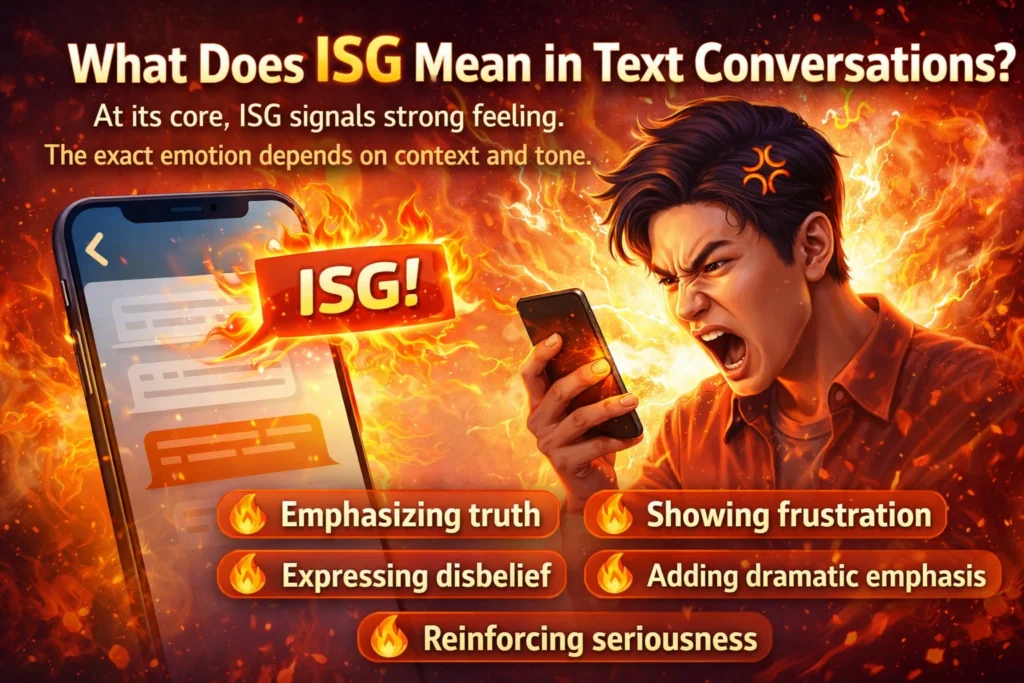
At its core, ISG signals strong feeling.
The exact emotion depends on context and tone.
Common intentions behind ISG include
- Emphasizing truth
- Showing frustration
- Expressing disbelief
- Adding dramatic emphasis
- Reinforcing seriousness
Unlike formal language, ISG is emotionally driven rather than informational.
Common Ways ISG Is Used in Texting
Emphasizing Honesty
People often use ISG to reinforce that they are telling the truth.
Example
ISG I did not touch your phone
Here, ISG works as a verbal underline.
Expressing Frustration or Annoyance
ISG can show that someone is reaching their limit.
Example
ISG if this app crashes again I am done
The phrase intensifies emotion rather than adding new information.
Showing Surprise or Disbelief
Sometimes ISG reflects shock.
Example
ISG that plot twist caught me off guard
The tone here is expressive and casual.
Adding Humor or Drama
Among friends, ISG can be playful.
Example
ISG this pizza saved my entire day
This usage is exaggerated and lighthearted.
Tone Variations of ISG in Text
Tone matters more than the words themselves.
Capitalization, punctuation, and emojis all affect meaning.
Friendly or Playful Tone
Often used with exaggeration or humor.
Example
ISG 😂 that was the funniest video I have seen all week
Neutral Emphasis
Straightforward reinforcement.
Example
ISG I already sent the email
Frustrated or Dismissive Tone
Used when emotions are running high.
Example
ISG you never listen
This version can feel sharp depending on the relationship.
Example Table Showing ISG in Context
| Text Message | Intended Tone | Meaning |
|---|---|---|
| ISG I locked the door | Honest and reassuring | Speaker is serious |
| ISG this weather is awful | Frustrated | Emphasizing annoyance |
| ISG 😂 that was wild | Playful | Lighthearted reaction |
| ISG stop asking me | Irritated | Emotional boundary |
Is ISG Considered Rude or Offensive?
ISG is informal and emotional.
It is not inherently rude, but it can feel intense.
Some people may be uncomfortable with religious references.
Others may interpret it as aggressive if used during conflict.
It is best avoided in professional, formal, or sensitive conversations.
When You Should Avoid Using ISG
ISG does not fit every situation.
Avoid using ISG in
- Work emails
- Academic writing
- Customer service conversations
- Messages to people you do not know well
- Formal announcements
In these settings, clarity and professionalism matter more than emotional emphasis.
Professional and Polite Alternatives to ISG
If you want emphasis without informality, consider these options.
| Alternative Phrase | Best Use Case |
|---|---|
| I assure you | Professional communication |
| I am confident that | Formal tone |
| Honestly | Casual but polite |
| To be clear | Workplace messages |
| I truly mean it | Emotional but respectful |
These options convey seriousness without slang.
ISG Compared With Similar Text Abbreviations
Understanding similar terms helps avoid confusion.
ISG vs ISTG
ISG and ISTG both stand for I swear to God.
ISTG is more explicit and slightly more common online.
ISG vs OMG
OMG expresses surprise or excitement.
ISG emphasizes sincerity or emotion.
ISG vs TBH
TBH means to be honest.
It is calmer and less emotionally charged than ISG.
Comparison Table of Related Slang
| Abbreviation | Meaning | Emotional Strength |
|---|---|---|
| ISG | I swear to God | High |
| ISTG | I swear to God | High |
| TBH | To be honest | Medium |
| OMG | Oh my God | Medium |
| FR | For real | Medium |
Alternate Meanings of ISG
Although rare in texting, ISG can have other meanings depending on context.
Outside casual messages, ISG may refer to
- Information Services Group in business settings
- Integrated Steering Group in technical documents
- International School Group in education
In text conversations, however, ISG almost always means I swear to God.
How to Tell Which Meaning Applies
Context is everything.
If the message is casual, emotional, or conversational, ISG likely means I swear to God.
If the message involves business, reports, or technical discussion, another meaning may apply.
Always look at the surrounding words and the platform.
Is ISG Still Popular Today?
Yes, ISG remains widely used.
It continues to appear in tweets, comments, captions, and private messages.
Younger users often prefer ISTG, but ISG is still recognizable across age groups.
Slang evolves, yet emotional shorthand tends to last.
Should You Use ISG Yourself?
Use ISG only when it matches your tone and audience.
It works best with friends, peers, or casual online interactions.
If there is any chance of misunderstanding, choose a clearer phrase.
FAQs
What does ISG mean in texting?
ISG means I swear to God and is used to emphasize emotion or sincerity.
Is ISG rude to use?
It is not rude by default, but it can sound intense depending on tone and context.
Can ISG be used jokingly?
Yes, many people use ISG humorously with friends.
Is ISG appropriate for work messages?
No, it is too informal for professional communication.
What is the difference between ISG and ISTG?
Both mean the same thing, but ISTG spells it out more clearly.
Does ISG always involve religion?
Not usually. Most users treat it as an expression rather than a literal statement.
Is ISG used more by younger people?
Yes, it is more common among teens and young adults.
How do I reply if someone texts me ISG?
Respond naturally based on context. You do not need to repeat the slang.
Conclusion:
ISG is a powerful little phrase in digital communication that adds emotion, emphasis, and personality to casual messages. Understanding its tone and context helps prevent misreading intent, while using it thoughtfully keeps conversations natural and respectful. When you know your audience, ISG can be expressive and effective, but when you’re unsure, choosing a clearer alternative is always the safer option.
Read More Related Articles:
- 12:12 Love Meaning: Signs from the Universe You Can’t Ignore (2026)
- OP Meaning in Gaming – The Term Every Gamer Uses (2026)
- POG Mean in Gaming: From Epic Wins to Gaming Chat Reactions (2026)

Neon Samuel is a digital content creator at TextSprout.com, dedicated to decoding modern words, slang, and expressions. His writing helps readers quickly grasp meanings and understand how terms are used in real conversations across text and social platforms.