
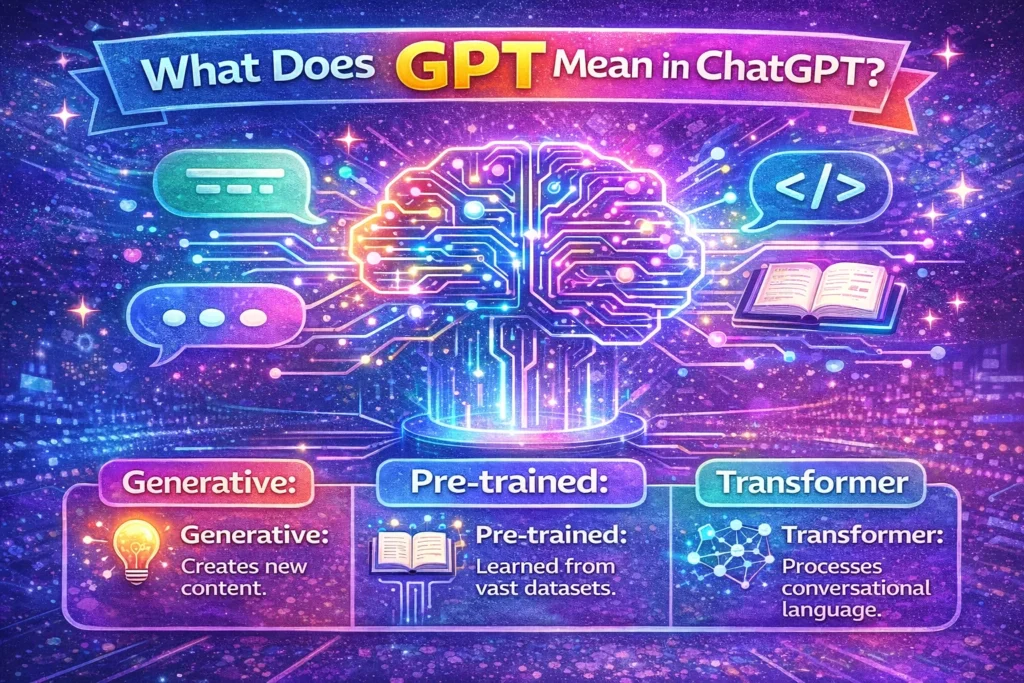
In ChatGPT, the term GPT stands for Generative Pre-trained Transformer. It refers to a type of artificial intelligence model designed to understand and generate human-like text. The model is trained on large datasets and uses a transformer architecture to predict and produce language in a natural and conversational way
If you have ever asked a chatbot to explain a concept, write a paragraph, or help with homework, you have already experienced what GPT technology can do. The phrase might sound technical at first, yet its purpose is simple. It helps computers understand language and respond to people in a way that feels natural and useful.
Understanding what GPT means in ChatGPT helps explain how modern AI chatbots work and why they can answer questions, generate ideas, and even hold conversations.
Understanding the Term GPT in Simple Words
To fully understand GPT, it helps to break down the three words that form the acronym.
Generative
The word generative means the model can create new content.
Instead of simply retrieving information from a database, it generates responses based on patterns it learned during training.
For example, GPT can generate:
- Explanations
- Articles
- Emails
- Stories
- Code snippets
- Answers to questions
When you ask ChatGPT a question, it does not search the internet like a traditional search engine. Instead, it generates an answer using patterns learned from large amounts of text.
Pre-trained
The phrase pre-trained means the model has already been trained before people start using it.
During training, the AI analyzes huge collections of text such as:
- Books
- Websites
- Articles
- Educational content
- Conversations
This process helps the model learn grammar, context, reasoning patterns, and general knowledge.
After pre-training, developers refine the model further so it responds more accurately and safely.
Transformer
The transformer is the underlying machine learning architecture that makes GPT powerful.
Introduced in 2017, the transformer model improved how computers understand language. Instead of reading text word by word in a strict sequence, it looks at the relationship between all words in a sentence.
This ability allows GPT models to:
- Understand context
- Recognize meaning
- Generate coherent sentences
- Maintain conversation flow
Without the transformer architecture, modern conversational AI would not be nearly as advanced.
What Does GPT Mean in ChatGPT Specifically?
In ChatGPT, the term GPT refers to the AI model powering the chatbot.
ChatGPT is essentially an application built around the GPT language model.
Think of it like this.
| Component | Role |
|---|---|
| GPT | The language model that understands and generates text |
| Chat Interface | The system that allows users to talk with the AI |
| Training & Safety Layers | Improvements that make responses helpful and safe |
In simple terms, GPT is the brain of ChatGPT, while ChatGPT itself is the platform where users interact with that brain.
Origin and History of GPT Technology
The GPT model was created by OpenAI, a research organization focused on artificial intelligence.
Over time, several versions of GPT were developed, each more powerful than the last.
Major GPT Versions
| Model | Release Year | Key Improvement |
|---|---|---|
| GPT | 2018 | First generative transformer language model |
| GPT-2 | 2019 | Stronger text generation and coherence |
| GPT-3 | 2020 | Massive leap in language understanding |
| GPT-4 | 2023 | Improved reasoning, accuracy, and creativity |
These improvements helped AI systems move from simple text prediction to advanced conversational assistants.
The release of ChatGPT made this technology accessible to everyday users, students, writers, programmers, and businesses.
Why GPT Became So Popular
The popularity of GPT technology grew rapidly because it solved several major challenges in natural language processing.
Key reasons GPT gained attention
- It produces human-like writing
- It understands context within conversations
- It adapts to many tasks
- It requires less task-specific programming
- It works across many industries
Before GPT models existed, most AI systems required specific training for each task. GPT changed this by learning general language patterns that can be applied to many tasks.
How GPT Works in ChatGPT
When someone types a message into ChatGPT, several steps happen behind the scenes.
- The system analyzes the user’s text.
- GPT evaluates the context of the conversation.
- The model predicts the most likely sequence of words for the response.
- The system delivers a natural language answer.
Instead of copying from a stored list of answers, GPT calculates responses dynamically using probability and context.
This is why ChatGPT can respond to:
- Homework questions
- Writing requests
- Coding problems
- Creative prompts
- Everyday questions
Each response is generated in real time.
Real-World Uses of GPT Technology
GPT models are used across many industries, not just chatbots.
Education
Students use GPT tools to:
- Understand complex concepts
- Get explanations for homework
- Practice writing skills
- Summarize notes
Business
Companies use GPT to help with:
- Customer support
- Content creation
- Marketing copy
- Email automation
Programming
Developers use GPT tools to:
- Generate code
- Debug programs
- Explain programming concepts
- Translate between programming languages
Writing and Creativity
Writers use GPT to:
- Brainstorm ideas
- Draft articles
- Improve grammar
- Create stories and scripts
These applications demonstrate why GPT has become such a widely discussed technology.
Examples of GPT Usage in ChatGPT
Here are some simple conversation examples showing how GPT works.
Friendly Example
User:
Can you explain photosynthesis?
ChatGPT response:
Photosynthesis is the process plants use to convert sunlight, water, and carbon dioxide into energy and oxygen.
Neutral Example
User:
Summarize the causes of World War I.
ChatGPT response:
World War I began due to a combination of nationalism, alliances, imperial competition, and the assassination of Archduke Franz Ferdinand.
Casual Example
User:
Write a short birthday message for my friend 🎉
ChatGPT response:
Happy Birthday! I hope your day is filled with laughter, great memories, and plenty of cake.
These examples show how GPT adapts its tone depending on the request.
Table: Tasks GPT Can Perform
| Task Type | Example Request | Output |
|---|---|---|
| Explanation | Explain gravity | Educational explanation |
| Writing | Write a blog intro | Paragraph content |
| Coding | Create a Python function | Code snippet |
| Translation | Translate English to Spanish | Converted sentence |
| Summarization | Summarize an article | Short summary |
GPT Compared With Other AI Technologies
Many people confuse GPT with other artificial intelligence tools.
The following table clarifies the differences.
| Technology | Purpose | Example |
|---|---|---|
| GPT | Generates and understands language | ChatGPT responses |
| Search Engines | Retrieve existing web pages | Google search results |
| Voice Assistants | Voice command systems | Alexa or Siri |
| Recommendation AI | Suggests products or content | Netflix recommendations |
GPT is unique because it creates original responses rather than retrieving prewritten answers.
Alternate Meanings of GPT
Although GPT is most commonly associated with artificial intelligence, the acronym can have other meanings depending on the context.
| Field | Meaning |
|---|---|
| Artificial Intelligence | Generative Pre-trained Transformer |
| Technology Hardware | GUID Partition Table |
| Gaming Communities | Occasionally used as slang abbreviations |
However, when discussing ChatGPT, GPT almost always refers to Generative Pre-trained Transformer.
Professional or Polite Alternatives
Sometimes people prefer to describe GPT technology using more general phrases.
Examples include:
- AI language model
- conversational AI system
- machine learning text generator
- natural language processing model
These phrases can help when explaining the concept to audiences unfamiliar with technical terminology.
Table: GPT Features Explained
| Feature | What It Means | Why It Matters |
|---|---|---|
| Language Understanding | Interprets meaning in text | Enables accurate answers |
| Context Awareness | Remembers earlier messages | Improves conversation flow |
| Text Generation | Creates new sentences | Allows creative responses |
| Multitasking Ability | Handles many tasks | Useful across industries |
Common Misunderstandings About GPT
Many people assume GPT functions like a search engine.
That is not exactly correct.
Here are a few common misconceptions.
GPT searches the internet for answers
In reality, GPT generates responses based on patterns learned during training.
GPT always knows the correct answer
Like any AI system, GPT can occasionally make mistakes or provide incomplete information.
GPT thinks like a human
GPT does not have thoughts or emotions.
It processes patterns in language using mathematical models.
Understanding these points helps people use the technology more effectively.
FAQs
What does GPT stand for in ChatGPT?
GPT stands for Generative Pre trained Transformer, a type of artificial intelligence model designed to understand and generate human like text.
Why is GPT important in ChatGPT?
GPT is the core technology that allows ChatGPT to understand questions and produce conversational responses.
Who created GPT technology?
GPT models were developed by the artificial intelligence research organization OpenAI.
Is GPT the same as ChatGPT?
Not exactly. GPT is the language model, while ChatGPT is the application that allows users to interact with that model.
How does GPT generate answers?
It predicts the most likely sequence of words based on context and patterns learned during training.
Can GPT replace search engines?
GPT can answer many questions, but search engines are still useful for finding specific websites or real time information.
Is GPT used outside of ChatGPT?
Yes. GPT models power many tools used in writing, programming, customer support, and research.
Will GPT continue to improve?
Artificial intelligence models are constantly evolving, so future versions will likely become even more capable.
Conclusion
The term GPT in ChatGPT refers to Generative Pre trained Transformer, an advanced artificial intelligence model designed to understand and generate human language.
This technology forms the foundation of modern conversational AI systems.
GPT works by learning patterns from large amounts of text and using those patterns to create meaningful responses. That ability allows ChatGPT to assist with writing, explanations, coding, education, and everyday questions.
Key points to remember include:
- GPT stands for Generative Pre trained Transformer
- It powers the responses generated in ChatGPT
- The technology uses transformer architecture to understand language
- GPT can perform many tasks including writing, summarizing, and explaining information
As artificial intelligence continues to develop, GPT models are expected to play an even larger role in how people interact with technology and access information.
Read More Related Articles:
- NKDA Mean in Medical Terms: Medical Chart Terminology In 2026
- NOI Mean in Real Estate: Number That Drives Value In 2026
- Torque Mean in a Car: Secret to Quick Acceleration In 2026

Neon Samuel is a digital content creator at TextSprout.com, dedicated to decoding modern words, slang, and expressions. His writing helps readers quickly grasp meanings and understand how terms are used in real conversations across text and social platforms.