
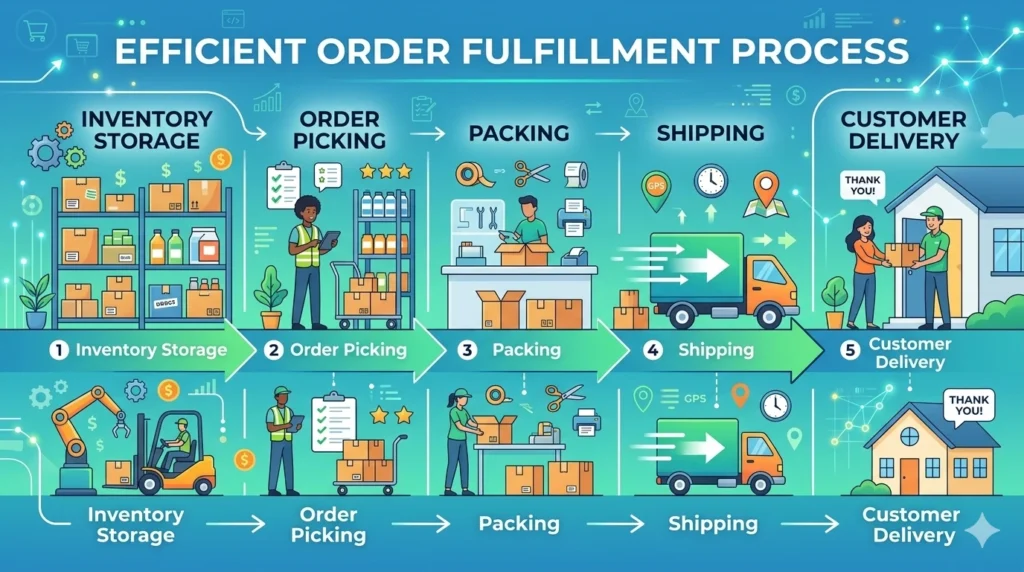
Fulfillment in shipping refers to the complete process of receiving, processing, packing, and delivering customer orders from a warehouse to the final customer.
It includes inventory storage, order picking, packing products, shipping them, and sometimes handling returns.
In simple terms, fulfillment is everything that happens after a customer places an order online until the package reaches their doorstep.
Imagine clicking the “Buy Now” button on your favorite online store. Within a few days, a package arrives neatly packed at your door. Behind that simple delivery lies a complex process known as order fulfillment in shipping.
Businesses today rely heavily on efficient fulfillment systems to keep customers satisfied. Fast delivery, accurate packing, and reliable logistics can make or break an online shopping experience. When fulfillment runs smoothly, customers receive exactly what they ordered and often come back for more.
The rapid growth of eCommerce has made fulfillment more important than ever. Companies must manage warehouses, coordinate shipping partners, track inventory, and handle returns while ensuring speed and accuracy.
Understanding what fulfillment means in shipping helps businesses improve logistics operations and also helps customers understand how their orders travel from warehouse shelves to their homes.
What Is Fulfillment in Shipping?
Fulfillment is the logistics process that begins when a customer places an order and ends when the product is successfully delivered.
The process typically includes:
• Receiving products from manufacturers
• Storing inventory in warehouses
• Processing customer orders
• Picking items from storage
• Packing items safely
• Shipping orders through delivery carriers
• Handling returns and exchanges
A fulfillment system ensures that the right product reaches the right customer quickly and efficiently.
The Origin and Growth of Fulfillment in Shipping
The concept of fulfillment became popular with the rise of mail-order catalogs in the early 20th century. Companies needed organized systems to process large numbers of customer orders.
However, fulfillment became a central business function during the eCommerce boom of the late 1990s and early 2000s.
Several factors contributed to its growth:
• Online shopping platforms expanded rapidly
• Customers expected faster delivery times
• Businesses began outsourcing logistics to fulfillment centers
• Advanced warehouse technology improved efficiency
Today, fulfillment operations use automation, robotics, and smart inventory systems to handle millions of orders daily.
Why Fulfillment Matters in Shipping
Fulfillment plays a major role in customer satisfaction and business success.
A strong fulfillment process ensures:
• Faster delivery times
• Accurate order handling
• Lower shipping costs
• Better inventory management
• Higher customer trust
Poor fulfillment, on the other hand, can lead to delayed shipments, wrong products being delivered, and unhappy customers.
For eCommerce businesses, fulfillment is often the difference between repeat buyers and lost customers.
Key Steps in the Fulfillment Process
The fulfillment process follows several organized stages.
1. Inventory Receiving
Products arrive from manufacturers or suppliers and are checked for quality and quantity before entering storage.
2. Inventory Storage
Items are stored in warehouses or fulfillment centers. Proper organization helps workers quickly locate products when orders arrive.
3. Order Processing
Once a customer places an order, the system verifies payment and sends the order details to the warehouse.
4. Picking
Workers or automated systems locate the ordered products within the warehouse.
5. Packing
Products are packed securely using protective materials to prevent damage during transit.
6. Shipping
Packages are handed over to shipping carriers such as postal services or courier companies.
7. Delivery and Returns
The order reaches the customer. If the customer wants to return the product, the fulfillment system handles the reverse logistics.
Fulfillment Process Overview
| Stage | Description | Goal |
|---|---|---|
| Inventory Receiving | Products arrive from suppliers | Verify quality and quantity |
| Storage | Items placed in warehouse shelves | Organized inventory |
| Order Processing | Order details sent to warehouse | Prepare items for shipping |
| Picking | Items retrieved from storage | Accurate product selection |
| Packing | Items packaged safely | Prevent damage |
| Shipping | Orders sent through carriers | Deliver to customers |
| Returns | Handling product returns | Customer satisfaction |
Real World Examples of Fulfillment in Shipping
Understanding fulfillment becomes easier with real life examples.
Example 1: Online Clothing Store
A customer orders a jacket from an online clothing website.
The fulfillment process looks like this:
- The website receives the order
- The warehouse system identifies the jacket location
- A worker picks the jacket from storage
- The item is packed in protective packaging
- A shipping label is printed
- The package is sent through a courier service
Within a few days, the customer receives the jacket.
Example 2: Electronics Retailer
An electronics company selling smartphones uses automated fulfillment centers.
Robotic systems locate the smartphone box, pack it, and send it to the shipping station. The package is then delivered to the customer within 24 to 48 hours.
Types of Fulfillment in Shipping
Businesses use different fulfillment models depending on their size and resources.
In House Fulfillment
Companies handle all logistics themselves using their own warehouses and staff.
This option offers greater control but requires more resources.
Third Party Fulfillment (3PL)
Businesses outsource logistics operations to specialized fulfillment companies.
These companies manage storage, packing, and shipping on behalf of the business.
Dropshipping
In dropshipping, sellers do not store products themselves.
When a customer places an order, the supplier ships the product directly to the customer.
Fulfillment Models Comparison
| Fulfillment Type | Who Handles Shipping | Best For | Key Advantage |
|---|---|---|---|
| In House | The business itself | Large companies | Full control |
| Third Party (3PL) | Logistics providers | Growing eCommerce brands | Saves time and effort |
| Dropshipping | Product suppliers | Small startups | No inventory needed |
Common Fulfillment Challenges
Even efficient fulfillment systems face challenges.
Some of the most common problems include:
Inventory shortages
Shipping delays
Packaging errors
Warehouse mismanagement
High shipping costs
Companies solve these issues by using advanced tracking systems and automated inventory management tools.
Tone and Context in Business Communication
The word fulfillment is mostly used in professional or business contexts. Its tone is usually neutral and technical.
Neutral Professional Tone
“The company improved its shipping fulfillment process to reduce delivery times.”
Friendly Business Tone
“We partner with trusted warehouses to ensure fast order fulfillment for our customers.”
Customer Support Tone
“Your order is currently in the fulfillment stage and will ship shortly.”
Fulfillment vs Similar Shipping Terms
Many people confuse fulfillment with other shipping related terms.
Fulfillment vs Shipping
Shipping refers only to the transportation of goods.
Fulfillment includes all logistics steps from order placement to delivery.
Fulfillment vs Logistics
Logistics is a broader term that includes transportation, warehousing, and supply chain management.
Fulfillment is a specific part of logistics focused on order processing and delivery.
Fulfillment vs Distribution
Distribution involves moving goods from manufacturers to retailers or warehouses.
Fulfillment focuses on sending products directly to customers.
Comparison Table of Related Terms
| Term | Meaning | Main Focus |
|---|---|---|
| Fulfillment | Entire order process | Customer delivery |
| Shipping | Transporting packages | Delivery movement |
| Logistics | Managing supply chain | Planning and coordination |
| Distribution | Moving products to stores | Wholesale supply |
Alternate Meanings of Fulfillment
Although fulfillment is commonly used in shipping and eCommerce, it has other meanings depending on the context.
Personal Fulfillment
In psychology or lifestyle discussions, fulfillment refers to a feeling of satisfaction or achievement in life.
Example:
“She found fulfillment in helping others.”
Legal Fulfillment
In legal contexts, fulfillment means completing obligations or meeting contractual requirements.
Example:
“The company fulfilled its contractual duties.”
Professional Alternatives to the Word Fulfillment
Sometimes businesses use related terms depending on the context.
Common alternatives include:
Order processing
Delivery management
Logistics handling
Order completion
Distribution services
These terms may appear in business reports or logistics discussions.
Practical Tips for Businesses Improving Fulfillment
Companies looking to improve their fulfillment process can follow several best practices.
Use warehouse management systems to track inventory
Optimize packaging to reduce shipping costs
Partner with reliable courier services
Use automated picking systems
Offer real time order tracking
Efficient fulfillment increases customer satisfaction and encourages repeat purchases.
Example Sentences Using Fulfillment
| Example Sentence | Context |
|---|---|
| The company improved its fulfillment process to deliver orders faster | Business operations |
| Our fulfillment center processes thousands of packages every day | Logistics |
| Your order has entered the fulfillment stage | Customer notification |
| Efficient fulfillment helps reduce shipping delays | Supply chain discussion |
FAQs
What does fulfillment mean in shipping?
Fulfillment in shipping refers to the complete process of receiving, processing, packing, and delivering customer orders from a warehouse to the final customer.
What is the fulfillment stage of an order?
The fulfillment stage begins after a customer places an order. During this stage the warehouse processes the order, picks the products, packs them, and prepares them for shipment.
What is a fulfillment center?
A fulfillment center is a warehouse facility where products are stored, orders are processed, and packages are prepared for shipment to customers.
What does order fulfillment include?
Order fulfillment includes inventory management, picking products, packing orders, shipping packages, and sometimes managing returns.
Is fulfillment the same as delivery?
No. Delivery is only the final step. Fulfillment includes the entire process from order placement to delivery.
Why is fulfillment important in eCommerce?
Fulfillment ensures customers receive their products quickly and accurately. Efficient fulfillment improves customer satisfaction and encourages repeat purchases.
What companies provide fulfillment services?
Many logistics companies offer third party fulfillment services that handle storage, packaging, and shipping for online businesses.
What happens after fulfillment is completed?
After fulfillment is completed the order is delivered to the customer. The process may also include follow up services such as returns or exchanges.
Conclusion
Fulfillment in shipping is a crucial process that connects online stores with customers around the world. It covers every step from receiving inventory to delivering the final package at the customer’s doorstep.
Businesses rely on efficient fulfillment systems to maintain fast shipping, accurate orders, and satisfied customers. Whether handled in house or through third party providers, a well organized fulfillment strategy can significantly improve operational efficiency.
For online retailers, mastering fulfillment is not just about logistics. It is about creating a reliable shopping experience that builds customer trust and long term brand loyalty.
Understanding how fulfillment works helps both businesses and customers appreciate the journey every package takes before it arrives safely at its destination.
Read More Related Articles:
- ABC Meaning in Roblox: What It Stands For and How It’s Used In 2026
- Torque Mean in a Car: Secret to Quick Acceleration In 2026
- NOI Mean in Real Estate: Number That Drives Value In 2026

Neon Samuel is a digital content creator at TextSprout.com, dedicated to decoding modern words, slang, and expressions. His writing helps readers quickly grasp meanings and understand how terms are used in real conversations across text and social platforms.