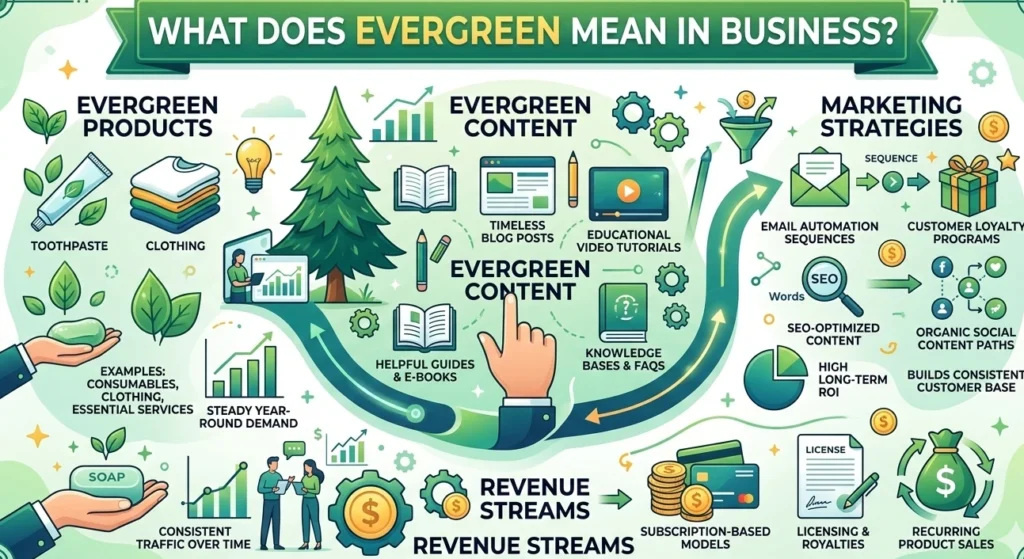
In business, “evergreen” refers to products, content, or strategies that remain valuable, relevant, and in demand over a long period without losing their effectiveness. Evergreen assets provide consistent revenue, engagement, or impact, unlike trends that fade quickly.
In the fast-moving world of business, trends come and go quickly. Marketing campaigns change, products evolve, and strategies shift with consumer demand. However, some ideas, content, and strategies remain relevant year after year. That’s where the term “evergreen” comes into play.
In business, evergreen refers to something that remains consistently valuable, relevant, and effective over a long period of time. It does not lose importance due to trends, seasons, or short-term changes in the market. Just like evergreen trees stay green throughout the year, evergreen business strategies or content continue to generate results long after they are created.
The concept of evergreen is commonly used in marketing, content creation, investing, and product strategy. Businesses aim to create evergreen products, services, or content because they provide steady value and long-term returns. Understanding what evergreen means in business can help entrepreneurs and marketers focus on sustainable growth instead of chasing short-lived trends.
The concept of evergreen is central to marketing, finance, content strategy, and long-term business planning. Companies that understand and leverage evergreen principles can secure steady growth and sustainable success.
Origin of the Term “Evergreen” in Business
The term “evergreen” comes from evergreen trees, which retain their leaves year-round. Unlike deciduous trees that lose foliage in winter, evergreen trees remain vibrant and constant.
Businesses adopted this metaphor to describe:
- Content: Articles, videos, or blogs that remain relevant indefinitely
- Products: Items with consistent demand regardless of seasonal trends
- Strategies: Marketing or sales tactics that generate results over the long term
Evergreen became popular in digital marketing around the 2000s when content and email automation needed long-lasting relevance. Companies noticed that certain resources kept generating value long after publication or launch, leading to the formal use of “evergreen business strategies.”
Why Evergreen Matters in Business
Evergreen approaches in business are powerful because they:
- Ensure long-term revenue: Products or services that remain relevant consistently generate sales.
- Reduce marketing costs: Content or campaigns that stay relevant need less frequent updates.
- Build authority: Evergreen content positions brands as reliable sources in their niche.
- Increase ROI: Resources with longevity offer better returns over time.
Example: A guide on “How to Start a Business” is evergreen content because new entrepreneurs need it year after year. On the other hand, a blog on “Top Marketing Trends 2026” becomes outdated within months.
Common Uses of “Evergreen” in Business
1. Evergreen Content
Content that remains relevant and valuable indefinitely.
- Examples:
- How-to guides
- Tutorials
- FAQs
- Product manuals
Practical tip: Optimize evergreen content for SEO to drive consistent traffic over years.
| Content Type | Example | Evergreen Potential |
|---|---|---|
| Blog post | “How to Start a Small Business” | High |
| Video tutorial | “Photoshop Basics for Beginners” | High |
| FAQ page | “Shipping and Returns Policy” | Very High |
| Industry news | “Tech Trends of 2026” | Low |
2. Evergreen Products
Products that maintain demand regardless of season or trend cycles.
- Examples:
- Basic household items: toothpaste, batteries, detergent
- Software subscriptions: antivirus programs, office suites
- Classic apparel: plain t-shirts, white sneakers
Practical insight: Evergreen products reduce risk because they are not dependent on fads. Companies like Procter & Gamble rely heavily on evergreen items for consistent revenue streams.
3. Evergreen Marketing Strategies
Marketing tactics that remain effective over time, such as:
- Email automation sequences
- Search engine optimization (SEO) campaigns
- Loyalty programs
- Referral programs
Example: A welcome email sequence for new subscribers continues to nurture leads year after year with minimal updates.
| Strategy Type | Example | Longevity |
|---|---|---|
| Email campaigns | Drip sequences for new users | High |
| Social media content | “How-to” video tutorials | High |
| Customer loyalty | Reward points system | Very High |
| Trend-based campaigns | Viral TikTok challenges | Low |
4. Evergreen Revenue Streams
Some business models rely on consistent, long-term income:
- Subscription models: Netflix, Spotify
- Licensing: Software or intellectual property
- Franchise models: McDonald’s, Subway
Evergreen revenue is predictable and stable, providing financial security and planning advantages.
Examples of Evergreen in Real-World Business
| Business Type | Evergreen Example | Why It’s Evergreen |
|---|---|---|
| E-commerce | Toothpaste, printer ink | Constant demand year-round |
| SaaS | Cloud storage subscription | Required consistently for users |
| Marketing agency | “Beginner’s Guide to SEO” blog post | Long-lasting value for clients |
| Education | Online course on Excel | Skills remain relevant indefinitely |
| Fitness | “Basic Yoga Routine for Beginners” video | Timeless interest and usability |
Pro tip: Evergreen content and products are not completely “set it and forget it.” Updating them periodically ensures accuracy, SEO relevance, and customer satisfaction.
Comparison with Trendy or Fad-Based Business Approaches
| Factor | Evergreen Approach | Trend-Based Approach |
|---|---|---|
| Longevity | Long-term | Short-term |
| Revenue Stability | High | Unpredictable |
| Marketing Frequency | Low to medium | High, must constantly push |
| Brand Authority | Builds credibility over time | May fade once trend ends |
| Examples | SEO content, toothpaste, software | Fidget spinners, viral memes |
Evergreen approaches often require strategic foresight, but the payoff is long-lasting.
Advantages of Evergreen Strategies
- Sustainable Growth: Continues generating revenue, leads, or engagement long after launch.
- Cost-Effective Marketing: Reduces the need for constant content creation or campaigns.
- Builds Brand Authority: Consistently valuable resources position the brand as reliable.
- Predictable Revenue: Helps with financial forecasting and planning.
- Customer Trust: Evergreen products and services fulfill ongoing needs.
Common Misconceptions About Evergreen
- Misconception: Evergreen content never needs updating.
Truth: Even evergreen resources require occasional updates for accuracy and relevance. - Misconception: Evergreen products are boring.
Truth: Evergreen doesn’t mean uninspired—it means essential and always in demand. - Misconception: Only digital products can be evergreen.
Truth: Physical products, services, and even business models can be evergreen.
Evergreen vs. Non-Evergreen Content
| Feature | Evergreen Content | Non-Evergreen Content |
|---|---|---|
| Relevance | Remains relevant for years | Loses relevance quickly |
| Maintenance | Low to medium | High, constant updates needed |
| SEO Value | Accumulates traffic over time | Short-lived spikes only |
| Example | “How to write a business plan” | “Top 10 Social Media Trends 2026” |
| Business Impact | Consistent leads or sales | Temporary engagement or buzz |
How to Create Evergreen Business Assets
- Focus on timeless topics: Choose content or products addressing fundamental needs.
- Prioritize quality: Long-lasting value comes from well-researched, well-executed resources.
- Optimize for search engines: SEO ensures evergreen content remains discoverable.
- Automate marketing where possible: Drip campaigns, scheduled social media posts, and automated workflows maintain engagement.
- Regularly update: Even evergreen assets benefit from occasional refreshes.
Example: HubSpot’s guides on marketing basics are evergreen because they cover principles that remain valid over years while minor updates ensure relevance.
Alternate Meanings of “Evergreen” in Business
While “evergreen” usually refers to content, products, or strategies, it can also mean:
- Finance: Evergreen loans or revolving credit facilities that do not require full repayment until canceled.
- Human Resources: Positions or skills that remain consistently valuable in an organization.
- Legal: Contracts or agreements that automatically renew unless terminated.
Polite alternatives for business writing include:
- Long-term
- Timeless
- Perennial
- Sustainable
Practical Examples Table
| Type | Example | Why Evergreen |
|---|---|---|
| Content | “How to Create a Business Plan” | Timeless, helpful for new entrepreneurs |
| Product | Toothpaste | Always in demand |
| Marketing Strategy | Welcome email sequence | Automates lead nurturing |
| Revenue Stream | Subscription software | Predictable, recurring revenue |
| HR Skills | Excel or communication training | Always valuable |
| Finance | Revolving credit facility | Continues until terminated |
FAQs
What does evergreen mean in marketing?
Evergreen marketing refers to campaigns or content that stay relevant over time, continually attracting leads and engagement.
Can a product be evergreen?
Yes, products with consistent, year-round demand like toothpaste, software subscriptions, or basic apparel are evergreen.
Is evergreen content better than trend-based content?
Both have value, but evergreen content provides long-term traffic and brand authority, while trend-based content provides short-term visibility.
Why is evergreen important for small businesses?
It allows consistent revenue generation and brand building without the constant expense of chasing trends.
How often should evergreen content be updated?
Typically every 6-12 months, or whenever industry standards or information changes.
Does evergreen apply to social media?
Yes, evergreen posts on social media, like tutorials or FAQs, continue driving engagement long after posting.
Can a service be evergreen?
Absolutely. Services that address ongoing needs, like accounting or IT support, are evergreen.
Is “evergreen” a strategy or a product type?
It can refer to both. It describes products, content, revenue streams, or overall business strategies with long-term relevance.
Does evergreen mean “no marketing needed”?
No, even evergreen assets benefit from marketing. The difference is they don’t require constant re-creation.
Conclusion
“Evergreen” in business represents long-lasting value, consistent demand, and strategies that endure beyond trends. Whether applied to content, products, marketing, or revenue models, evergreen principles help businesses grow sustainably and reduce long-term risks.
Key takeaways:
- Evergreen content and products provide consistent value and revenue.
- Always update assets periodically to maintain relevance.
- Evergreen strategies reduce marketing effort while increasing brand authority.
- Incorporate evergreen principles for long-term financial and operational stability.
Businesses that master evergreen approaches gain predictable growth, customer trust, and market resilience. 🌱
Read More Related Articles:
- What Does ISTG Mean? Used When People Are Fed Up (2026)
- HU Meaning in Text: Simple Guide with Examples You Can’t Miss (2026)
- KK Mean in Texting: Why It Can Sound Passive-Aggressive (2026)

Ivy Madison is a content creator at TextSprout.com, specializing in word definitions, internet slang, acronyms, and text abbreviations. She delivers clear and engaging explanations, helping readers quickly understand modern digital language and trending terms.