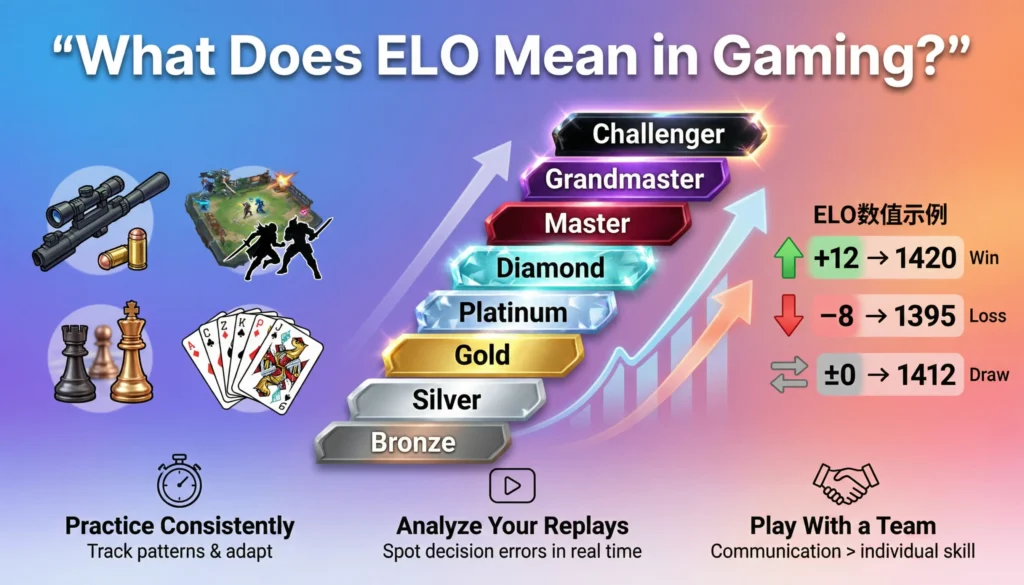
In gaming, ELO is a ranking system that measures a player’s skill level relative to others.
Originally developed for chess by Arpad Elo, it has since been adapted to many competitive games, including esports, multiplayer online battle arenas (MOBAs), and first-person shooters.
ELO scores increase when a player wins and decrease when they lose, helping match players of similar skill levels. If you’ve ever wondered why your rank keeps fluctuating in a game like League of Legends, Overwatch, or Valorant, understanding ELO is key. Let’s dive into the origins, calculations, usage, and strategies for improving your ELO.
If you’ve ever played competitive video games or followed esports, you’ve likely come across the term ELO. It often appears in leaderboards, matchmaking rankings, or player statistics. But what does it actually mean, and why is it so important for gamers?
The ELO system has become a standard in many competitive games, from chess to popular online multiplayer games like League of Legends, Valorant, and CS:GO. By assigning numerical values to players based on wins, losses, and the relative skill of opponents, ELO provides a fair and objective way to match players and track improvement. Understanding ELO is key for gamers who want to analyze their performance, climb ranks, and compete at higher levels.
Origin of ELO
The ELO system was created by Arpad Elo, a Hungarian-American physics professor and chess enthusiast, in the 1960s. Before ELO, chess rankings were inconsistent and subjective. Elo’s system introduced a mathematical approach to rank players based on actual game outcomes.
Key points about its origin:
- Developed for chess in the 1960s.
- Quickly adopted by FIDE, the international chess federation, in 1970.
- Later adapted to gaming, including online multiplayer games, to objectively rate skill.
ELO’s popularity stems from its simplicity and fairness. Unlike older systems that ranked players based on win counts or subjective judgment, ELO calculates rankings dynamically based on performance relative to opponents.
How ELO Works in Gaming
At its core, ELO is a relative skill rating system. Every player has a numerical score representing their skill. After a match:
- Winning against a higher-rated player → bigger ELO increase
- Winning against a lower-rated player → smaller ELO increase
- Losing to a higher-rated player → smaller ELO decrease
- Losing to a lower-rated player → bigger ELO decrease
This encourages fair matchmaking, ensuring players face opponents of similar skill.
Example:
- Player A: 1500 ELO
- Player B: 1600 ELO
- Player A wins → gains +25 ELO
- Player B loses → loses -25 ELO
ELO constantly adjusts to reflect current skill, so no rating is permanent.
ELO Calculation Explained
The ELO formula is surprisingly simple for competitive games. The main idea: calculate the expected score, then adjust based on the actual result.
Step 1: Calculate Expected ScoreEA=1+10(RB−RA)/4001
- E_A → expected score for Player A
- R_A → current rating of Player A
- R_B → current rating of Player B
Step 2: Update RatingRA′=RA+K(SA−EA)
- R’_A → new rating for Player A
- S_A → actual score (1 = win, 0.5 = draw, 0 = loss)
- K → factor determining sensitivity (often 20–40 for games)
Example Table:
| Player | Current ELO | Opponent ELO | Expected Score | Actual Result | ELO Change |
|---|---|---|---|---|---|
| A | 1500 | 1600 | 0.36 | 1 | +25 |
| B | 1600 | 1500 | 0.64 | 0 | -25 |
This system is simple but ensures dynamic ranking based on performance against stronger or weaker opponents.
Why ELO is Popular in Gaming
- Fair matchmaking: Players face others of similar skill, improving competitiveness.
- Clear progress tracking: ELO provides a numerical value reflecting skill improvements.
- Dynamic adjustments: Rankings change continuously with wins/losses, unlike static league systems.
- Adaptable: ELO works across genres—chess, MOBAs, FPS games, and online card games.
Games that use ELO or ELO-based systems include:
- League of Legends → Matchmaking Rating (MMR) inspired by ELO
- Overwatch → Skill Rating (SR) based on ELO principles
- Chess.com and Lichess → Digital ELO for online chess
- Counter-Strike: Global Offensive → Hidden ELO-like matchmaking ratings
- Valorant → Competitive rating system inspired by ELO
Examples of ELO in Gaming Context
| Game | ELO Name | How It’s Used |
|---|---|---|
| League of Legends | MMR | Determines rank and matchmaking |
| Overwatch | Skill Rating (SR) | Adjusts after each competitive match |
| CS:GO | Matchmaking Rating | Hidden ELO affects matchmaking and rank |
| Hearthstone | Ranked Score | Wins increase ELO, losses decrease it |
| Chess.com | ELO | Global chess ranking |
Friendly tip: Higher ELO ≠ always better gameplay—it reflects statistical skill, not style or creativity.
Understanding ELO Tiers and Divisions
Many games using ELO have tiered ranking systems:
| Tier | Typical ELO Range | Description |
|---|---|---|
| Bronze | 0–1200 | Beginners or casual players |
| Silver | 1200–1400 | Moderate skill |
| Gold | 1400–1600 | Above average, improving players |
| Platinum | 1600–1800 | Skilled, competitive players |
| Diamond | 1800–2000 | Highly skilled |
| Master/Challenger | 2000+ | Top-tier professionals |
These divisions motivate players to climb, as moving up tiers is a visible achievement beyond the raw ELO number.
Comparison With Other Ranking Systems
| System | Key Difference from ELO |
|---|---|
| Glicko/Glicko-2 | Adds rating deviation for confidence level |
| TrueSkill (Microsoft) | Accounts for team games and individual impact |
| Ladder systems | Focus on position, not numerical rating |
| Win/Loss counts | Only tracks outcomes, not relative strength |
ELO is favored for simplicity, while alternatives handle more complex team or variable scenarios.
Strategies to Improve Your ELO
- Focus on Consistency: Winning against slightly weaker players steadily increases ELO.
- Avoid Tilt: Losing multiple matches in a row can harm your ELO; mental state matters.
- Play Stronger Opponents: High-risk, high-reward strategy. Winning significantly boosts ELO.
- Team Coordination: For team-based games, cooperate to maximize win probability.
- Track Performance: Analyze past games to identify weaknesses.
Pro tip: Don’t obsess over raw numbers—use ELO as a skill benchmark, not a self-worth measure.
FAQs
What does ELO stand for in gaming?
It stands for “Elo rating system”, named after chess developer Arpad Elo.
How is ELO different from rank or tier?
Rank is often a visual representation (like Gold, Platinum), while ELO is the numerical underlying value determining that rank.
Can ELO decrease even if I play well?
Yes, if you lose against lower-ranked players or the game’s system recalibrates. ELO is relative.
Is higher ELO always better?
Generally yes, but it only reflects performance relative to others, not creativity or enjoyment.
Do all games use ELO?
No. Some games use ladder points, skill ratings, or custom matchmaking systems inspired by ELO.
What is hidden ELO?
Many games calculate a hidden ELO to match players fairly, even if public ranks differ.
Can team performance affect ELO?
Yes, in team games like MOBAs or shooters, your ELO is influenced by match outcomes and sometimes personal contribution.
How do beginners increase ELO quickly?
Start by playing against similar or slightly weaker opponents, focus on learning mechanics, and avoid unnecessary risks.
Advanced Insights on ELO
- K-Factor Tuning: Games adjust how sensitive ELO is with a “K-factor” to prevent excessive fluctuation. Beginners often have a higher K to quickly find their true skill level.
- Decay Mechanisms: Some competitive games reduce ELO over time for inactivity to keep rankings current.
- Matchmaking Balance: ELO ensures teams are balanced, reducing one-sided matches and improving player retention.
- Psychological Impact: Many players perceive rank as skill, but understanding the math behind ELO prevents frustration.
Common Misconceptions About ELO
- “ELO = Skill 100%” → Not always. It’s statistical and relative.
- “I can grind ELO easily” → ELO rewards consistency, not occasional wins.
- “Losing to lower-ranked players doesn’t matter” → Actually, it reduces your rating significantly.
- “Public rank shows everything” → Behind the scenes, hidden ELO often gives a more accurate skill measure.
Conclusion
ELO in gaming is more than a number—it’s a dynamic, statistical reflection of skill. By understanding its principles, calculation, and impact on matchmaking, players can approach competitive games strategically rather than emotionally.
Key takeaways:
- ELO adjusts based on relative performance, rewarding wins against stronger opponents.
- Most competitive games use ELO-inspired systems for fairness and progression.
- Numbers aren’t everything—focus on skill improvement, teamwork, and strategy.
- Advanced mechanics like K-factors, decay, and hidden ELO make the system fairer over time.
Understanding ELO allows you to track improvement, climb ranks, and enjoy competitive gaming with clarity.
Read More Related Articles:
- What Does MVR Mean in Baseball? The Stat Explained Clearly In 2026
- What Does Slugging Mean in Baseball? How Power Hitters Dominate the Game In 2026
- What Does PRA Mean in Basketball? The Stat Every Bettor Should Know In 2026

Neon Samuel is a digital content creator at TextSprout.com, dedicated to decoding modern words, slang, and expressions. His writing helps readers quickly grasp meanings and understand how terms are used in real conversations across text and social platforms.