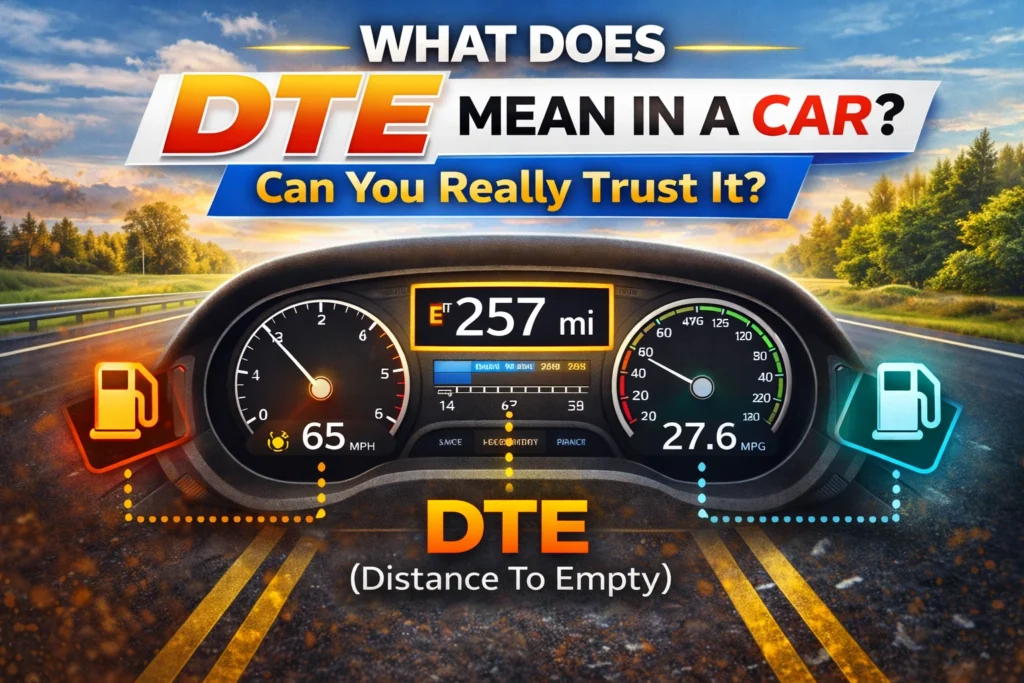
In the automotive world, DTE stands for “Distance To Empty.” It is a gauge or metric that indicates approximately how far a vehicle can travel with the remaining fuel in its tank.
For example, if your car shows a DTE of 250 miles, it means you can drive roughly 250 miles before the fuel runs out.
If you’ve ever glanced at your dashboard and noticed the letters DTE, you might have wondered what they actually mean and whether you should pay attention. Modern vehicles are packed with smart features, and understanding them can help you drive more confidently and avoid unexpected surprises on the road. So, what does DTE mean in a car, and why does it matter for everyday driving?
DTE stands for Distance to Empty. It is a dashboard feature that estimates how many miles or kilometers your car can travel before the fuel tank runs empty. The system calculates this number based on your current fuel level and recent driving patterns, giving you a real-time projection of your remaining range.
In simple terms, DTE helps you answer one important question: How far can I go before I need to refuel?
DTE is an essential feature for drivers because it helps plan fuel stops, estimate travel distances, and manage fuel efficiency. Understanding how it works can improve your driving experience, prevent unexpected breakdowns, and even help save money on gas.
Origin and Popularity of DTE in Cars
DTE is a modern automotive abbreviation that became widely adopted as car dashboards evolved from analog gauges to digital displays. Early cars only had fuel level indicators (empty to full). As technology progressed, car manufacturers introduced DTE as a smart way to estimate driving range based on fuel consumption.
Why DTE Became Popular
- Convenience: Drivers no longer have to guess how far they can go.
- Fuel efficiency awareness: Seeing the estimated range encourages efficient driving.
- Trip planning: Helps drivers avoid running out of fuel unexpectedly.
- Integration with technology: Modern cars can pair DTE with navigation systems for optimized routes.
Most modern vehicles, from economy cars to luxury SUVs, now display DTE prominently on the dashboard or infotainment screen.
How DTE Works in a Car
DTE calculations rely on the amount of fuel remaining in the tank and the vehicle’s recent fuel consumption rate.
Step-by-Step Process:
- Sensors detect fuel level – A fuel level sensor measures how much fuel is left in the tank.
- Fuel consumption rate calculation – The car calculates how many miles per gallon (MPG) or kilometers per liter (km/L) the car is currently consuming, often averaged over the last 50–100 miles.
- Range estimation – The remaining fuel is divided by the consumption rate to give the DTE in miles or kilometers.
For example:
- Fuel left: 10 gallons
- Average consumption: 25 miles per gallon
- DTE = 10 × 25 = 250 miles
⚠️ Note: DTE is an estimate, not a guarantee. Driving habits, terrain, and traffic conditions can affect actual range.
Real-Life Examples of DTE in Cars
Friendly Example:
You are on a road trip. Your car dashboard shows a DTE of 180 miles. You can confidently plan your next fuel stop before your tank runs low. ⛽
Neutral Example:
While commuting daily, your car shows a DTE of 50 miles. You decide to refuel in the next few miles to avoid getting stranded.
Negative/Dismissive Example:
Ignoring your DTE warning of 30 miles could leave you stranded on a highway 😬.
Table: DTE in Different Driving Conditions
| Fuel Remaining | Average Consumption | Driving Scenario | Approx. DTE |
|---|---|---|---|
| 10 gallons | 25 MPG | Highway | 250 miles |
| 10 gallons | 20 MPG | City traffic | 200 miles |
| 5 gallons | 25 MPG | Highway | 125 miles |
| 5 gallons | 18 MPG | Stop-and-go city | 90 miles |
How DTE Compares With Related Car Terms
| Term | Difference from DTE | Example |
|---|---|---|
| Fuel Gauge | Shows fuel level only, not range | Half tank = fuel gauge shows 50% |
| MPG (Miles per gallon) | Measures fuel efficiency, not range | 25 MPG → 25 miles per gallon |
| Range | Sometimes used interchangeably, but can include battery-electric cars | 200-mile range left |
| Trip Computer | Can show DTE along with MPG, trip distance, and average speed | Trip computer displays 180 miles DTE |
Tip: While DTE is closely related to range, DTE is calculated dynamically based on driving behavior and fuel efficiency, whereas range may refer to a car’s maximum possible distance under standard conditions.
Alternate Meanings and Contexts
While DTE is most commonly understood as Distance To Empty in automotive contexts, it can have other meanings in technology or industry:
- Data Terminal Equipment (Technology/Networking) – Used in telecommunications.
- Dynamic Thermal Efficiency (Engineering) – Refers to energy systems.
In cars, DTE almost always refers to Distance To Empty, so context matters.
Tips for Using DTE Effectively
- Monitor it regularly: Keep an eye on DTE for long trips.
- Refuel early: Don’t wait until DTE reaches zero to avoid stress or damage.
- Adjust driving habits: Smooth acceleration and moderate speed can improve DTE.
- Account for external factors: Hills, cargo weight, and air conditioning can reduce DTE.
- Check calibration: Some vehicles allow recalibrating DTE for more accurate results.
Table: DTE vs Fuel Gauge vs MPG
| Feature | What it Shows | Key Use |
|---|---|---|
| DTE | Estimated distance you can travel with remaining fuel | Trip planning, preventing fuel depletion |
| Fuel Gauge | Fuel level in tank | Know how full your tank is |
| MPG | Fuel efficiency | Track driving habits and fuel economy |
Real-Life Driving Scenarios Using DTE
Long Road Trip:
- Car shows DTE 400 miles
- You plan a fuel stop every 300 miles for safety
City Driving:
- Stop-and-go traffic reduces fuel efficiency
- DTE drops faster than expected → refuel sooner
Night Driving / Bad Weather:
- Increased fuel consumption reduces DTE
- Always check DTE more frequently
Electric/Hybrid Cars:
- DTE can also apply to electric range for hybrid vehicles, showing how far you can drive on battery or fuel combined.
FAQs
1. What does DTE mean in a car?
DTE stands for Distance To Empty, indicating how far a vehicle can drive with the remaining fuel.
2. How accurate is DTE?
It is an estimate. Driving conditions, terrain, and habits can affect the actual distance.
3. How is DTE calculated?
Using the remaining fuel in the tank and average fuel consumption (MPG or km/L).
4. Does DTE work in electric cars?
Yes, in hybrid or electric vehicles, it shows the remaining range based on battery or fuel level.
5. Can I rely on DTE to never run out of fuel?
Not entirely. Always refuel before DTE reaches zero to avoid unexpected situations.
6. Why does DTE change frequently?
It updates dynamically based on driving speed, traffic, and fuel consumption patterns.
7. Is DTE displayed on all cars?
Most modern vehicles with digital dashboards show DTE, but older cars may only have fuel gauges.
8. Can driving habits improve DTE?
Yes. Smooth acceleration, maintaining steady speed, and avoiding excess idling can increase DTE.
Conclusion
Understanding DTE is essential for any driver. It helps you:
- Plan fuel stops efficiently
- Avoid running out of fuel unexpectedly
- Monitor driving habits for better fuel economy
- Combine with navigation systems for trip planning
Key Takeaways:
- DTE = Distance To Empty
- It estimates remaining driving distance based on fuel and consumption
- Always treat DTE as a guideline, not a guarantee
- Useful in both conventional and hybrid/electric vehicles
- Monitoring DTE promotes safer, smarter driving
By using DTE wisely, drivers can manage fuel, save money, and enjoy stress-free journeys.
Read More Related Articles:
- ECON Mean in a Car: Truth About This Fuel-Saving Feature In 2026
- SH Meaning in Text Messages: Why Context Matters (2026)
- Lament Mean in the Bible: Spiritual Significance (2026)

Ivy Madison is a content creator at TextSprout.com, specializing in word definitions, internet slang, acronyms, and text abbreviations. She delivers clear and engaging explanations, helping readers quickly understand modern digital language and trending terms.