Trying to conceive can feel like learning a whole new language. Suddenly, you’re seeing abbreviations like DPO, BFP, BFN, CD, and LH everywhere—on fertility apps, pregnancy forums, and test strips. One of the most common (and confusing) terms is DPO.
So, what does DPO mean in pregnancy, and why does everyone seem to count it so carefully?
Let’s break it down step by step—in a clear, friendly, and medically accurate way—so you can confidently understand what DPO means, how it’s used, and why it matters during the two-week wait.
Definition:
DPO stands for “Days Past Ovulation.”
In pregnancy tracking, DPO refers to the number of days that have passed since ovulation occurred, helping estimate when implantation, pregnancy testing, and early symptoms may happen.
What Is DPO in Pregnancy?
DPO = Days Past Ovulation
It’s a time-tracking term used in fertility and pregnancy contexts to measure how many days have passed since your ovary released an egg (ovulation).
For example:
- 1 DPO → One day after ovulation
- 7 DPO → Seven days after ovulation
- 14 DPO → Fourteen days after ovulation (often when a pregnancy test is taken)
Unlike gestational age (which starts from your last period), DPO focuses on ovulation timing, making it especially useful for people trying to conceive (TTC).
Why Is DPO Important During Pregnancy Tracking?
DPO is important because key early pregnancy events happen on specific days past ovulation, not on calendar dates.
DPO helps you estimate:
- When implantation may occur
- When pregnancy hormones (hCG) begin rising
- When a pregnancy test may show accurate results
- Whether symptoms are hormonal or pregnancy-related
This is why you’ll often see phrases like:
“I’m 10 DPO—too early to test?”
Origin and Popularity of the Term DPO
The term DPO originates from:
- Fertility science
- Reproductive endocrinology
- Ovulation tracking methods
Why it became popular
- Rise of fertility apps (Flo, Clue, Premom, Ovia)
- Online TTC communities and forums
- Home ovulation predictor kits (OPKs)
- Increased awareness of cycle tracking
Today, DPO is widely used in:
- Pregnancy forums
- Reddit TTC groups
- Facebook fertility communities
- Fertility clinics
- Medical discussions (informally)
How DPO Fits Into the Menstrual Cycle
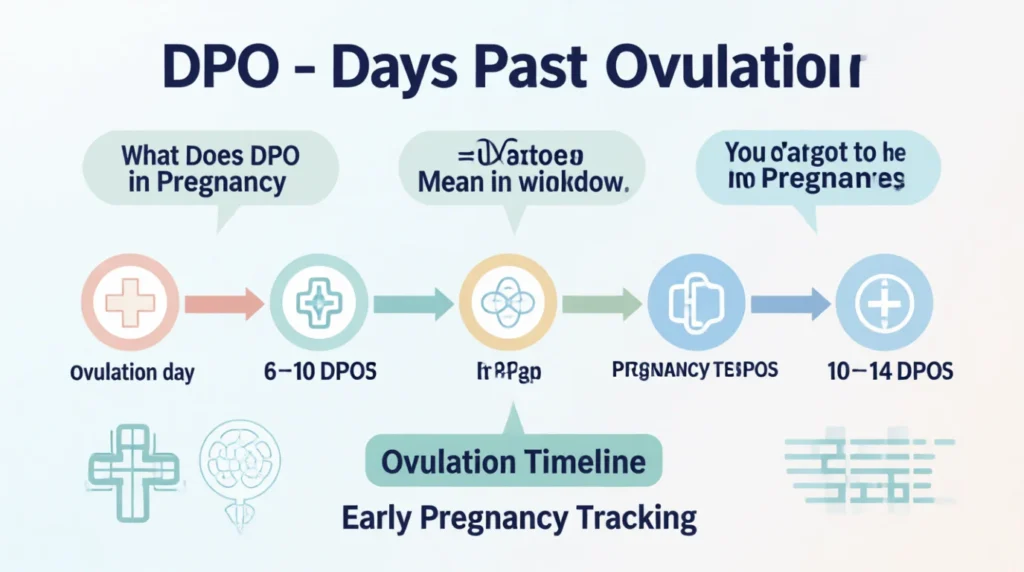
Here’s how DPO fits into a typical cycle:
- Menstrual period starts → Cycle Day 1 (CD1)
- Ovulation occurs → Egg is released
- DPO count begins → The day after ovulation = 1 DPO
- Implantation window → Usually 6–10 DPO
- Pregnancy test window → Usually 10–14 DPO
DPO Timeline Table
| DPO Day | What’s Happening in the Body |
|---|---|
| 1–3 DPO | Egg may be fertilized |
| 4–5 DPO | Fertilized egg travels to uterus |
| 6–10 DPO | Implantation may occur |
| 8–10 DPO | Early pregnancy hormones begin |
| 10–12 DPO | Some tests may detect hCG |
| 13–14 DPO | Missed period, clearer test results |
💡 Note: Implantation timing varies—earlier or later implantation is normal.
How to Calculate DPO Accurately
You can calculate DPO if you know your ovulation day.
Ways to identify ovulation:
- Ovulation Predictor Kits (OPKs)
- Basal Body Temperature (BBT) charting
- Fertility tracking apps
- Ultrasound monitoring (clinical)
- Cervical mucus observation
Example Calculation
- Ovulation on March 1
- March 2 = 1 DPO
- March 11 = 10 DPO
DPO and Pregnancy Testing
This is where DPO really matters.
Why testing too early gives false negatives
Pregnancy tests detect hCG, which:
- Appears only after implantation
- Increases gradually each day
Testing by DPO
- 8–9 DPO: Too early (likely negative)
- 10–11 DPO: Possible faint positive
- 12–14 DPO: Most reliable results
- 15+ DPO: Strong positives likely
This explains why many people ask:
“Can I get a positive at 9 DPO?”
DPO and Early Pregnancy Symptoms
Some people experience symptoms before a positive test—but DPO helps explain why.
Common symptoms by DPO
- 5–7 DPO: Usually progesterone-related
- 8–10 DPO: Possible implantation symptoms
- 10–14 DPO: Early pregnancy signs may appear
Examples
- Cramping
- Spotting (implantation bleeding)
- Fatigue
- Breast tenderness
⚠️ These symptoms can also occur in non-pregnant cycles, so DPO helps manage expectations.
Real-World Usage of DPO
Friendly / Casual
“I’m only 7 DPO, trying not to symptom-spot 😅”
Neutral / Informational
“At 12 DPO, pregnancy tests are generally more accurate.”
Frustrated / Emotional
“13 DPO and still negative—this wait is exhausting.”
This DPO language often reflects emotions during the two-week wait, making it common in supportive communities.
DPO vs Related Pregnancy Terms
| Term | Meaning | How It’s Used |
|---|---|---|
| DPO | Days Past Ovulation | Tracks early pregnancy timing |
| CD | Cycle Day | Tracks menstrual cycle days |
| LMP | Last Menstrual Period | Used by doctors for dating |
| GA | Gestational Age | Medical pregnancy age |
| LH | Luteinizing Hormone | Signals ovulation |
DPO vs Gestational Age: What’s the Difference?
- DPO starts from ovulation
- Gestational age starts from the last menstrual period
That’s why doctors say:
“You’re 4 weeks pregnant”
even if you conceived only 2 weeks ago.
Alternate Meanings of DPO
Outside pregnancy, DPO can mean:
- Data Protection Officer (legal/IT context)
- Deferred Payment Option (finance)
👉 In pregnancy discussions, DPO almost always means Days Past Ovulation.
Polite or Professional Alternatives to DPO
In clinical or formal writing, you may see:
- “Post-ovulation day”
- “Days after ovulation”
- “Luteal phase day”
DPO is more common in casual and patient-facing contexts.
Usage Tips for Beginners
- Don’t compare DPO symptoms too closely with others
- Implantation timing varies between people
- Negative tests before 12 DPO are common
- Stress can affect cycles—be gentle with yourself
Conclusion
DPO (Days Past Ovulation) is a simple but powerful way to understand early pregnancy timing. It helps explain:
- When implantation may occur
- Why early tests are often negative
- How hormones change after ovulation
If you’re trying to conceive, learning DPO can reduce confusion, manage expectations, and make fertility tracking far less stressful.
💛 Remember: Every cycle and every body is different. DPO is a guide—not a guarantee.
Frequently Asked Questions (FAQs)
1. What does DPO mean in pregnancy tests?
DPO shows how many days have passed since ovulation, helping determine when a pregnancy test may be accurate.
2. Can I be pregnant at 7 DPO?
Yes, but implantation may not have occurred yet, so tests usually show negative.
3. Is 10 DPO too early to test?
It’s early but possible. Results may be faint or negative even if pregnant.
4. What DPO is implantation most common?
Implantation typically occurs between 6–10 DPO, most commonly around 8–9 DPO.
5. Why do doctors not use DPO?
Doctors use gestational age (from LMP) because it’s standardized, even when ovulation date is unknown.
6. Can DPO be wrong?
Yes, if ovulation was misidentified. Late ovulation can shift DPO calculations.
7. Is DPO used after pregnancy is confirmed?
Mostly no. It’s mainly used during TTC and early testing phases.
8. What is the two-week wait (TWW) in relation to DPO?
The TWW spans roughly 1–14 DPO, the waiting period between ovulation and pregnancy testing.

Luna Hartley is a content creator at TextSprout.com, where she specializes in explaining word meanings, modern phrases, and everyday language used in texts and online conversations. Her writing focuses on clarity and context, helping readers understand how words are actually used in real communication.