
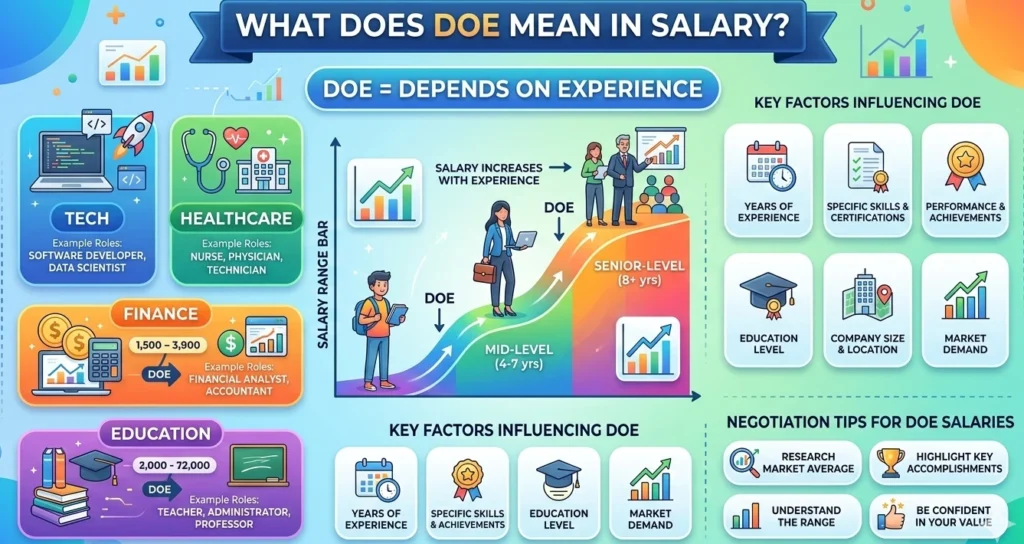
In salary contexts, DOE stands for “Depending on Experience.”
It indicates that the final compensation offered for a role will vary based on a candidate’s skills, qualifications, and previous work experience.
If you’ve ever browsed job postings or salary offers, you might have noticed the term DOE listed next to the compensation. It’s a common abbreviation that can leave many job seekers scratching their heads. Understanding what DOE means in salary is crucial for negotiating effectively, assessing job offers, and planning your career.
Although DOE seems simple, its implications can be significant. Employers use it to signal flexibility, while candidates must interpret it wisely to ensure fair pay. In this article, we’ll break down everything about DOE, its origin, usage, real-world examples, alternatives, and tips for negotiating your salary.
Origin and Popularity of DOE in Job Offers
DOE is widely used in job listings, HR communications, and recruitment across industries. The term’s popularity comes from the need for flexibility in salary ranges.
- Origin: DOE emerged from corporate HR practices to allow salary negotiation based on the candidate’s experience level. Instead of publishing a fixed number, companies could attract a broader range of applicants while reserving the right to adjust compensation.
- Why it’s popular:
- Allows employers to remain competitive for top talent.
- Signals to candidates that experience is valued.
- Avoids the limitations of a one-size-fits-all salary.
In industries like technology, finance, healthcare, and education, DOE has become almost standard. Job boards, recruitment agencies, and LinkedIn listings frequently include DOE alongside base salary ranges.
Usage of DOE in Salary Contexts
DOE indicates that the salary for a role isn’t fixed and will vary depending on factors such as:
- Years of relevant experience
- Previous job performance
- Education and certifications
- Special skills or unique expertise
Example:
“Software Engineer – $70,000–$90,000 DOE”
- If you have 1–2 years of experience, you might be offered $70,000.
- If you have 5+ years of experience with specialized skills, you might receive $90,000 or more.
DOE is often paired with phrases like:
- “Negotiable”
- “Based on experience”
- “Competitive salary DOE”
Table: How DOE Reflects Experience
| Candidate Experience | Possible Salary | Notes |
|---|---|---|
| Entry-level (0–2 years) | $50,000–$60,000 | Standard starting pay |
| Mid-level (3–5 years) | $60,000–$75,000 | Relevant skills and achievements increase offer |
| Senior-level (5+ years) | $75,000–$90,000+ | Leadership, certifications, or specialized expertise may maximize DOE |
Examples of DOE in Real-World Job Listings
Friendly Example
A marketing manager posting:
“Salary: $60,000–$80,000 DOE”
This tells applicants: “Bring your experience; we’ll reward it accordingly.”
Neutral Example
An IT recruiter:
“Compensation: $90,000 DOE”
This indicates flexibility but may require negotiation to reach the higher end.
Slightly Dismissive/Warning Example
Sometimes DOE can be a red flag if employers want to offer lower pay under the guise of “experience-dependent” salaries. Always research market standards before accepting an offer.
Comparison: DOE vs Other Salary Terms
While DOE is widely used, it’s helpful to compare it to other common salary phrases:
| Term | Meaning | How it Differs from DOE |
|---|---|---|
| Negotiable | Open to discussion | DOE still implies some base reference tied to experience |
| Market Rate | Salary reflects industry standard | DOE focuses on individual experience rather than average salary |
| Salary Range | Explicit min–max pay | DOE allows flexibility but may not explicitly list numbers |
| TBD (To Be Determined) | Not yet decided | DOE is decided but depends on candidate profile |
Understanding these differences helps in interpreting job postings accurately.
DOE Across Industries
DOE is not limited to one sector. Its meaning stays the same, but how it’s applied can vary:
- Technology: Experience with programming languages, projects, and certifications impact final offers.
- Healthcare: Years of practice, specializations, and licensing influence DOE salaries.
- Education: Teaching experience, advanced degrees, and administrative skills affect DOE ranges.
- Finance: Experience managing budgets, client portfolios, or regulatory compliance can raise DOE offers.
Table: DOE Examples by Industry
| Industry | Example Job | DOE Impact |
|---|---|---|
| Tech | Software Developer | Higher offers for cloud or AI expertise |
| Healthcare | Registered Nurse | DOE may reflect certifications or ICU experience |
| Education | High School Teacher | Advanced degrees or leadership experience increase pay |
| Finance | Financial Analyst | Years in investment or audit roles influence DOE |
Alternate Meanings of DOE
While DOE in salary almost always means “Depending on Experience,” the abbreviation can appear elsewhere with different meanings:
- Department of Energy – Government agency in the U.S.
- Design of Experiments – Research methodology in statistics
- Dead on Entry – In emergency services or medical contexts
When reading a salary posting, context usually makes the meaning clear. If in doubt, ask HR for clarification.
Polite or Professional Alternatives to DOE in Job Listings
Sometimes employers use more professional phrasing instead of DOE:
- “Salary commensurate with experience” – Professional, slightly formal
- “Competitive compensation based on your qualifications” – Polished and marketable
- “Pay scale varies with experience and skill” – Neutral and clear
Example:
“Senior Developer – Competitive salary commensurate with experience” reads more formal than “DOE” but conveys the same meaning.
How DOE Affects Salary Negotiation
DOE can give you leverage if approached correctly:
- Research industry standards: Know the typical salary for your role and experience level.
- Highlight relevant experience: Document your achievements, certifications, or specialized skills.
- Negotiate confidently: DOE indicates flexibility; don’t hesitate to request the higher end if justified.
- Ask clarifying questions: “Can you provide a salary range for DOE positions?”
Tip: DOE is a starting point. Negotiating effectively can significantly impact your earnings.
Example Scenario: Negotiating DOE Salary
Suppose a company posts:
“Marketing Specialist – $55,000–$70,000 DOE”
- Candidate A: 1 year experience → $55,000–$60,000
- Candidate B: 5 years experience + portfolio → $65,000–$70,000
Here, DOE ensures that experience and achievements are directly rewarded.
Practical Tips for Candidates
- Always confirm whether DOE is negotiable.
- Benchmark your experience against the market to justify your request.
- Highlight transferable skills and certifications.
- Keep communication professional and polite when discussing DOE salary.
- Remember DOE is a tool for fairness, not a reason for employers to lowball offers.
FAQs
1. What does DOE mean in salary?
DOE stands for “Depending on Experience,” indicating that your pay depends on your skills, qualifications, and prior experience.
2. Does DOE mean I can negotiate?
Yes. DOE implies flexibility. Your experience and credentials can help you secure a higher offer.
3. How do I know if DOE is fair?
Research industry salary standards and compare your experience to the job requirements.
4. Is DOE common in all industries?
It’s very common in tech, finance, healthcare, and education but appears across nearly all sectors.
5. Can DOE salaries be misleading?
Sometimes. If no base range is given, always clarify before accepting an offer.
6. Is DOE the same as “Negotiable”?
Not exactly. Negotiable can be broader; DOE specifically ties the final salary to your experience.
7. How do I discuss DOE with HR?
Politely ask for the typical range for candidates with similar experience. Emphasize your skills and achievements.
8. Can DOE include benefits and bonuses?
Typically DOE refers to base salary. Benefits, bonuses, and perks are usually separate but may be negotiated together.
Conclusion
DOE in salary is more than just a three-letter abbreviation—it’s a key factor in fair compensation. It allows employers to adjust offers based on a candidate’s experience, skills, and qualifications, while providing flexibility in hiring. Understanding DOE, researching your market value, and negotiating professionally can help you maximize your salary potential.
Key Takeaways:
- DOE = Depending on Experience
- Salary will vary based on your qualifications, achievements, and skills
- DOE gives candidates negotiation leverage
- Research, preparation, and professionalism are critical when dealing with DOE salary offers
Mastering the concept of DOE ensures that you are prepared to evaluate job offers accurately, negotiate effectively, and achieve fair compensation for your experience.
Read More Related Articles:
- HMB Meaning in Text Messages: What It Stands For, When to Use It &Better Alternatives (2026)
- Zeal Meaning in the Bible: Passion or Problem? (2026)
- Rebuke Mean in the Bible: Learn Its Meaning and Power (2026)

Neon Samuel is a digital content creator at TextSprout.com, dedicated to decoding modern words, slang, and expressions. His writing helps readers quickly grasp meanings and understand how terms are used in real conversations across text and social platforms.