Divisible in math refers to a number that can be divided by another number without leaving a remainder. For example, 12 is divisible by 3 because 12 ÷ 3 = 4 with no remainder.
In mathematics, the term divisible describes a number that can be divided by another number evenly, without leaving a remainder. If one number divides into another completely, we say the first number is divisible by the second. For example, 20 is divisible by 5 because 20 ÷ 5 equals 4 with no remainder. However, 22 is not divisible by 5 because the result leaves a remainder. Understanding divisibility is a foundational skill in arithmetic, helping students simplify fractions, solve equations, and recognize number patterns more efficiently.
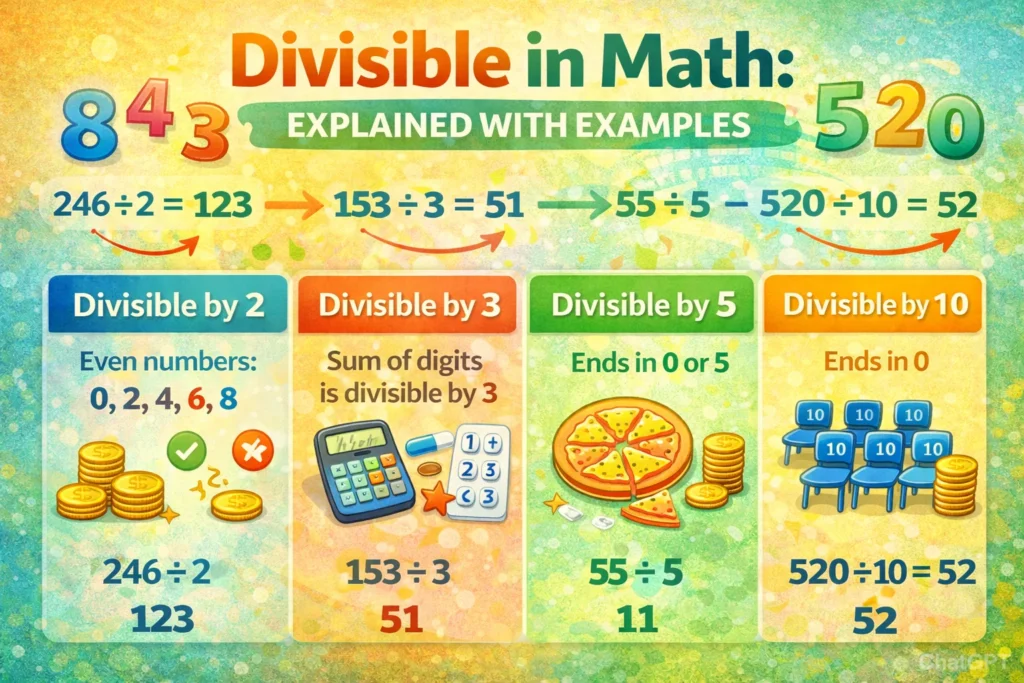
In 2026, divisibility rules remain one of the fastest tools for mental math and exam preparation. Instead of performing long division every time, you can apply quick tests. A number is divisible by 2 if it ends in an even digit. It is divisible by 3 if the sum of its digits is divisible by 3. A number is divisible by 5 if it ends in 0 or 5. These rules make calculations quicker and build strong number sense. With consistent practice examples and real life applications like budgeting or grouping items evenly, understanding what divisible means becomes both practical and powerful.
Understanding the term divisible in math might seem simple at first, but it carries subtle nuances that are important for both beginners and advanced learners. Whether you’re tackling arithmetic in school, solving algebra problems, or exploring number theory, knowing what “divisible” really means helps you build a solid foundation.
In this guide, we’ll break down the meaning, origin, usage, examples, comparisons, and practical applications of divisibility in math. By the end, you’ll feel confident spotting divisible numbers in everyday problems and math puzzles.
Origin of the Term “Divisible”
The term “divisible” comes from the Latin word divisibilis, which means “able to be divided.” Mathematicians adopted the term to describe numbers that can be neatly separated into equal parts.
- Early usage traces back to medieval arithmetic texts where scholars explored factors and multiples.
- It gained popularity in school mathematics because understanding divisibility is key to mastering fractions, multiples, and prime numbers.
- The concept is widely used in number theory, algebra, and even computer science for algorithms that require factorization.
Divisibility isn’t just an academic term; it has real-world roots. For example, splitting a pizza among friends or dividing money evenly depends on the principle of divisibility.
Usage in Math
In mathematics, we say that a number a is divisible by b if dividing a by b results in a whole number, meaning there is no remainder left over. In formal notation, this relationship can be written in two common ways. One way is
a ÷ b equals an integer
Another way uses symbolic notation
b | a
The vertical line symbol | is read as “divides.” So when you see 3 | 12, it means “3 divides 12.” This tells us that 12 can be divided evenly by 3 without producing a fraction or decimal.
Divisibility is a core concept in number theory and basic arithmetic. It helps mathematicians describe relationships between numbers clearly and efficiently. Rather than repeatedly performing division calculations, divisibility allows us to quickly determine whether one number fits evenly into another.
Key Points About Divisibility
If a number is divisible by another number, the result of division is always a whole number. There is no remainder. For example, 18 is divisible by 6 because 18 ÷ 6 equals 3 exactly.
Divisibility is used to identify factors of a number. A factor is any number that divides another number evenly. For instance, the factors of 24 include 1, 2, 3, 4, 6, 8, 12, and 24 because each of these numbers divides 24 without leaving a remainder.
It plays an important role in simplifying fractions. When reducing a fraction to its lowest terms, we divide both the numerator and denominator by their greatest common factor. For example, 8 over 12 can be simplified to 2 over 3 because both numbers are divisible by 4.
Divisibility is also foundational for prime factorization and identifying multiples. Prime factorization breaks a number into prime numbers that divide it evenly. Understanding which numbers divide evenly makes this process faster and more systematic.
Overall, divisibility forms the backbone of many higher level math topics, from algebra to advanced number theory.
Examples of Divisible Numbers
Let’s look at some friendly examples to make this concept crystal clear:
| Number | Divisible By | Explanation |
|---|---|---|
| 12 | 2, 3, 4, 6, 12 | 12 ÷ 3 = 4 (no remainder), 12 ÷ 4 = 3 |
| 15 | 1, 3, 5, 15 | 15 ÷ 5 = 3, 15 ÷ 3 = 5 |
| 20 | 1, 2, 4, 5, 10, 20 | 20 ÷ 4 = 5, 20 ÷ 5 = 4 |
| 7 | 1, 7 | Prime number, only divisible by 1 and itself |
✅ Quick tip: If a number ends in 0 or 5, it’s divisible by 5.
✅ Quick tip: If the sum of digits is divisible by 3, the whole number is divisible by 3.
How to Determine Divisibility
Mathematicians have developed divisibility rules to make identifying divisible numbers faster. Here are the most common ones:
| Divisible By | Rule |
|---|---|
| 2 | Number ends in 0, 2, 4, 6, or 8 |
| 3 | Sum of digits divisible by 3 |
| 4 | Last two digits divisible by 4 |
| 5 | Number ends in 0 or 5 |
| 6 | Number divisible by both 2 and 3 |
| 9 | Sum of digits divisible by 9 |
| 10 | Number ends in 0 |
These rules save time and make problem-solving more intuitive, especially when working with large numbers.
Real-Life Examples of Divisibility
Understanding divisibility is not just for classroom exercises or exam preparation. It shows up in daily decisions, budgeting, cooking, organizing events, and even in technology. Once you recognize it, you start seeing divisibility everywhere.
Money Sharing
Imagine you and four friends receive 60 dollars to split equally. To divide it fairly, you calculate 60 ÷ 5. The result is 12, which means each person receives 12 dollars. Since there is no remainder, 60 is divisible by 5.
Now imagine the amount was 62 dollars. Dividing 62 by 5 would not give a whole number. You would have leftover money that cannot be evenly distributed without breaking it into smaller units. Divisibility quickly tells you whether equal sharing is possible.
Event Planning
Suppose you are arranging 24 chairs for a small event and want to place them in rows of 6. When you calculate 24 ÷ 6, the answer is 4. That means you can form exactly 4 rows with no chairs left over.
If you tried rows of 5 instead, 24 ÷ 5 would leave a remainder. This tells you the arrangement will not be perfectly even. Event planners often use divisibility without even realizing it when organizing seating, tables, or group activities.
Recipe Scaling
Cooking is another practical example. If a recipe serves 3 people and you need to serve 9, you check whether 9 is divisible by 3. Since 9 ÷ 3 equals 3, you simply triple each ingredient. Divisibility makes scaling recipes accurate and stress free.
Technology and Computer Science
Even in computer science, divisibility plays a major role. Algorithms use divisibility rules to check whether a number is prime. Programmers rely on it when generating number sequences, designing encryption systems, or organizing data into equal groups.
From splitting bills to writing code, divisibility quietly powers many everyday systems. Once you understand it, you gain a practical tool that extends far beyond math class.
Comparison With Related Terms
It helps to differentiate divisible from similar terms to avoid confusion:
| Term | Meaning | Example |
|---|---|---|
| Divisible | Number divides another without remainder | 12 is divisible by 3 |
| Factor | Number that divides another evenly | 3 is a factor of 12 |
| Multiple | Product of a number and an integer | 12 is a multiple of 3 |
| Prime | Number divisible only by 1 and itself | 7 is prime |
💡 Note: Divisible focuses on the action (12 can be divided by 3), while factor and multiple focus on relationship.
Alternate Meanings
In math, divisible is very specific. Outside mathematics, the term can imply:
- Logical division: Splitting tasks or items fairly.
- Computing: Checking if a number fits a certain modulus in programming.
But for all practical purposes, when you see divisible in math, it’s almost always about numbers and zero remainders.
Polite and Professional Alternatives
When writing formally, you can use these alternatives without changing meaning:
- “Evenly divisible” – emphasizes no remainder.
- “Can be divided exactly by” – clear in academic writing.
- “Divides evenly into” – common in textbooks and explanations.
FAQs
1. What does divisible mean in simple terms?
Divisible means a number can be divided by another number without leaving a remainder.
2. How can I tell if a number is divisible by 2?
Check if it ends in 0, 2, 4, 6, or 8.
3. Is 0 divisible by any number?
Yes, 0 is divisible by any non-zero number because 0 ÷ x = 0.
4. Can negative numbers be divisible?
Absolutely. For example, -12 is divisible by 3 because -12 ÷ 3 = -4.
5. What is the difference between divisible and factor?
Divisible is the action of dividing without remainder. Factor is the number that divides another evenly.
6. Are decimals divisible?
Technically, divisibility refers to integers. Decimals require exact division to yield a whole number.
7. Can a number be divisible by itself?
Yes, every number is divisible by itself and by 1.
8. Why is divisibility important in math?
It helps simplify fractions, find multiples and factors, and is foundational for algebra and number theory.
Conclusion:
- Divisible means no remainder after division.
- Use divisibility rules to check numbers quickly.
- Remember that prime numbers have only two divisors: 1 and themselves.
- Practice with real-life examples like splitting money, arranging objects, or scaling recipes.
- Understanding divisibility improves problem-solving, algebra skills, and number sense.
✅ Tip: When stuck, always check smaller divisibility rules first, then move to larger numbers.
Read More Related Articles:
- POG Mean in Gaming: From Epic Wins to Gaming Chat Reactions (2026)
- Someone Texted You “TS”? Here’s What It Means and How to Respond (2026)
- “Eres” Meaning in Spanish: More Than Just “You Are” In 2026

Luna Hartley is a content creator at TextSprout.com, where she specializes in explaining word meanings, modern phrases, and everyday language used in texts and online conversations. Her writing focuses on clarity and context, helping readers understand how words are actually used in real communication.