
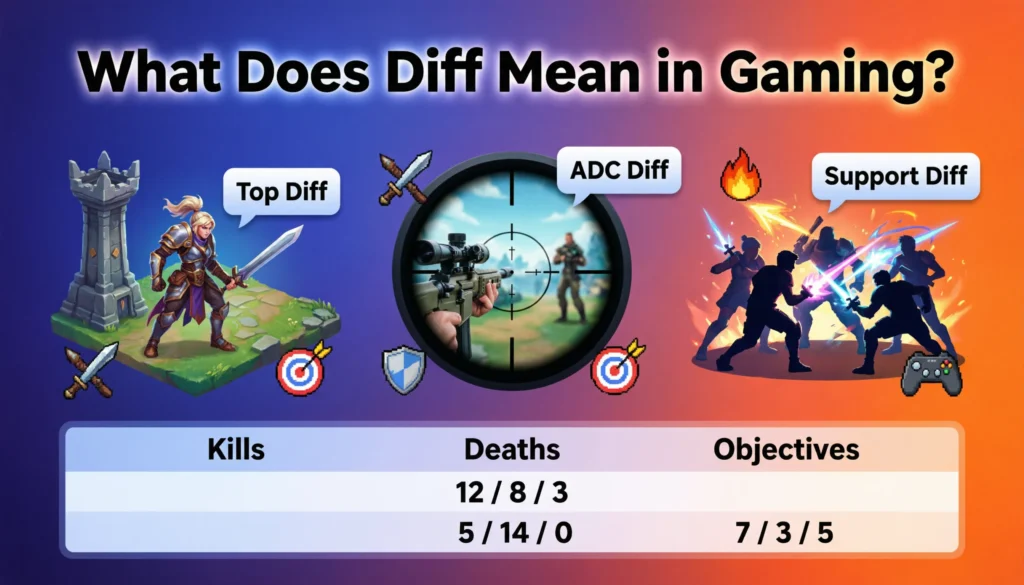
In gaming, “diff” is shorthand for “difference” and is often used to describe the performance gap between players, teams, or characters in competitive gameplay. It highlights which player or team is performing better or worse in a match.
For example, saying “Top lane diff” in a multiplayer online battle arena (MOBA) game means the top laner is either outperforming or underperforming compared to their opponent.
If you’ve spent any time in competitive online games or scrolling through gaming forums, you’ve probably seen players type “diff” in chat after a match or in a post-match discussion. Unlike friendly abbreviations like “WP” (Well Played), diff carries a more pointed and realistic tone—it’s usually about comparing performance and highlighting differences between players or teams.
In gaming, diff is short for “difference”. It’s often used to indicate that one player or team significantly outperformed another, usually in a way that influenced the outcome of the match. For example, a player might type “Top lane diff” in a MOBA game like League of Legends to suggest that the top-lane player’s performance was far better or worse than their opponent’s.
The term has become a staple in modern gaming culture because it’s quick, direct, and often blunt. While it can be used humorously among friends, it can also be interpreted as critical or even salty, depending on the context. Understanding diff helps gamers communicate effectively about performance, match analysis, and strategy while keeping the competitive conversation clear and realistic.
Though short, diff has become one of the most commonly used terms in gaming communities, especially in fast-paced games like League of Legends, Valorant, Call of Duty, and Overwatch. Understanding it is essential for both casual and competitive gamers who want to interpret match discussions, chat messages, or strategy reviews.
Origin and Popularity of “Diff” in Gaming
The term “diff” is derived from the English word “difference”, commonly abbreviated in online forums, chat, and messaging due to the need for speed and brevity. Its rise in popularity coincided with the growth of competitive gaming and esports communities in the 2010s.
Gamers started using diff in live matches, post-game analyses, and social media discussions to quickly express:
- Who had the upper hand in a match
- Which lane or role was winning or losing
- General performance discrepancies between opponents
For example:
- “Top lane diff” → Top lane player is dominating the opponent
- “ADC diff” → Attack Damage Carry is performing better or worse than their lane counterpart
This usage became so common that diff is now almost a universal shorthand in online gaming communities.
How “Diff” Became a Meme
On platforms like Reddit, Twitch, and Discord, diff started being used sarcastically or humorously:
- “Mid diff” → Could imply the mid-laner is struggling badly
- “No jungle diff” → Expressing frustration that a teammate didn’t contribute
The term is concise and impactful, making it perfect for fast in-game chat where every second counts.
Usage of “Diff” in Gaming
The meaning of diff depends heavily on context:
- Performance Gap Between Players
- Example: “Top lane diff” → Top laner is significantly better or worse than the opposing top laner.
- Team vs. Team Performance
- Example: “Team diff” → One team is dominating the other across multiple metrics (kills, objectives, map control).
- Role-Specific Differences
- Example: “Support diff” → The support player is outperforming or underperforming their counterpart.
- Weapon or Character Differences
- Example: “Sniper diff” → One sniper is landing better shots and achieving higher impact.
- Casual or Humorous Use
- Sometimes used jokingly to exaggerate someone’s performance: “Bot lane diff lol.”
The versatility of diff makes it relevant in almost any competitive game, from MOBAs and first-person shooters to fighting games and sports simulations.
Real-Life Gaming Examples
League of Legends:
- “Top diff” → The top laner is performing much better than the enemy top laner, giving their team a strategic advantage.
Valorant:
- “Jett diff” → A player using Jett is outperforming their counterpart, possibly securing more kills and clutch plays.
Call of Duty:
- “Sniper diff” → The sniper on one team is landing more shots and influencing the game more than the opposing sniper.
Overwatch:
- “Tracer diff” → One Tracer player is outplaying the other, creating a noticeable performance gap.
Table: Common Gaming Scenarios Using “Diff”
| Scenario | Game Type | “Diff” Usage | Meaning |
|---|---|---|---|
| Lane dominance | MOBA | “Top diff” | Top laner is performing better than opponent |
| Role-specific performance | MOBA | “Support diff” | Support player is outplaying counterpart |
| Character advantage | FPS | “Jett diff” | Jett player outperforming enemy Jett |
| Weapon mastery | Shooter | “Sniper diff” | One sniper is dominating the other |
| Team dominance | Any | “Team diff” | Entire team is performing better |
Tone and Interpretation of “Diff”
Depending on context, diff can convey:
- Neutral observation: Simply describing a difference in performance.
- Friendly banter: Joking with teammates about who is doing better.
- Frustration or criticism: Implying a teammate is underperforming.
For example:
- Friendly: “Mid diff, but we can still win if we group.”
- Critical: “Bot lane diff, what were they even doing?”
- Neutral: “ADC diff, keep farming and don’t die.”
Emojis are often added to soften or emphasize tone:
- 😎 → Dominating
- 😢 → Underperforming
- 😂 → Joking or exaggerating
Comparison with Related Gaming Terms
| Term | Difference from “Diff” | Example |
|---|---|---|
| OP (Overpowered) | Describes game balance, not player performance | “Akali OP” → Akali is too strong in this patch |
| GG (Good Game) | Ends the game or signals respect | “GG wp” → Good game, well played |
| Meta | Most effective strategies/characters | “Top lane meta diff” → Indicates top lane performance influenced by meta choices |
| Feed | Player repeatedly dying | “He’s feeding, total diff” → Poor performance contributes to opponent’s advantage |
| Tilt | Emotional state affecting play | “Stop tilting, focus” → Related to performance, not shorthand for difference |
Key takeaway: While diff highlights comparative performance, these other terms describe balance, behavior, or strategy.
Alternate Meanings of “Diff”
Though primarily used in gaming, diff can have other interpretations:
- General English: Short for “difference,” e.g., “There’s a diff between theory and practice.”
- Programming/Tech: “Diff” is a command or file showing changes between two versions of code.
- Casual Chat: Sometimes used humorously outside gaming to compare anything.
However, in online gaming contexts, the meaning is almost always performance-related.
Professional or Polite Alternatives in Gaming
While diff is common, some situations call for a more formal or polite phrasing:
- “Performance gap” → “There is a noticeable performance gap in the top lane.”
- “Advantage” → “Our mid lane has an advantage over their mid.”
- “Outperforming” → “Our support is outperforming the enemy support.”
- “Underperforming” → “The ADC is underperforming relative to the opponent.”
These alternatives can be useful in team discussions, guides, or coaching without sounding casual or aggressive.
Table: Polite Alternatives to “Diff”
| Term | Casual Usage | Polite/Professional Alternative |
|---|---|---|
| Diff | Top lane diff | Top lane has a performance advantage |
| Diff | ADC diff | ADC is outperforming the opponent |
| Diff | Bot diff | Bot lane is underperforming |
| Diff | Mid diff | Mid lane has a noticeable gap in performance |
Tips for Understanding or Using “Diff” in Games
- Context is Key: Always consider the game, role, and situation.
- Observe Metrics: Kills, deaths, assists, objectives, and economy often indicate diff.
- Avoid Toxicity: Using diff sarcastically can annoy teammates; use tact.
- Combine with Strategy: Noticing diff helps adjust playstyle or rotations.
- Learn Emojis & Slang: Many players use emojis to emphasize diff (😎😢😂).
Extended Example Table: Performance Analysis Using “Diff”
| Player | Role | Kills | Deaths | Objectives | Diff Interpretation |
|---|---|---|---|---|---|
| Player1 | Top | 10 | 2 | 2 towers | Top diff, dominating lane |
| Player2 | Mid | 6 | 5 | 1 tower | Slightly underperforming mid diff |
| Player3 | ADC | 8 | 3 | 1 dragon | ADC diff, outperforming opponent |
| Player4 | Support | 1 | 2 | 3 assists | Support diff, contributing well |
| Player5 | Jungle | 3 | 6 | 1 dragon | Jungle diff, struggling in map control |
FAQs
1. What does “diff” mean in gaming?
It’s shorthand for “difference,” highlighting performance gaps between players, roles, or teams.
2. Is “diff” only used in MOBA games?
No, it’s used in all competitive games, including FPS, fighting games, and sports simulations.
3. Can “diff” be positive or negative?
Yes, positive when a player/team is outperforming, negative when underperforming.
4. Why do players use “diff” instead of full words?
It’s faster and concise, especially in real-time chat or social media posts.
5. Is it considered toxic to say “diff”?
It depends on tone; used sarcastically or aggressively, it can be seen as toxic.
6. Are there stats that indicate diff?
Yes, kills, deaths, assists, farm (CS), objective control, and damage dealt often indicate diff.
7. Can new players understand “diff”?
Yes, but context matters; watching professional games or streams helps.
8. Are there other shorthand terms like “diff” in gaming?
Yes, terms like OP, feed, tilt, meta, and GG are also common shorthand.
Conclusion
In gaming, “diff” is a powerful shorthand that communicates performance differences quickly and effectively. Whether observing a lane in a MOBA, a sniper in an FPS, or any competitive scenario, understanding diff allows players to assess matches, adapt strategies, and engage in community discussions.
Key Takeaways:
- Diff = difference in performance between players, roles, or teams
- Can be positive (outperforming) or negative (underperforming)
- Context, tone, and metrics matter for interpretation
- Polite alternatives include “advantage,” “performance gap,” or “outperforming”
- Understanding diff helps improve gameplay and strategic decision-making
Mastering the meaning of diff is essential for competitive gaming, streaming commentary, and esports communication.
Read More Related Articles:
- What Does Te Amo Mean in English? Here’s the Truth (2026)
- What Does -3.5 Mean in a Point Spread? Betting Guide (2026)

Luna Hartley is a content creator at TextSprout.com, where she specializes in explaining word meanings, modern phrases, and everyday language used in texts and online conversations. Her writing focuses on clarity and context, helping readers understand how words are actually used in real communication.