
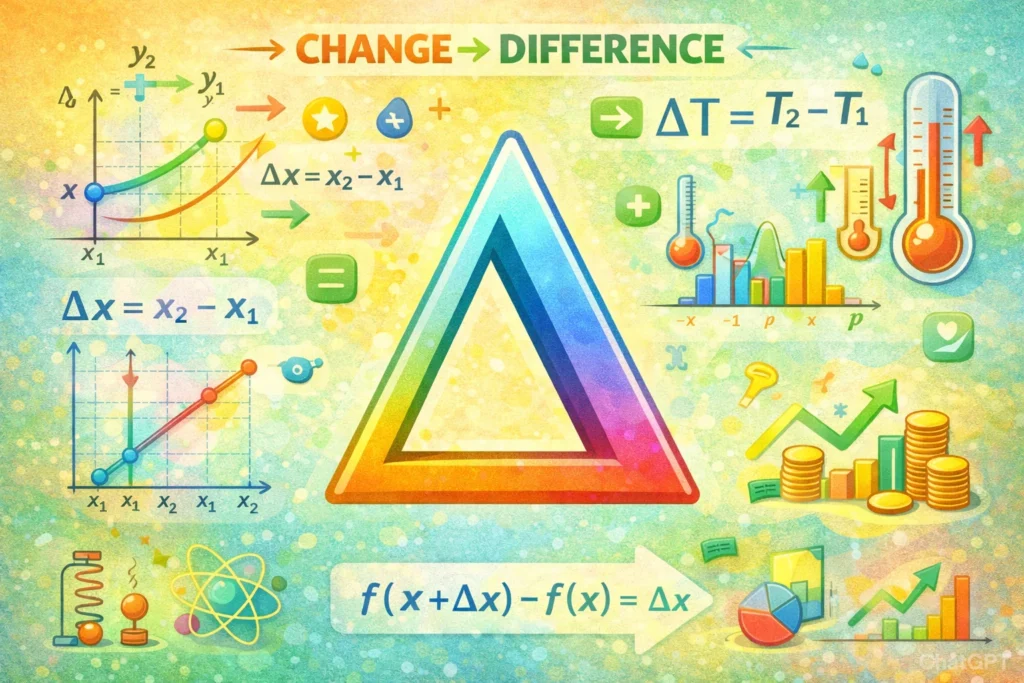
In mathematics, delta (Δ) represents a change or difference in a variable, often used to indicate how one quantity varies relative to another. It is commonly used in algebra, calculus, physics, and statistics to signify differences, increments, or variations.
Understanding delta in math might feel tricky at first, but once you see it in context, it’s surprisingly intuitive. Whether you’re calculating a change in temperature, measuring a stock market shift, or finding derivatives in calculus, delta is your go-to symbol for change. 🌟
In this comprehensive guide, we’ll explore delta’s meaning, origin, real-world applications, examples, comparisons with related terms, alternative uses, and FAQs. By the end, you’ll have a clear grasp of this versatile mathematical symbol.
Origin of Delta in Math
The Greek letter Delta, written as Δ in uppercase and δ in lowercase, has a long and fascinating history in mathematics and science. Its origins trace back to ancient Greece, where letters in the Greek alphabet were commonly used not only for language but also for representing numbers, quantities, and abstract ideas. Over time, these symbols became deeply embedded in scientific notation, shaping the way we express mathematical concepts even in 2026.
Greek Alphabet and Early Symbolism
Delta is the fourth letter of the Greek alphabet. In ancient Greek numerals, letters were assigned numerical values, and delta represented the number four. Its triangular shape is believed to have evolved from earlier Phoenician scripts, where symbols gradually transformed into the structured letters we recognize today.
Because of its clear geometric appearance, Δ also became associated with triangular shapes in geometry. In fact, in mathematics and engineering diagrams, a triangle is sometimes informally referred to as a delta due to its resemblance to the uppercase letter.
Meaning in Mathematics
Historically, delta came to symbolize change or difference. This meaning likely developed from its use in logical and scientific writing, where scholars needed a concise way to represent variation between two quantities. Instead of writing “change in x,” mathematicians could simply write Δx.
For example:
- Δx represents the change in variable x
- Δy represents the change in variable y
- ΔT often represents change in temperature
This symbolic efficiency made delta incredibly powerful. It allowed mathematicians to express complex ideas in a compact, standardized way.
Role in Calculus and Advanced Math
Delta gained even more prominence with the development of calculus. In limits and derivatives, Δx is used to represent a small change in a variable. As this change becomes extremely small, it helps define rates of change, slopes, and instantaneous variation.
In algebra and geometry, lowercase δ sometimes represents small quantities or specific constants. In trigonometry, uppercase Δ can also denote the area of a triangle. The symbol became flexible, precise, and universally recognizable.
Popularity and Standardization
As mathematics expanded globally, textbooks and scientific literature adopted delta as a standard symbol for variation. Its consistent use in physics, engineering, economics, and statistics reinforced its meaning. Students across the world now learn that when they see Δ, they should think of difference, change, or variation.
Its popularity continues because it is simple, efficient, and deeply rooted in mathematical tradition. From ancient Greek scholars to modern digital classrooms, delta has remained a symbol of transformation and measurable change.
Delta is now ubiquitous in math, appearing in algebra, calculus, physics, statistics, and engineering.
How Delta is Used in Math
Delta is incredibly versatile. Let’s break down the most common ways it’s applied:
1. Change or Difference
In most contexts, Δ indicates the difference between two values.
Formula Example:Δx=x2−x1
Here, Δx represents the change in the variable x between two points.
Real-life example:
If your bank account grows from $500 to $600, the change in balance is:ΔBalance=600−500=100
✅ Friendly tip: Think of delta as a “delta moment” — the amount something has shifted or changed.
2. In Calculus
In calculus, delta often appears in limits and derivatives. The derivative itself can be seen as the rate of change using delta.f′(x)=Δx→0limΔxΔy
Here, Δy represents the change in y, while Δx represents the change in x.
Example:
If y = x² and x changes from 2 to 3:Δy=32−22=9−4=5
3. In Physics and Engineering
Delta is frequently used to show change in physical quantities:
| Quantity | Symbol | Example |
|---|---|---|
| Temperature | ΔT | ΔT = T_final – T_initial |
| Distance | Δd | Δd = d₂ – d₁ |
| Velocity | Δv | Δv = v₂ – v₁ |
Physics students often say: “Delta tells you what’s different from start to finish.”
4. In Statistics
In statistics, Δ can represent differences or deviations in datasets.
Example:
Suppose a survey measures income last year ($50k) vs this year ($55k).ΔIncome=55,000−50,000=5,000
Friendly Examples of Delta Usage
Here’s a quick table of delta in context with tones:
| Scenario | Formula | Tone | Explanation |
|---|---|---|---|
| Bank account growth | ΔBalance = 600 – 500 | Friendly 🙂 | Shows positive change |
| Temperature drop | ΔT = 18°C – 25°C = -7°C | Neutral | Shows decrease in value |
| Stock market loss | ΔStock = 150 – 200 = -50 | Slightly negative 😬 | Highlights loss or decline |
Comparison With Related Terms
Delta is often confused with similar concepts or symbols. Here’s a quick guide:
| Term | Difference From Delta | Example |
|---|---|---|
| d | Lowercase “d” represents infinitesimal change in calculus | dy/dx |
| ∇ (Nabla) | Indicates gradient or vector derivative, not just change | ∇f(x, y) |
| Difference / Diff | Sometimes written as x₂ – x₁ in plain text | Same as Δx, but less symbolic |
Tip: Use delta when you want to emphasize change explicitly in mathematical notation.
Alternate Meanings of Delta
Although delta is widely recognized in mathematics as a symbol for change or difference, its meaning extends far beyond algebra and calculus. Over centuries, the Greek letter Δ has been adopted across multiple disciplines, each giving it a slightly different but related interpretation. At its core, delta almost always represents change, difference, variation, or a triangular form. The context determines the exact meaning.
Science and Chemistry
In science, particularly in chemistry and physics, Δ commonly represents a measurable change in a quantity. For example, ΔH stands for change in enthalpy, which refers to the heat absorbed or released during a chemical reaction. If ΔH is positive, the reaction absorbs heat. If it is negative, heat is released.
Similarly, ΔT represents change in temperature, and ΔP represents change in pressure. Scientists rely on delta because it provides a quick, standardized way to show variation between an initial and final state.
In physics formulas, you will often see expressions such as
Δv for change in velocity
ΔE for change in energy
This consistent usage reinforces delta’s identity as a symbol of measurable difference.
Finance and Investing
In finance, particularly in options trading, delta has a specialized meaning. It measures how sensitive an option’s price is to changes in the price of its underlying asset. In simple terms, delta shows how much an option’s value is expected to move when the stock price changes by one unit.
For example, if an option has a delta of 0.60, it means the option’s price is expected to move 0.60 units for every 1 unit move in the stock price. Traders use delta to manage risk and predict potential gains or losses. In this field, delta represents responsiveness or sensitivity to change, which still aligns with its mathematical roots.
Geography and General Usage
Outside science and finance, the word delta is also used in geography. A river delta refers to a triangular landform created where a river deposits sediment as it flows into a larger body of water. Famous examples include the Nile Delta and the Mississippi River Delta. The name comes from the triangular shape of these landforms, which resemble the uppercase Greek letter Δ.
In everyday language, delta can also simply mean change in a system. For instance, someone might say, “What’s the delta between last year’s sales and this year’s?” In this case, delta casually refers to the difference between two values.
The Common Thread
Whether in chemistry, finance, geography, or casual conversation, delta consistently relates to one central idea: difference or transformation. Sometimes it represents numerical change. Sometimes it reflects physical shape. In every case, the meaning connects back to its original symbolic role as a marker of variation.
Professional alternative:
When writing formally, you can replace Δ with “change in” for clarity, e.g., Δx → “change in x”.
FAQs
What does delta mean in math?
Delta represents the change or difference in a variable or quantity.
How is delta used in algebra?
In algebra, Δ usually shows the difference between two values, like Δx = x₂ – x₁.
What is the difference between Δ and d in calculus?
Δ indicates finite change, while d represents infinitesimally small change used in derivatives.
Can delta be negative?
Yes, Δ can be negative if the value decreases over time or between points.
What is Δy/Δx in simple terms?
It represents the average rate of change of y with respect to x.
Is delta used outside of math?
Absolutely, in physics, finance, chemistry, and engineering to indicate change or variation.
What is the lowercase delta (δ) used for?
Lowercase δ often denotes small changes or errors in measurements or functions.
How do I pronounce Δ in math?
It’s pronounced “delta” (DEL-tah).
Conclusion:
- Delta is the symbol for change in math, physics, and statistics.
- It can represent positive, negative, or zero changes.
- Widely used in algebra, calculus, physics, and finance.
- Simple rule: Δ = final – initial.
- Friendly tip: think of delta as the math version of “what’s different”.
By understanding delta, you’ll instantly make equations and formulas more intuitive. Whether analyzing data, calculating rates, or studying physics, delta is your go-to symbol for change.
Read More Related Articles:
- What Does Te Amo Mean in English? Here’s the Truth (2026)
- “De Nada” Meaning in Spanish: Real-World Examples In 2026
- What Does < Mean in Math? How to Use It in Equations and Inequalities (2026)

Ivy Madison is a content creator at TextSprout.com, specializing in word definitions, internet slang, acronyms, and text abbreviations. She delivers clear and engaging explanations, helping readers quickly understand modern digital language and trending terms.