
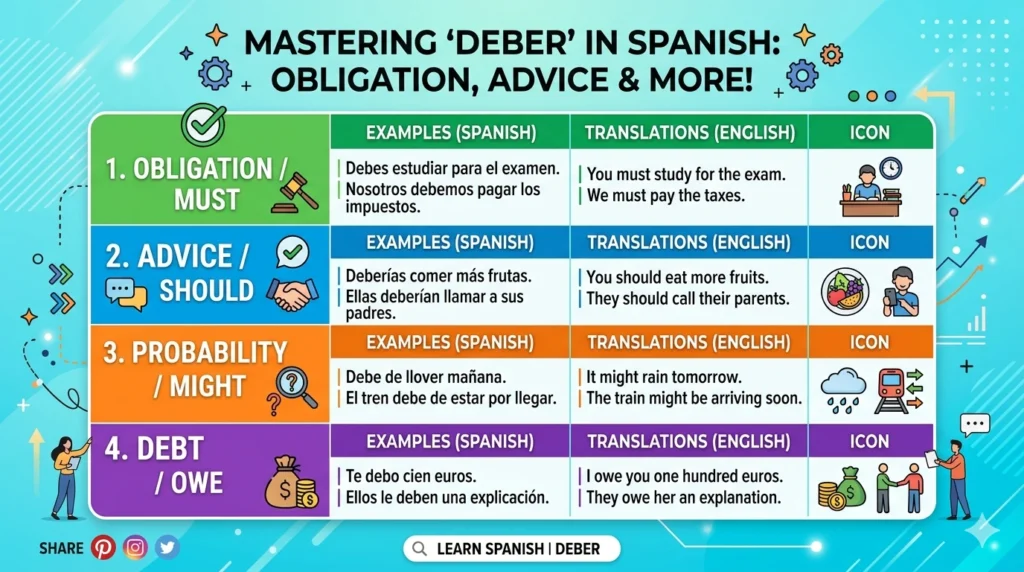
In Spanish, deber primarily means “to owe” or “must/should,” depending on context. It can indicate obligation, duty, or financial responsibility. The meaning changes slightly based on whether it’s used as a verb, noun, or in idiomatic expressions.
Spanish learners often encounter deber early in their studies, yet it can be confusing because its meaning shifts with context. From expressing responsibilities like “Debo estudiar” (I must study) to indicating debt like “Debo dinero” (I owe money), understanding deber is key to both conversation and comprehension.
The beauty of deber is its versatility. It can show obligation, give advice, express probability, or indicate financial owing. In everyday life, mastering deber lets you communicate duties, expectations, and responsibilities more naturally and fluently.
Origin and Popularity of Deber
The word deber comes from the Latin debere, meaning “to owe.” Historically, it was used in legal, financial, and moral contexts to express obligation or debt. Over centuries, its usage expanded into everyday Spanish, covering both monetary owing and personal duty.
Today, deber is a fundamental verb in Spanish education. Learners encounter it early because it frequently appears in conversations, textbooks, and media. Its popularity stems from its flexibility—whether expressing advice, moral duty, or debts, deber is indispensable in Spanish communication.
Primary Meanings of Deber
The meaning of deber depends on context. Below are the main uses:
| Use | Meaning | Example | Translation |
|---|---|---|---|
| Obligation / Duty | Expressing what someone must do | Debo estudiar para el examen. | I must study for the exam. |
| Advice / Recommendation | Suggesting an action | Deberías comer más verduras. | You should eat more vegetables. |
| Probability / Assumption | Speculating about something | Debe de ser tarde ya. | It must be late already. |
| Debt / Financial Owing | Indicating money owed | Debo veinte dólares a Juan. | I owe Juan twenty dollars. |
| Moral / Ethical Duty | Expressing responsibility | Debemos ayudar a los necesitados. | We must help those in need. |
Notice how deber can shift from moral or practical obligations to financial matters. This versatility makes it one of the most commonly used verbs in Spanish.
Examples of Deber in Context
- Obligation / Duty:
“Debo terminar este proyecto hoy.”
Translation: I must finish this project today. - Advice / Recommendation:
“Deberías descansar más.”
Translation: You should rest more. - Probability / Assumption:
“Debe de estar lloviendo afuera.”
Translation: It must be raining outside. - Debt / Financial Owing:
“Le debo dinero a mi hermano.”
Translation: I owe my brother money. - Moral / Ethical Duty:
“Debemos cuidar el medio ambiente.”
Translation: We must take care of the environment.
How Deber Compares to Related Spanish Verbs
Understanding deber alongside similar verbs helps learners avoid confusion.
| Verb | Meaning | Difference from Deber | Example |
|---|---|---|---|
| Tener que | Must / Have to | More direct, emphasizes necessity | Tengo que estudiar. – I have to study. |
| Poder | Can / Be able to | Expresses ability, not obligation | Puedo terminar esto hoy. – I can finish this today. |
| Hacer bien | Should / Ought to | Often used in moral advice | Harías bien en descansar. – You would do well to rest. |
Deber often feels softer or more formal than tener que, making it useful in polite recommendations or moral expressions.
Alternate Meanings and Idiomatic Uses
Deber also appears in idiomatic expressions that slightly alter its meaning:
| Expression | Meaning | Example | Translation |
|---|---|---|---|
| Deber de + infinitive | Assumption / Probability | Debe de ser el profesor. | It must be the teacher. |
| Deber cuentas | To be accountable / owe an explanation | Le debe cuentas a su jefe. | He owes his boss an explanation. |
| A deber | Unpaid / pending | Tengo esta tarea a deber. | I have this assignment pending. |
These idiomatic uses highlight how flexible deber is, blending obligation, speculation, and responsibility in everyday Spanish.
Polite or Professional Alternatives
When giving advice or expressing obligation, you can use more polite or professional alternatives to deber:
- Es recomendable + infinitive – Es recomendable estudiar antes del examen. (It is recommended to study before the exam.)
- Conviene + infinitive – Conviene descansar después de trabajar. (It is advisable to rest after working.)
- Es necesario + infinitive – Es necesario cumplir con las reglas. (It is necessary to follow the rules.)
These expressions soften the tone, making advice or obligations sound less direct.
Common Confusions with Deber
Many Spanish learners confuse deber with other modal verbs, especially in expressing obligation:
| Confusion | Difference | Example |
|---|---|---|
| Deber vs Tener que | Deber is softer / polite; tener que is stronger / direct | Debes estudiar. (You should study) vs Tienes que estudiar. (You have to study) |
| Deber vs Poder | Deber = obligation, poder = ability | Debes terminar esto. (You must finish this) vs Puedes terminar esto. (You can finish this) |
| Deber vs Hacer bien | Deber = obligation/advice, hacer bien = moral correctness | Debes ayudar. vs Harías bien en ayudar. |
Understanding these distinctions helps communicate clearly and avoid misunderstandings.
Practical Tips for Using Deber
- When advising friends or colleagues, deberías feels more polite than debes.
- Use deber in writing, emails, or formal speech to express duties professionally.
- Remember deber de + infinitive for probability; it’s common in spoken Spanish.
- Track your understanding by creating flashcards for the different contexts: obligation, advice, debt, and probability.
Table – Deber Context Tracker for Learners
| Context | Form | Example | English |
|---|---|---|---|
| Obligation | Debo + infinitive | Debo estudiar. | I must study. |
| Advice | Deberías + infinitive | Deberías dormir más. | You should sleep more. |
| Probability | Debe de + infinitive | Debe de estar lloviendo. | It must be raining. |
| Debt | Debo + object | Debo dinero a mi amigo. | I owe my friend money. |
FAQs
1. What does deber mean in Spanish?
It primarily means “to owe” or “must/should,” indicating obligation, advice, or debt depending on context.
2. How do you use deber to give advice?
Use deberías + infinitive to suggest actions politely. Example: Deberías comer más frutas. – You should eat more fruit.
3. Is deber the same as tener que?
Not exactly. Deber is softer and often used for advice or moral duty, while tener que expresses direct necessity.
4. Can deber mean “owe money”?
Yes, deber can indicate financial debt. Example: Le debo 50 dólares a Ana. – I owe Ana 50 dollars.
5. What is the difference between deber and deber de?
Deber de + infinitive expresses probability or assumption. Example: Debe de ser tarde. – It must be late.
6. Can deber express moral obligations?
Yes, it can communicate ethical duties. Example: Debemos respetar a los demás. – We must respect others.
7. How is deber conjugated in present tense?
Here’s a quick table:
| Subject | Conjugation | Example |
|---|---|---|
| Yo | debo | Yo debo estudiar. |
| Tú | debes | Tú debes trabajar. |
| Él/Ella/Usted | debe | Ella debe descansar. |
| Nosotros | debemos | Debemos ayudar. |
| Vosotros | debéis | Vosotros debéis aprender. |
| Ellos/Ellas/Ustedes | deben | Ellos deben pagar la cuenta. |
8. Are there polite alternatives to deber in Spanish?
Yes, you can use expressions like es recomendable, conviene, or es necesario to soften obligation or advice.
Conclusion
Deber is one of the most versatile verbs in Spanish, encompassing obligation, advice, debt, and probability. Understanding its different uses is crucial for both learners and fluent speakers. By paying attention to context, conjugation, and nuances, you can express moral duties, financial responsibility, and polite suggestions with ease.
Whether you’re saying “Debo estudiar”, giving advice like “Deberías descansar”, or explaining debt with “Le debo dinero”, mastering deber opens the door to more natural and effective communication in Spanish.
Read More Related Articles:
- What Does Patent Mean in Medical Terms? Clinical Significance In 2026
- What Does Pick 6 Mean in Football? From Interception to Touchdown In 2026
- What Does SRS Mean in a Car: Why This Safety Feature Matters In 2026

Neon Samuel is a digital content creator at TextSprout.com, dedicated to decoding modern words, slang, and expressions. His writing helps readers quickly grasp meanings and understand how terms are used in real conversations across text and social platforms.