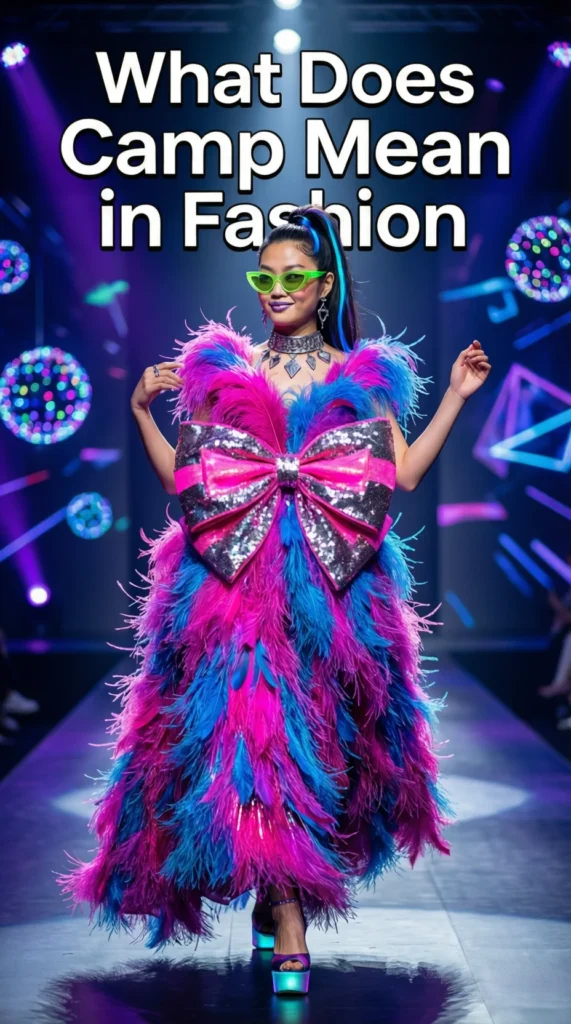
Imagine a feathered gown with neon accessories, glitter dripping from head to toe, and a wink of irony in every step. That’s camp in fashion. But what does “camp” really mean, and why has it become a cornerstone of both haute couture and pop culture?
Far from being just “fun” or “silly,” camp is a deliberate celebration of artifice and exaggeration. It thrives on theatricality, irony, and self-aware humor, allowing wearers to transform clothing into storytelling. From Lady Gaga’s dramatic red carpet looks to the Met Gala’s unforgettable camp-themed editions, this aesthetic challenges our ideas of elegance, taste, and even identity.
In this article, we’ll break down the origin, meaning, and usage of camp in fashion, explore its examples, compare it with similar styles, and provide practical tips to use it confidently.
Definition:
Camp in fashion is a style aesthetic that embraces exaggeration, irony, theatricality, and playful over-the-top elements. It celebrates boldness, humor, and extravagance, often intentionally flouting traditional notions of “good taste” to make a statement.
Origin of Camp in Fashion
The concept of camp is not new—it dates back decades and even centuries in terms of cultural influence. Its modern interpretation in fashion draws heavily from art, literature, and queer culture.
- Etymology: The term “camp” likely originates from the French word se camper, meaning “to pose in an exaggerated manner.”
- Cultural roots: Camp has strong ties to LGBTQ+ communities, particularly gay men, who used humor, theatricality, and flamboyance as self-expression in a society that often marginalized them.
- Popularization: The 1964 essay Notes on “Camp” by Susan Sontag is widely credited with defining camp as an aesthetic philosophy, noting its love for artifice, excess, and stylization.
Features of Camp
| Feature | Description | Example |
|---|---|---|
| Exaggeration | Pushing clothing or makeup to an extreme level | Oversized bows, dramatic ruffles |
| Irony & Humor | Playful mockery of “serious” fashion | Glittery tuxedos for a formal event |
| Theatricality | Outfits meant to be seen and perform | Feathered dresses, theatrical capes |
| Bold Color & Texture | Bright, contrasting colors, unusual fabrics | Neon, sequins, faux fur |
| Self-Aware Style | Knowing it’s over-the-top, embracing it | Costume-inspired evening gowns |
How Camp Became Popular in Fashion
Camp evolved from underground subcultures to mainstream fashion thanks to celebrity influence and high-profile events.
- 1970s–1980s: Camp gained visibility in nightlife, drag culture, and glam rock. Artists like David Bowie and Elton John embraced flamboyant, theatrical styles.
- 2000s: Designers like Jeremy Scott, Moschino, and Gucci under Alessandro Michele popularized camp with bold, ironic, and playful collections.
- 2019 Met Gala: Titled Camp: Notes on Fashion, it cemented the aesthetic in global popular culture, with celebrities showcasing dramatic, exaggerated, and sometimes humorous looks.
Usage of Camp in Fashion
Camp isn’t just a runway statement—it can be incorporated in everyday life or used for themed events.
Everyday Wear
- Mixing bold prints or textures with humor
- Statement accessories that exaggerate style
- Subtle nods like quirky jewelry or playful patterns
Special Events & Costumes
- Red carpet gowns with exaggerated silhouettes
- Over-the-top makeup paired with eccentric outfits
- Festival fashion and drag performances
Tone Matters
Camp can communicate friendly, neutral, or dismissive tones, depending on the context:
- Friendly/playful: A glittery bag paired with casual jeans
- Neutral: An oversized bow without irony
- Dismissive/critical: Using camp mockingly to indicate something is “ridiculous” or overdone
Camp Fashion Examples With Context
| Example | Tone | Context |
|---|---|---|
| Lady Gaga’s 2010 Meat Dress | Bold/Theatrical | Red carpet statement, media sensation |
| Moschino’s cartoon-inspired outfits | Playful/Ironic | Runway fashion highlighting humor in design |
| RuPaul’s Drag Race costumes | Dramatic/Exaggerated | Performance-driven, embracing exaggeration |
| Feathered, sequined Met Gala gowns | Extravagant | Celebratory high fashion, camp as art |
Comparison: Camp vs. Similar Fashion Concepts
Camp is often confused with other expressive fashion terms. Here’s a comparison to clarify:
| Term | Definition | How It Differs From Camp |
|---|---|---|
| Kitsch | Art or objects considered in poor taste, often unintentionally | Camp is intentional, kitsch may be accidental |
| Avant-garde | Experimental, innovative, breaking traditional norms | Camp focuses on exaggeration and humor rather than pure innovation |
| Maximalism | Emphasis on abundance and layers | Camp adds irony and theatricality, not just layering |
| Drag Fashion | Performance-driven, exaggerated gender expression | Camp can exist in everyday fashion and isn’t limited to drag |
Alternate Meanings of Camp
While in fashion, camp refers to exaggerated, theatrical style, it can also mean:
- Outdoor setting: A campsite or tent (completely unrelated to fashion).
- Military camp: A place for soldiers to stay.
- Playful attitude: Sometimes used informally to describe someone “camping it up” or being overly dramatic in behavior.
Polite & Professional Alternatives to Camp
For professional or formal discussions, you might describe camp-inspired fashion without using the term directly:
- Theatrical fashion: Emphasizes drama and performance.
- Exaggerated style: Highlights bold or oversized elements.
- Statement fashion: Focuses on outfits that capture attention.
- Playful elegance: Suggests fun without implying excess.
Tips for Wearing Camp Fashion
- Start small: Use accessories, bold shoes, or statement bags.
- Mix with neutrals: Let one piece be exaggerated while keeping others minimal.
- Embrace color & texture: Sequins, metallics, feathers, and neon are key.
- Have fun: Irony and humor are central to the camp aesthetic.
- Context matters: Camp at casual events differs from red carpet or festival settings.
Conclusion:
In conclusion, camp in fashion is all about exaggeration, humor, and theatricality, creating a playful and eye-catching aesthetic that stands out. Originating in queer culture and later popularized by art, designers, and celebrities, camp has evolved into a celebrated style embraced worldwide. It can appear in subtle or extreme forms depending on the context, making it versatile for both everyday wear and high-fashion statements. By incorporating accessories or statement pieces, anyone can experiment with camp, adding a bold, fun, and confident touch to their personal style.
When experimenting with camp, remember: confidence is your best accessory. If it feels fun, bold, or ironic—and you own it—you’ve got camp mastered.
FAQs
1. What does camp mean in fashion for everyday wear?
Camp in everyday fashion can be subtle: bright accessories, quirky patterns, or playful prints without being overly theatrical.
2. Is camp the same as kitsch?
Not exactly. Camp is intentional, humorous, and self-aware. Kitsch may unintentionally appear in poor taste.
3. Can men wear camp fashion?
Absolutely. Camp is gender-neutral. Men can experiment with bold suits, colorful accessories, or dramatic silhouettes.
4. Is camp considered “good taste”?
Camp intentionally flouts traditional taste. Its value lies in creativity, exaggeration, and humor rather than conventional elegance.
5. Who popularized camp in fashion?
Susan Sontag defined the concept in literature, while designers like Moschino, Jeremy Scott, and Gucci brought it to fashion. Celebrities like Lady Gaga and Billy Porter popularized it in public.
6. What events are ideal for camp fashion?
Red carpet events, fashion shows, drag performances, costume parties, and themed galas.
7. Can camp be minimalist?
Not really—camp thrives on exaggeration. Minimalism contradicts its essence.
8. How do I start experimenting with camp fashion?
Start with accessories, playful prints, or statement shoes, then gradually add more bold elements while embracing irony and humor.
Read More About
- What Does “No Mames Wey” Mean in English? Cultural Significance (2026)
- What Does DPO Mean in Pregnancy? Full Guide for Expecting Moms (2026)

Neon Samuel is a digital content creator at TextSprout.com, dedicated to decoding modern words, slang, and expressions. His writing helps readers quickly grasp meanings and understand how terms are used in real conversations across text and social platforms.